My Cart
Your Cart 0

    Your cart is empty.

  • Total (Amount) ₹0.00
NCERT Exemplar · Class 12 · Physics

Chapter 15: Communication Systems

Practice each question, then open the answer or worked solution.

Questions

30 questions
Q15.11Multiple choice

Audio sine waves of 3 kHz frequency are used to amplitude modulate a carrier signal of 1.5 MHz. Which of the following statements are true?

Show answerHide answer
Correct option: B
Show solutionHide solution
Worked solution

(b) The bandwidth required for amplitude modulation is 6kHz

(d) The sideband frequencies are 1503 kHz and 1497 kHz.
Q15.12Written answer

A TV transmission tower has a height of 240 m. Signals broadcast from this tower will be received by LOS communication at a distance of (assume the radius of the earth to be 6.4 × 10⁶ m)

(a) 100 km

(b) 24 km

(c) 55 km
(d) 50 km

Show solutionHide solution
Worked solution

(b) 24 km

(c) 55 km
(d) 50 km

Q15.13Written answer

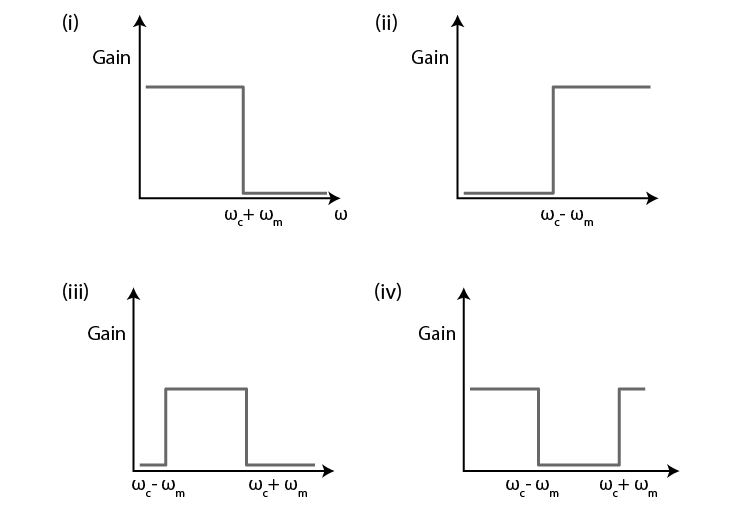
The frequency response curve in the figure for the filter circuit used for production of AM wave should be

Exemplar Solutions Class 12 Physics Chapter 15 - 2

(a) (i) followed by(ii)

(b) (ii) followed by (i)

(c) (iii)

(d) (iv)

Show solutionHide solution
Worked solution

(a) (i) followed by(ii)

(b) (ii) followed by (i)

(c) (iii)

Q15.14Written answer

In amplitude modulation, the modulation index m, is kept less than or equal to 1 because

(a) m > 1, will result in interference between the carrier frequency and message frequency, resulting in distortion

(b) m > 1 will result in overlapping of both sidebands resulting into loss of information

(c) m > 1 will result in a change in phase between the carrier signal and the message signal

(d) m > 1 indicates the amplitude of message signal greater than the amplitude of the carrier signal resulting in distortion

Show solutionHide solution
Worked solution

(b) m > 1 will result in overlapping of both sidebands resulting into loss of information

(d) m > 1 indicates the amplitude of message signal greater than the amplitude of the carrier signal resulting in distortion

Very Short Answers
Q15.15Multiple choice

Which of the following would produce analogue signals and which would produce digital signals?

Show answerHide answer
Correct option: A
Show solutionHide solution
Worked solution

i) A vibrating tuning fork and ii) musical sound due to a vibrating sitar string will produce analogue

iii) Light pulse and iv) Output of NAND gate will produce digital signals.

Q15.16Written answer

Would sky waves be suitable for transmission of TV signals of 60 MHz frequency?

Show solutionHide solution
Worked solution

Skywaves won’t be suitable for transmission of TV signals of 60 MHz frequency as the TV signals are beyond 60 MHz. Space wave transmission needs to be used.

Q15.17Written answer

Two waves A and B of frequencies 2 MHz and 3 MHz, respectively are beamed in the same direction for communication via skywave. Which one of these is likely to travel a longer distance in the ionosphere before suffering total internal reflection?

Show solutionHide solution
Worked solution

The refractive index of B would be more than a refractive index of A because the frequency of wave B s more than the frequency of wave A.

Q15.18Written answer

The maximum amplitude of an A.M. wave is found to be 15 V while its minimum amplitude is found to be 3 V. What is the modulation index?

Show solutionHide solution
Worked solution

Modulation index is defined as the ratio of change of amplitude of carrier wave to the amplitude of the original carrier wave.

The maximum amplitude of AM wave is = Amax = Ac + Am = 15 V

The minimum amplitude of the AM wave is = Amin = Ac – Am = 3V

m = modulation index = Am/Ac = 2/3

Q15.19Written answer

Compute the LC product of a tuned amplifier circuit required to generate a carrier wave of 1 MHz for amplitude modulation.

Show solutionHide solution
Worked solution

LC = 2.54 × 10⁻¹⁴ seconds

Q15.20Written answer

Why is an AM signal likely to be noisier than an FM signal upon transmission through a channel?

Show solutionHide solution
Worked solution

The instantaneous voltage of the carrier wave varies by the modulating wave voltage in the AM. Therefore, the AM signal is more likely to be noisily than an FM signal.

Short Answers