My Cart
Your Cart 0

    Your cart is empty.

  • Total (Amount) ₹0.00
NCERT Exemplar · Class 12 · Physics

Chapter 12: Atoms

Practice each question, then open the answer or worked solution.

Questions

29 questions
Q12.21Written answer

Using the Bohr model, calculate the electric current created by the electron when the H-atom is in the ground state.

Show solutionHide solution
Worked solution

Let v be the velocity of the electron

Number of revolutions per unit time = f = 2πa0/v

The electric current is given as I = Q

When change Q flows in time T

Such that Q = e

Therefore, the electric current is given as I = 2πa0/v e
Q12.22Written answer

Show that the first few frequencies of light that are emitted when electrons fall to the nth level from levels higher than n are approximate harmonics (i.e. in the ratio 1 : 2: 3…) when n >>1.

Show solutionHide solution
Worked solution

Frequency of any line in the series on the spectrum of hydrogen is expressed as the difference between the two atoms

fcm = cRZ2[1/(n+p)2 – 1/n2]

where m = n + p

Substituting for p we get,

fcm = (2cRZ2/n3)p

Q12.23Written answer

What is the minimum energy that must be given to an H atom in ground state so that it can emit an Hγ line in Balmer series? If the angular momentum of the system is conserved, what would be the angular momentum of such Hγ photon?

Show solutionHide solution
Worked solution

Energy required for the transition from n = 1 to n = 5 is given as:

E = E5 – E1 = (-13.6/52) – (-13.6/12) = 13.06 eV

Angular momentum is given as = change in angular momentum of electron = 5(h/2π) – 2(h/2 π) = 3h/2 π = 3.17 × 10⁻³⁴ Js.

Long Answers
Q12.24Written answer

The first four spectral lines in the Lyman series of an H-atom are λ = 1218 Å, 1028Å, 974.3 Å and 951.4Å. If instead of Hydrogen, we consider Deuterium, calculate the shift in the wavelength of these lines.

Show solutionHide solution
Worked solution

Let μH and μD be the reduced masses of electrons of hydrogen and deuterium respectively.

ni and nf are the fixed mass series for hydrogen and deuterium

Rh/Rd = μH/ μD

Reduced mass of hydrogen = μH = me/1+me/M = me (1-me/M)

Reduced mass of deuterium = μD = 2M.me/2M(1+me/2M) = me(1- me/2M)

μH/ μD = 0.99973

λD/ λH = 0.99973

λD = 0.99973 λH

Therefore, change in wavelength = λH – λD = 0.3 Å

Q12.25Written answer

Deuterium was discovered in 1932 by Harold Urey by measuring the small change in wavelength for a particular transition in 1H and 2H. This is because the wavelength of transition depends to a certain extent on the nuclear mass. If nuclear motion is taken into account then the electrons and nucleus revolve around their common centre of mass. Such a system is equivalent to a single particle with a reduced mass µ, revolving around the nucleus at a distance equal to the electron-nucleus separation. Here µ = me M/(me +M) where M is the nuclear mass and me is the electronic mass. Estimate the percentage difference in wavelength for the 1st line of the Lyman series in 1H and 2H. (Mass of 1H nucleus is 1.6725 × 10⁻²⁷ kg, Mass of 2H nucleus is 3.3374 × 10⁻²⁷ kg, Mass of electron = 9.109 × 10⁻³¹ kg.)

Show solutionHide solution
Worked solution

The energy of an electron in the nth state is

En = -μZ2e4/8ε02h2(1/n2)

For hydrogen atom, μH = meMh/(me + Mh)

For deuterium atom, μD = meMd/(me + Md)

The wavelength of the transition for hydrogen is = λH = 3/4 μHe4/8ε02h2c

The wavelength of the transition for deuterium is = λD = 3/4 μDe4/8ε02h2c

The difference between the wavelength is = λ = λH – λD = 2.714 × 10⁻²%

Q12.26Written answer

If a proton had a radius R and the charge was uniformly distributed, calculate using Bohr theory, the ground state energy of a H-atom when (i) R = 0.1Å, and (ii) R = 10 Å.

Show solutionHide solution
Worked solution

The kinetic energy of the H atom is 13.6 eV

Potential energy of an electron and proton is -27.2 eV

Total energy of the electron = -13.6 eV

When R = 0.1Å, the ground state energy is same as the earlier = -13.6 eV

When R = 10 Å,

The kinetic energy = 0.16 eV

The potential energy of electron and proton = -3.83 eV

Total energy of the electron = -3.67 eV.

Q12.27Written answer

In the Auger process, an atom makes a transition to a lower state without emitting a photon. The excess energy is transferred to an outer electron which may be ejected by the atom. (This is called an Auger electron). Assuming the nucleus to be massive, calculate the kinetic energy of an n = 4 Auger electron emitted by Chromium by absorbing the energy from an = 2 to n = 1 transition.

Show solutionHide solution
Worked solution

The energy in the nth state = -Rch Z2/n2 = -13.6 Z2/n2 eV

Where R is the Rydberg constant and Z = 24

Energy released is (13.6Z2)(3/4)

Energy required to eject 4 electron is 13.6 Z2/16 eV

Therefore, the kinetic energy is 13.6Z2(3/4 – 1/16) = 5385.6 eV.

Q12.28Written answer

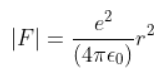
The inverse square law in electrostatics is
Exemplar Solutions Class 12 Physics Chapter 12 - 4 for the force between an electron and a proton. The 1 r dependence of | F | can be understood in quantum theory as being due to the fact that the ‘particle’ of light (photon) is massless. If photons had a mass mp, force would be modified to
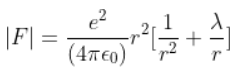
Exemplar Solutions Class 12 Physics Chapter 12 - 5 where λ = m cp /ℏ and ℏ = ℏ/2π . Estimate the change in the ground state energy of an H-atom if mp were 10–6 times the mass of an electron.
Show solutionHide solution
Worked solution

Mass of photon = 9.1 × 10-37 kg

Wavelength associated with the photon = h/mpc

Total energy E = -13.6 + 27.2 λ rA

Where λrA = δ

Q12.29Written answer

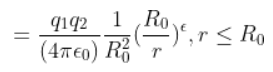
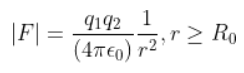
The Bohr model for the H-atom relies on the Coulomb’s law of electrostatics. Coulomb’s law has not directly been verified for very short distances of the order of angstroms. Supposing Coulomb’s law between two opposite charge + q1, –q2 is modified to
Exemplar Solutions Class 12 Physics Chapter 12 - 6
Exemplar Solutions Class 12 Physics Chapter 12 - 7 Calculate in such a case, the ground state energy of an H-atom, if ε = 0.1, R0 = 1Å.

Show solutionHide solution
Worked solution

Case 1: When ε = 0.1, R0 = 1Å

R1 = 8 × 10-11

M = 0.08 nm

Velocity at ground level is v1 = 1.44 × 10⁶ m/s

Case 2:

When n = 1 and v1 = h/mr1

Kinetic energy = 5.9 eV

Potential energy = -17.3 eV

Total energy = -11.4 eV

The basic unit of matter, which is the smallest thing in existence, is called an atom. The size of an atom is usually variable in nature, depending on the type of element. Protons, neutrons and electrons are the three different particles present inside the atom. Atoms, when grouped together, form molecules. For example, an oxygen molecule is made from smaller oxygen atoms which are grouped together.

The different parts of an atom are

  1. Quarks
  2. Proton
  3. Neutron
  4. Electron
  5. Ion
  6. Nucleus
  7. Electrons