My Cart
Your Cart 0

    Your cart is empty.

  • Total (Amount) ₹0.00
NCERT Exemplar · Class 12 · Physics

Chapter 11: Dual Nature of Radiation and Matter

Practice each question, then open the answer or worked solution.

Questions

29 questions
Q11.11Written answer

The de Broglie wavelength of a photon is twice the de Broglie wavelength of an electron. The speed of the electron is ve = c/100. Then

(a) Ee/Ep = 10-4

(b) Ee/Ep = 10-2

(c) Pe/mec = 10-2

(d) Pe/mec = 10-4

Show solutionHide solution
Worked solution

The correct answers are

b) Ee/Ep = 10-2

c) Pe/mec = 10-2
Q11.12Written answer

Photons absorbed in matter are converted to heat. A source emitting n photon/sec of frequency ν is used to convert 1kg of ice at 0°C to water at 0°C. Then, the time T taken for the conversion

(a) decreases with increasing n, with ν fixed

(b) decreases with n fixed, ν increasing

(c) remains constant with n and ν changing such that nν = constant

(d) increases when the product nν increases

Show solutionHide solution
Worked solution

The correct answers are

a) decreases with increasing n, with ν fixed

b) decreases with n fixed, ν increasing

c) remains constant with n and ν changing such that nν = constant

Q11.13Multiple choice

A particle moves in a closed orbit around the origin, due to a force which is directed towards the origin. The de Broglie wavelength of the particle varies cyclically between two values λ1, λ2 with λ1>λ2. Which of the following statement are true?

Show solutionHide solution
Worked solution

The correct answers are

b) The particle could be moving in an elliptic orbit with origin as its focus

d) When the de Broglie wavelength is λ2, the particle is nearer the origin than when its value is λ1

Very Short Answers
Q11.14Written answer

A proton and an α-particle are accelerated, using the same potential difference. How are the de Broglie wavelengths λp and λa related to each other?

Show solutionHide solution
Worked solution

The proton and α-particle are accelerated at the same potential difference.

λ = h/√2mqv

λ is proportional to 1/√mq

λp/ λa = √maqa/mpqp = √8

Therefore, the wavelength of the proton is √8 times the wavelength of α-particle.

Q11.15Written answer

(i) In the explanation of the photoelectric effect, we assume one photon of frequency ν collides with an electron and transfers its energy. This leads to the equation for the maximum energy Emax of the emitted electron as Emax = hν – φ0 where φ0 is the work function of the metal. If an electron absorbs 2 photons (each of frequency ν ) what will be the maximum energy for the emitted electron?

(ii) Why is this fact (two-photon absorption) not taken into consideration in our discussion of the stopping potential?

Show solutionHide solution
Worked solution

i) From the question, the energy absorbed by the electron is two protons with frequency v and v’= 2v where v’ is the frequency from the emitted electron.

Emax = hv – ϕ0

ii) The emission is negligible as the chances of the same proton absorbing the energy is very low.

Q11.16Written answer

There are materials which absorb photons of shorter wavelength and emit photons of longer wavelength. Can there be stable substances which absorb photons of larger wavelength and emit light of shorter wavelength?

Show solutionHide solution
Worked solution

The wavelength of the photon increases when the frequency decreases. There are two possible cases and they are; case one in which the photons have a smaller wavelength and the energy is consumed against work function. In case two, the photons might have a longer wavelength and emit photons with shorter and lesser energy.

Q11.17Written answer

Do all the electrons that absorb a photon come out as photoelectrons?

Show solutionHide solution
Worked solution

No, not all electrons that are absorbed as a photon come out as a photoelectron.

Q11.18Written answer

There are two sources of light, each emitting with a power of 100 W. One emits X-rays of wavelength 1nm and the other visible light at 500 nm. Find the ratio of a number of photons of X-rays to the photons of visible light of the given wavelength?

Show solutionHide solution
Worked solution

Ex = hvx

Ev = hvv

Let nx and nv be the no.of photons from x-rays and visible light are of equal energies and they emit 100 W power.

nxhvx = nvhvv

nx/nv = vv/vx = λx/λv

nx/nv = 1 nm/500 nm

nx:nv = 1:500

Short Answers
Q11.19Written answer

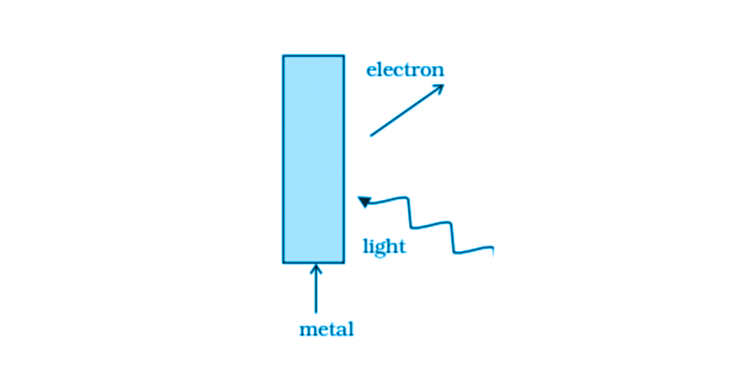
Consider the figure given for photoemission. How would you reconcile with momentum-conservation? Note light (photons) have momentum in a different direction than the emitted electrons.

Exemplar Solutions Physics Class 12 Chapter 11 - 14

Show solutionHide solution
Worked solution

When the photons strike the metal surface, there is a transfer of momentum to the atoms on the metal surface which results in a decrease in speed of the photons. The momentum of photons is transferred to the nucleus and electrons on the metal surface. The electrons emitted are in the opposite direction that of the photons. Nevertheless, the total momentum transferred by the photons and electrons will be equal.

Q11.20Written answer

Consider a metal exposed to light of wavelength 600 nm. The maximum energy of the electron doubles when light of wavelength 400 nm is used. Find the work function in eV.

Show solutionHide solution
Worked solution

Let K1 and K2 be the maximum energy emitted by the electrons when 600 and 400 nm wavelength is used.

K2 = 2K1

Therefore, the work function, ϕ = 1.03 eV