A particle is dropped from a height H. The de Broglie wavelength of the particle as a function of height is proportional to
(a) H
(b) H ½
(c) H0
(d) H–1/2
Show solutionHide solution
The correct answer is d) H–1/2
Your cart is empty.
Practice each question, then open the answer or worked solution.
A particle is dropped from a height H. The de Broglie wavelength of the particle as a function of height is proportional to
(a) H
(b) H ½
(c) H0
(d) H–1/2
The correct answer is d) H–1/2
The wavelength of a photon needed to remove a proton from a nucleus which is bound to the nucleus with 1 MeV energy is nearly
The correct answer is b) 1.2 × 10⁻³ nm
Consider a beam of electrons (each electron with energy E0) incident on a metal surface kept in an evacuated chamber. Then
(a) no electrons will be emitted as only photons can emit electrons
(b) electrons can be emitted but all with an energy, E0
(c) electrons can be emitted with any energy, with a maximum of E0 – φ (φ is the work function)
(d) electrons can be emitted with any energy, with a maximum of E0
The correct answer is d) electrons can be emitted with any energy, with a maximum of E0
Consider Fig. 11.7 in the NCERT textbook of physics for Class XII. Suppose the voltage applied to A is increased. The diffracted beam will have the maximum at a value of θ that
(a) will be larger than the earlier value
(b) will be the same as the earlier value
(c) will be less than the earlier value
(d) will depend on the target
The correct answer is c) will be less than the earlier value
A proton, a neutron, an electron and an α-particle have the same energy. Then their de Broglie wavelengths compare as
(a) λp = λn > λe > λα
(b) λα < λp = λn < λe
(c) λe < λp = λn > λα
(d) λe = λp = λn = λα
The correct answer is b) λα < λp = λn < λe
An electron is moving with an initial velocity
and is in a magnetic field
Then it’s de Broglie wavelength
(a) remains constant
(b) increases with time
(c) decreases with time
(d) increases and decreases periodically
The correct answer is a) remains constant
An electron (mass m ) with an initial velocity
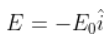
is in an electric field
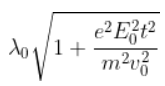
It’s de Broglie wavelength at time t is given by
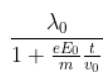
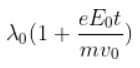
a)

b)

c) λ0
d) λ0t
The correct answer is a)
An electron (mass m) with an initial velocity
is in an electric field
. If λ0 = h/mv0, it’s de Broglie wavelength at time t is given by
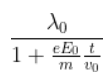
a) λ0
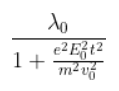
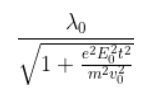
b)

c)

d)

The correct answer is c)
Relativistic corrections become necessary when the expression for the kinetic energy 1/2 mv2 , becomes comparable with mc2, where m is the mass of the particle. At what de Broglie wavelength will relativistic corrections become important for an electron?
(a) λ =10nm
(b) λ =10–1nm
(c) λ =10–4nm
(d) λ =10–6nm
The correct answers are
c) λ =10–4nm
d) λ =10–6nm
Two particles A1 and A2 of masses m1, m2 (m1 > m2) have the same de Broglie wavelength. Then
(a) their momenta are the same
(b) their energies are the same
(c) energy of A1 is less than the energy of A2
(d) energy of A1 is more than the energy of A2
The correct answers are
a) their momenta are the same
c) energy of A1 is less than the energy of A2