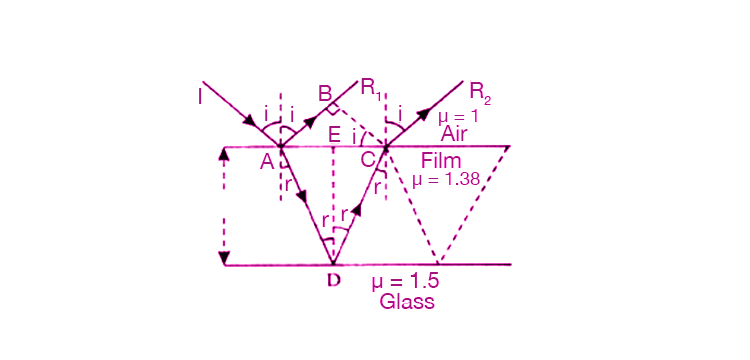
IA is incident at point A such that there is an incident angle I formed from air to film surface. AR1 and AD are the reflected and refracted rays. D is the point where the partial reflection from the glass and film interface. CR2 and AR1 are parallel to each other.
μ(AD + CD) – AB
AD = AC = d/cos r
d tan r = AC/2
d = 1000 Ao
Wave optics is the physical branch of optics used in different scientific studies. Different phenomena that occur are polarisation, interference and diffraction. With the help of a mirror, lens or aperture, the scattering of light can be measured.
Here are some of the fields where wave optics are utilised.
- Electrical Engineering
- Optical Engineering
- Applied Physics
Concepts Discussed in the NCERT Class 12 Physics Exemplar for Chapter 10 Wave Optics
- Introduction
- Huygens Principle – Statement and Experiment
- Refraction and Reflection of Plane Waves Using Huygens Principle
- Refraction of a Plane Wave
- Refraction at a Rarer Medium
- Reflection of a Plane Wave by a Plane Surface
- The Doppler Effect – Statement, Formula and Significance
- Coherent and Incoherent Addition of Waves – Interference Pattern Studies and Formula Derivation
- Interference of Light Waves and Young’s Experiment – Statement, Formula Derivation, Numerical Problems and Significance
- Diffraction
- The Single Slit
- Seeing the Single Slit Diffraction Pattern
- Resolving Power of Optical Instruments
- The Validity of Ray
- Polarisation
- Polarisation by Scattering
- Polarisation by Reflection