My Cart
Your Cart 0

    Your cart is empty.

  • Total (Amount) ₹0.00
NCERT Exemplar · Class 12 · Physics

Chapter 10: Wave Optics

Practice each question, then open the answer or worked solution.

Questions

23 questions
Q10.21Multiple choice

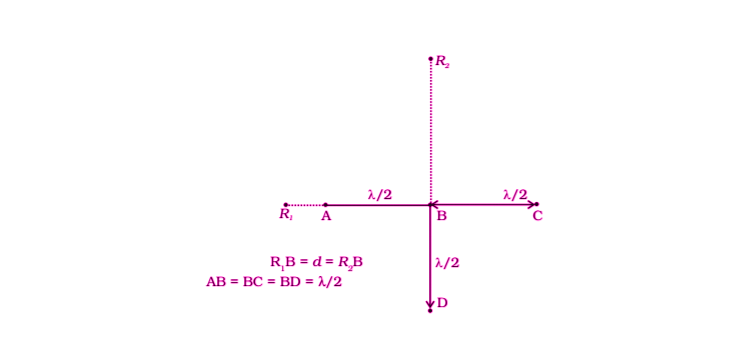
Four identical monochromatic sources A, B, C, D as shown in the figure produce waves of the same wavelength λ and are coherent. Two receiver R1 and R2 are at great but equal distances from B.

Exemplar Solutions Class 12 Physics Chapter 10 - 15

Show answerHide answer
Correct option: A
Show solutionHide solution
Worked solution

i) R2 is the larger signal.

ii) When B is switched off, R1 is y = a cos ꞷt

IR1 = a2/2

R2 is y = a cos ꞷt

IR2 = a2/2

So, it can be said that R1 and R2 are the same.

iii) When D is switched off, R1 is y = a cos ꞷt

IR1 = 1/2 a2

R2 is y = 3a cos ꞷt

IR2 = 9a2/2

iv) Therefore, R1 indicates B when B is switched off and R2 indicates D is switched off.

Q10.22Written answer

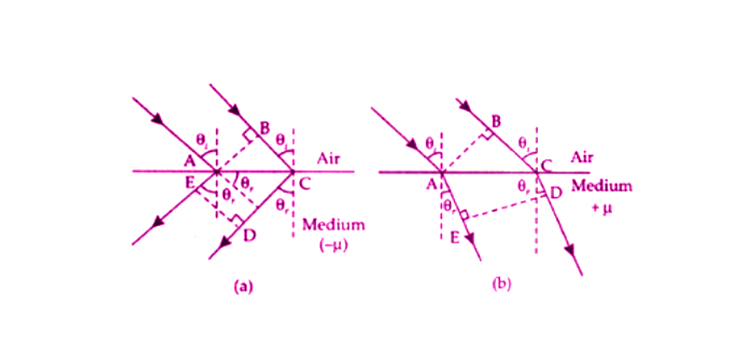
The optical properties of a medium are governed by the relative permittivity (εr) and relative permeability (µr ). The refractive index is defined as √µr εr = n. For ordinary material εr > 0 and µr > 0 and the positive sign is taken for the square root. In 1964, a Russian scientist V. Veselago postulated the existence of material with εr < 0 and µr < 0. Since then such ‘metamaterials’ have been produced in the laboratories and their optical properties studied. For such materials n = -√µrεr. As light enters a medium of such refractive index the phases travel away from the direction of propagation.

(i) According to the description above show that if rays of light enter such a medium from the air (refractive index =1) at an angle θ in 2nd quadrant, them the refracted beam is in the 3rd quadrant

(ii) Prove that Snell’s law holds for such a medium

Show solutionHide solution
Worked solution

i)

Exemplar Solutions Class 12 Physics Chapter 10 - 16

BC = √μrεr (CD-AE)

BC >0; CD > AE

-√μrεr AE = BC – √μrεr CD

BC = √μrεr (CD – AE)

AE > CD

Therefore, BC < 0

ii) BC = AC sin θi

CD – AE = AC sin θr

BC = √μrεr

AC sin θi = √μrεr AC sin θr

sin θi/sin θr = √μrεr

Q10.23Written answer

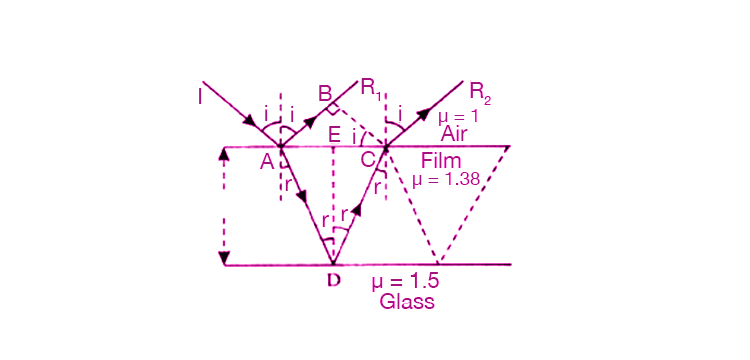
To ensure almost 100 per cent transmissivity, photographic lenses are often coated with a thin layer of dielectric material. The refractive index of this material is intermediated between that of air and glass (which makes the optical element of the lens). A typically used dielectric film is MgF2 (n = 1.38). What should the thickness of the film be so that at the centre of the visible spectrum (5500 Ao) there is maximum transmission?

Show solutionHide solution
Worked solution

Exemplar Solutions Class 12 Physics Chapter 10 - 17

IA is incident at point A such that there is an incident angle I formed from air to film surface. AR1 and AD are the reflected and refracted rays. D is the point where the partial reflection from the glass and film interface. CR2 and AR1 are parallel to each other.

μ(AD + CD) – AB

AD = AC = d/cos r

d tan r = AC/2

d = 1000 Ao

Wave optics is the physical branch of optics used in different scientific studies. Different phenomena that occur are polarisation, interference and diffraction. With the help of a mirror, lens or aperture, the scattering of light can be measured.

Here are some of the fields where wave optics are utilised.

  1. Electrical Engineering
  2. Optical Engineering
  3. Applied Physics
Concepts Discussed in the NCERT Class 12 Physics Exemplar for Chapter 10 Wave Optics
  1. Introduction
  2. Huygens Principle – Statement and Experiment
  3. Refraction and Reflection of Plane Waves Using Huygens Principle
  4. Refraction of a Plane Wave
  5. Refraction at a Rarer Medium
  6. Reflection of a Plane Wave by a Plane Surface
  7. The Doppler Effect – Statement, Formula and Significance
  8. Coherent and Incoherent Addition of Waves – Interference Pattern Studies and Formula Derivation
  9. Interference of Light Waves and Young’s Experiment – Statement, Formula Derivation, Numerical Problems and Significance
  10. Diffraction
  11. The Single Slit
  12. Seeing the Single Slit Diffraction Pattern
  13. Resolving Power of Optical Instruments
  14. The Validity of Ray
  15. Polarisation
  16. Polarisation by Scattering
  17. Polarisation by Reflection