My Cart
Your Cart 0

    Your cart is empty.

  • Total (Amount) ₹0.00
NCERT Exemplar · Class 12 · Physics

Chapter 10: Wave Optics

Practice each question, then open the answer or worked solution.

Questions

23 questions
Q10.11Written answer

Consider a point at the focal point of a convergent lens. Another convergent lens of short focal length is placed on the other side. What is the nature of the wavefronts emerging from the final image?

Show solutionHide solution
Worked solution
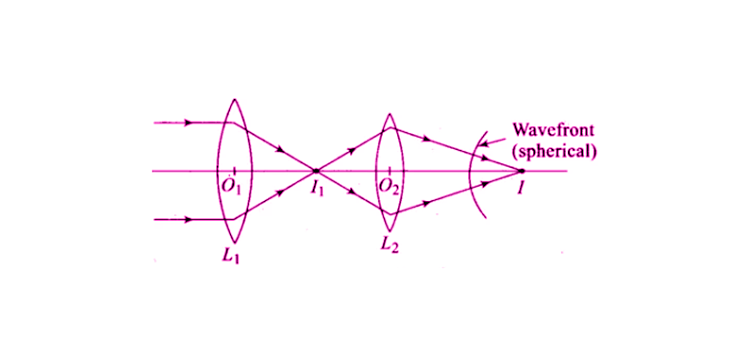
Exemplar Solutions Class 12 Physics Chapter 10 - 5

The orientation of wavefront and the ray are perpendicular to each other. In the above figure, L1 is the source of parallel rays, forming I2 at the focal length of the lens. The image formed acts as L2 through which the light rays get converged into L2 and the final image I is formed.
Q10.12Written answer

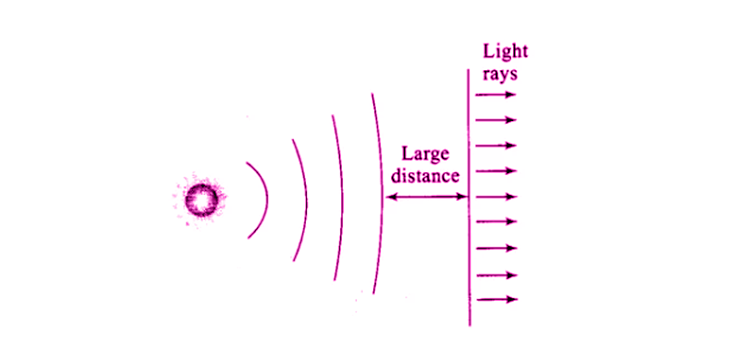
What is the shape of the wavefront on earth for sunlight?

Show solutionHide solution
Worked solution

Exemplar Solutions Class 12 Physics Chapter 10 - 6

We know that the distance between the sun and the earth is very large. We also know that the sun is spherical and can be considered as a point source of light which is present at a very large distance. When the point source is kept at a distance, the wavefront formed will be almost plane.

Q10.13Written answer

Why is the diffraction of sound waves more evident in daily experience than that of lightwave?

Show solutionHide solution
Worked solution

The frequency of sound waves varies from 20 Hz to 20,000 Hz with a wavelength of 15 m to 15 mm respectively. The diffraction of sound takes place when the size of the slit is comparable to the wavelength of the sound. The wavelength of visible light is 0.4 to 0.7 micron. The diffraction of the light doesn’t take place when the size of the slits is different from the wavelength of the visible light.

Q10.14Written answer

The human eye has an approximate angular resolution of φ = 5.8 × 10⁻⁴ rad and a typical photo printer prints a minimum of 300 dpi (dots per inch, 1 inch = 2.54 cm). At what minimal distance z should a printed page be held so that one does not see the individual dots.

Show solutionHide solution
Worked solution

Angular separation, φ = 5.8 × 10⁻⁴ rad

The average distance between the two dots = 2.54/300 = 0.85 × 10⁻² cm

At distance z cm, the angle subtended = 0.85 × 10⁻²/z

Resolution angle for human = 0.85 × 10⁻²/z

Maximum distance between 2 dots = z = 14.5 cm

The above distance is less than the distinct vision, which normal person cannot see.

Q10.15Written answer

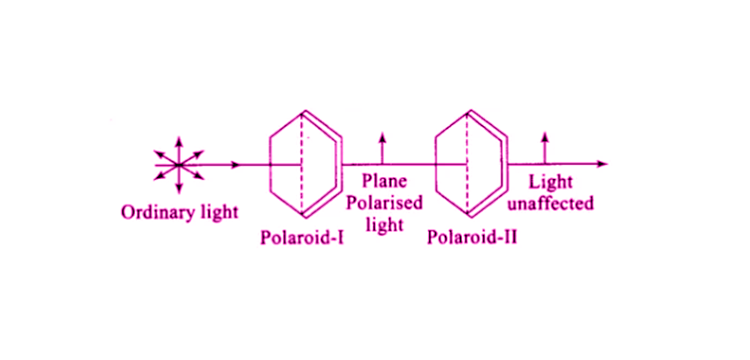
A polaroid (I) is placed in front of a monochromatic source. Another polaroid (II) is placed in front of this polaroid (I) and rotated till no light passes. A third polaroid (III) is now placed in between (I) and (II). In this case, will light emerge from (II)? Explain.

Show solutionHide solution
Worked solution

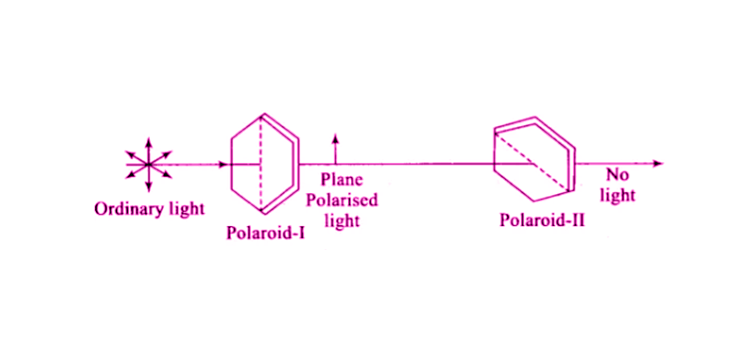
A polaroid (I) is placed in front of a monochromatic source and polaroid (II) is placed in front of polaroid (I). When the light passes through the polaroid (II), the light is unaffected.

Exemplar Solutions Class 12 Physics Chapter 10 - 7

Polaroid (II) is rotated such that there is no passage of light. The rotation is made such that the polaroid (II) is perpendicular to polaroid (I). When the polaroid (II) is rotated there is no passage of light.

Exemplar Solutions Class 12 Physics Chapter 10 - 8

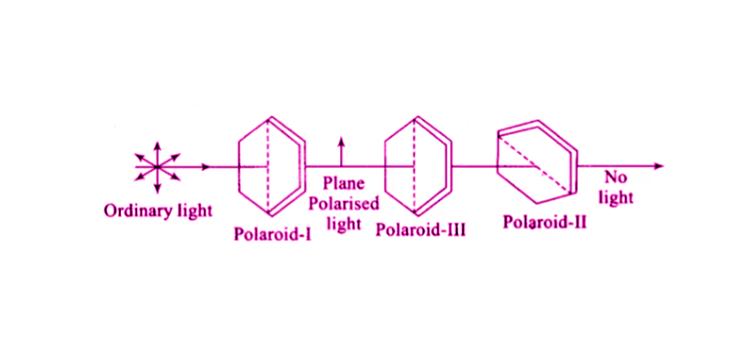
When a polaroid (III) is placed between the polaroid (I) and (II) such that the polaroid (III) is not placed perpendicular to the axis, so there is no passage of light.

Exemplar Solutions Class 12 Physics Chapter 10 - 9

Short Answers
Q10.16Written answer

Can reflection result in plane-polarized light if the light is incident on the interface from the side with higher refractive index?

Show solutionHide solution
Worked solution

Exemplar Solutions Class 12 Physics Chapter 10 - 10

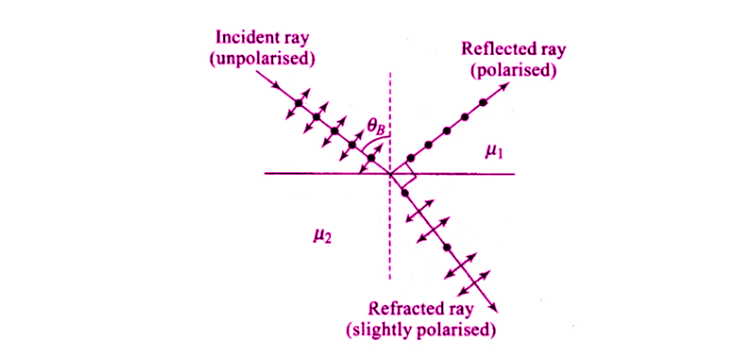
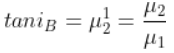
When the angle of incidence is equal to the Brewster’s angle such that the transmitted light is polarized and reflected light is plane-polarized. Following is the equation:

Exemplar Solution Physics Class 12 Chapter 10 Img 6

Such that μ2 < μ1

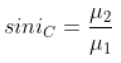
When the light travels in a medium, the critical angle is given as

Exemplar Solution Physics Class 12 Chapter 10 Img 7

Where μ2 < μ1

So, it can be said that |tan iB| > |sin iC| when iB < iC.

Q10.17Written answer

For the same objective, find the ratio of the least separation between two points to be distinguished by a microscope for light of 5000 Ao and electrons accelerated through 100V used as the illuminating substance.

Show solutionHide solution
Worked solution

5000 Ao = 5000 × 10-10 m

1/d = 2 sin β/1.22λ

dmin = 1.22 λ/ 2 sin β

λd = 1.22/10 × 10-10 m

When the 100V light is used, d’min = 1.22 λd/ 2 sin β

d’min = 1.22 × 1.22 × 10-10/2 sin β

The required ratio = dmin/d’min = 1.22/5000 = 0.244 × 10⁻³

Q10.18Written answer

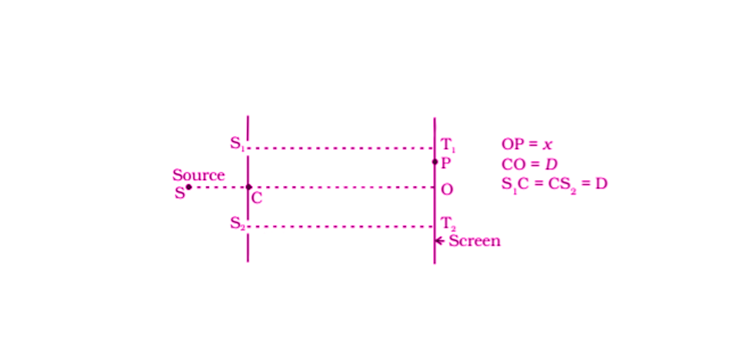
Consider a two-slit interference arrangements such that the distance of the screen from the slits is half the distance between the slits. Obtain the value of D in terms of λ such that the first minima on the screen falls at a distance D from the centre O.

Exemplar Solutions Class 12 Physics Chapter 10 - 11

Show solutionHide solution
Worked solution

The minima will occur when ∆x = S2P – S1P = (2n-1/2)λ

Exemplar Solutions Class 12 Physics Chapter 10 - 12

S1P = √D2 + (D – x)2

S2P = √D2 + (D + x)2

T2P = D + x

T1P = D – x

22-1/2221/2

D = 0.404λ

Long Answers
Q10.19Written answer

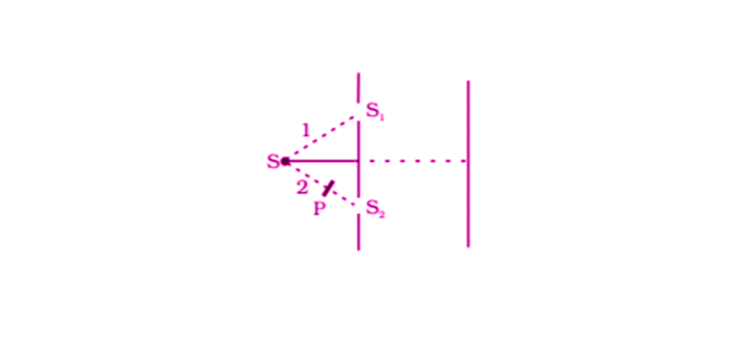
The figure shown a two-slit arrangement with a source which emits unpolarised light. P is a polariser with axis whose direction is not given. If I0 is the intensity of the principal maxima when no polarizer is present, calculate in the present case, the intensity of the principal maxima as well as of the first minima.

Exemplar Solutions Class 12 Physics Chapter 10 - 13

Show solutionHide solution
Worked solution

Amplitude of the wave in perpendicular polarisation

Exemplar Solution Physics Class 12 Chapter 10 Img 8

Amplitude of the wave in parallel polarisation

Exemplar Solution Physics Class 12 Chapter 10 Img 9

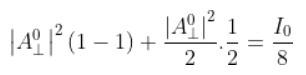
Intensity at the first minima with polariser

Exemplar Solution Physics Class 12 Chapter 10 Img 10

Q10.20Written answer

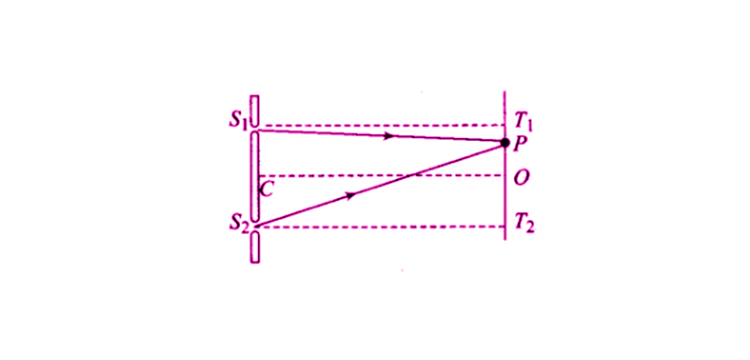
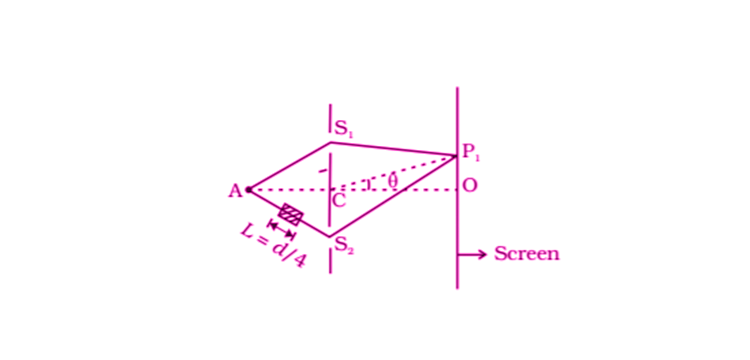
AC = CO = D, S1 C = S2 C = d << D A small transparent slab containing material of µ =1.5 is placed along AS2. What will be the distance from O of the principal maxima and of the first minima on either side of the principal maxima obtained in the absence of the glass slab?

Exemplar Solutions Class 12 Physics Chapter 10 - 14

Show solutionHide solution
Worked solution

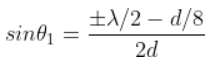
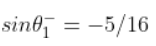
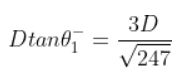
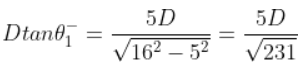
∆x = 2d sin θ+(μ-1)L

sin θ0 = -1/16

From central maxima, OP = -D/16

Exemplar Solution Physics Class 12 Chapter 10 Img 11

On the positive side,

Exemplar Solution Physics Class 12 Chapter 10 Img 12

On the negative side,

Exemplar Solution Physics Class 12 Chapter 10 Img 13

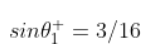
The first principal maxima on the positive side is at a distance, which is above point O

Exemplar Solution Physics Class 12 Chapter 10 Img 14

The first principal minima on the negative side is at distance, which is below point O

Exemplar Solution Physics Class 12 Chapter 10 Img 15