Total charge –Q is uniformly spread along the length of a ring of radius R. A small test charge +q of mass m is kept at the centre of the ring and is given a gentle push along the axis of the ring.
a) show that the particle executes a simple harmonic oscillation
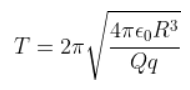
b) obtain its time period
Show solutionHide solution
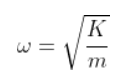
a) The charge q is displaced by z along the axis of the ring. The force acting on the charge q will be at the centre O. simple harmonic is the motion undertaken by the charge q. Also, charge q is proportional to the z and is directed towards the centre O.
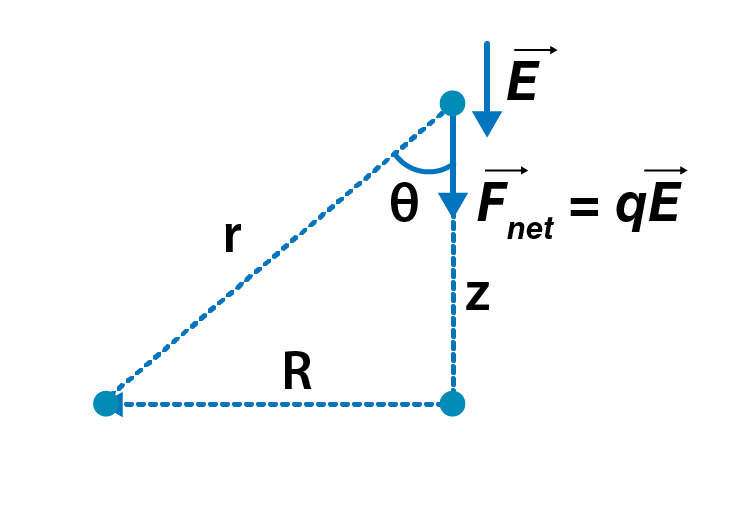
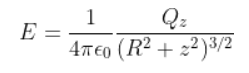
Electric field at the axis of the ring is given as:
The net force on the charge Fnet = qE
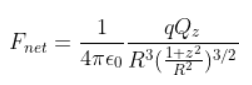
Since z << R, we get
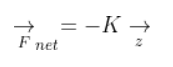
b) Time period is given as
When matter experiences a force when placed in a magnetic field, the property of matter is called an electric charge. The field surrounding an electric charge is called an electromagnetic field, where opposite charges attract each other. It is a scalar quantity, and the charge can be either positive or negative in nature. Electric charges are measured in coulombs, and they can be quantised in nature.
The Important Concepts of Electric Charges and Fields NCERT Exemplar Solutions- Electric Charge – Introduction to charges, historical experiments, detection of charge, the electroscope and other experiments
- Conductors and Insulators – Definitions, electric circuits and properties
- Charging by Induction – Pith and ball experiment, charge by induction and metal sphere experiment
- Basic Properties of Electric Charge
- Additivity of charges
- Charge is conserved
- Quantisation of charge
- Coulomb’s Law – Derivation, formulas, application and numerical problems
- Forces between Multiple Charges – Calculation of force, formula derivation and calculations
- Electric Field – Calculation, formula derivation and applications
- Electric field due to a system of charges
- The physical significance of the electric field
- Electric Field Lines – Meaning, pictorial representation and applications
- Electric Flux -Definition, formula derivation and calculations – Derivation of Torque, applications and calculations
- Electric Dipole
- The field of an electric dipole
- The physical significance of dipoles
- Dipole in a uniform external field
- Continuous Charge Distribution – Derivation of surface charge density, linear charge density and volume charge density, derivation of formulas and calculation of problems
- Gauss’s Law – Statement, derivation and calculations
- Applications of Gauss’s Law
- Field due to an infinitely long straight, uniformly charged wire
- Field due to a uniformly charged infinite plane sheet
- Field due to a uniformly charged thin spherical shell