My Cart
Your Cart 0

    Your cart is empty.

  • Total (Amount) ₹0.00
NCERT Exemplar · Class 12 · Physics

Chapter 1: Electric Charges and Fields

Practice each question, then open the answer or worked solution.

Questions

31 questions
Q1.21Written answer

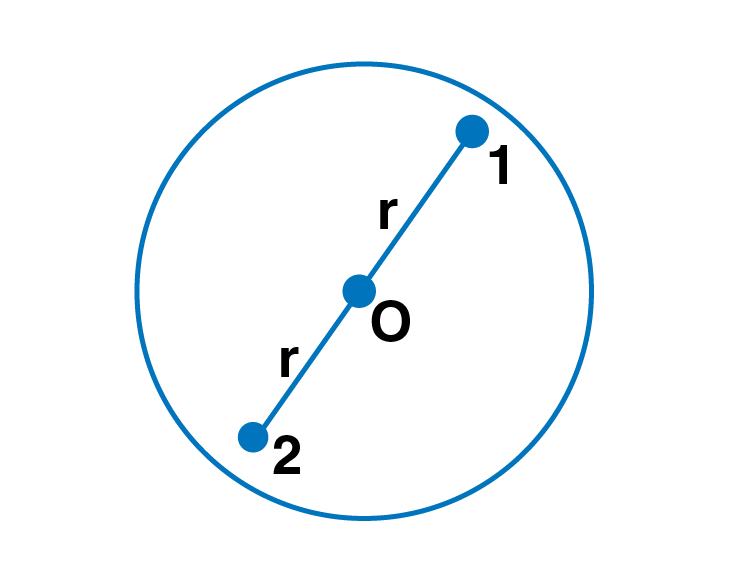
Consider a coin of example 1.20. It is electrically neutral and contains equal amounts of positive and negative charge of magnitude 34.8 kC. Suppose that these equal charges were concentrated in two-point charges separated by

a) 1 cm

b) 100 m

Find the force on each such point charge in each of the three cases. What do you conclude from these results?

Show solutionHide solution
Worked solution

a) F1 = |q|2/4πε0r12 = 1.09 × 10²³ N

b) F2 = |q|2/4πε0r22 = 1.09 × 10¹⁵ N

c) F3 = |q|2/4πε0r32 = 1/09 × 107 N
Q1.22Written answer

Figure represents a crystal unit of caesium chloride, CsCl. The caesium atoms, represented by open circles are situated at the corners of a cube of side 0.40 nm, whereas a Cl atom is situated at the centre of the cube. The Cs atoms are deficient in one electron while the Cl atom carries an excess electron

a) what is the net electric field on the Cl atom due to eight Cs atoms?

b) suppose that the Cs atom at the corner A is missing. What is the net force now on the Cl atom due to seven remaining Cs atoms?

Show solutionHide solution
Worked solution

a) The net electric field at the centre of the cube is zero as the chlorine atom is distributed equally from all the eight corners of the cube from the centre.

b) The vector sum of the electric field due to charge A is EA + Eseven charges = 0

Q1.23Written answer

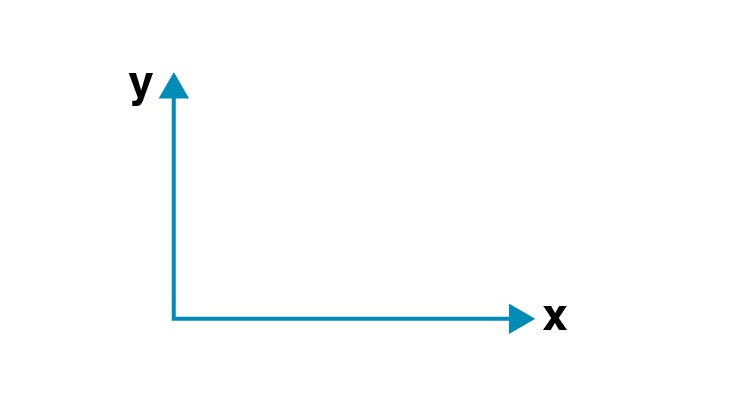
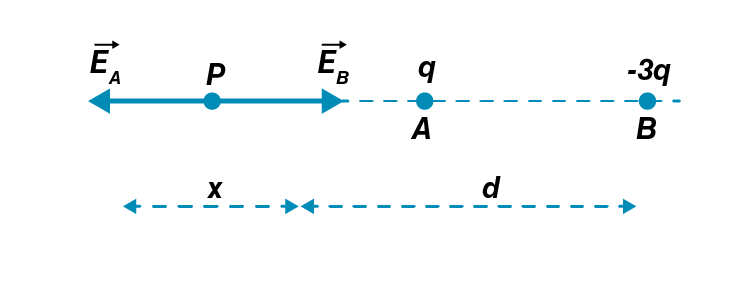
Two charges q and -3q are placed fixed on x-axis separated by distance ‘d’. Where should a third charge 2q be placed such that it will not experience any force?

Show solutionHide solution
Worked solution

Exemplar Solutions Physics Class 12 Chapter 1 - 16

At point P,

q/4πε0 x2 = 3q/4πε0 (x+d)2

(x + d)2 = 3x2

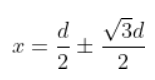
Solving the above equation, we get

Exemplar Solutions Class 12 Chapter 1 Img 26

Therefore, the distance between the 2q and q charges is d/2(1+√3)

Q1.24Written answer

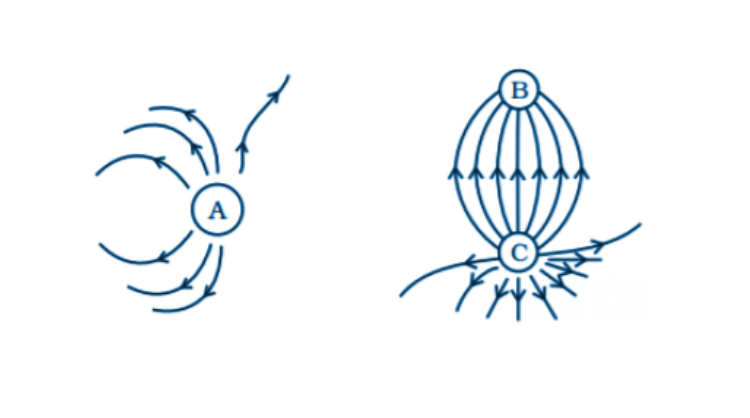
Figure shows the electric field lines around three-point charges A, B, and C

Exemplar Solutions Physics Class 12 Chapter 1 - 17

a) which charges are positive?

b) which charge has the largest magnitude? Why?

c) in which region or regions of the picture could the electric field be zero?

i) near A

ii) near B

iii) near C

iv) nowhere

Show solutionHide solution
Worked solution

a) A and C are positive as electric lines come out from the positive charge.

b) The magnitude of C is maximum than A and B because as the electric lines of forces from charge increases, the intensity of the electric field increases.

c) The electric field will be zero between A and C as that is the neutral point.

Q1.25Written answer

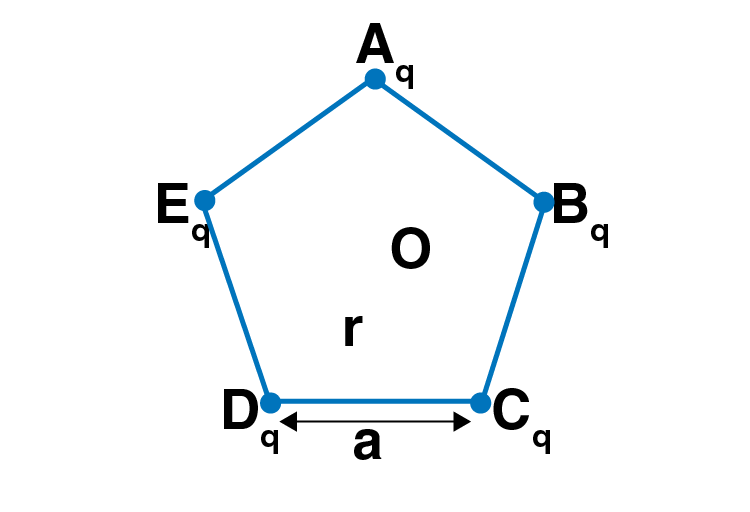
Five charges, q each are placed at the corners of a regular pentagon of side ‘a’

Exemplar Solutions Physics Class 12 Chapter 1 - 18

a) i) what will be the electric field at O, the centre of the pentagon?

ii) what will be the electric field at O if the charge from one of the corners is removed?

iii) what will be the electric field at O if the charge q at A is replaced by –q?

b) how would you answer to a) be affected if pentagon is replaced by an n-sided regular polygon with charge q at each of its corners?

Show solutionHide solution
Worked solution

a) i) The net electric field at O will be zero as it is symmetric to all the five charges.

ii) Following is the electric field at O if the charge from one of the corners is removed:

E1 = -1q/4πε0r2

Also, the direction of the electric field will be from O to A.

iii) Following is the electric field at O if the charge q at A is replaced by –q:

E = -2q/4πε0r2

b) When an n-sided regular polygon with charge q is replaced at each of the corners, then

i) Again at centre O, the net electric field will be zero.

ii) The direction of the electric field will be from O to opposite of OA and the electric field is given as:

E2 = -q/4πε0r2

iii) The electric field will be from O to A and is given as:

E = -2q/4πε0r2

Long Answer
Q1.26Written answer

In 1959 Lyttleton and Bondi suggested that the expansion of the universe could be explained if matter carried a net charge. Suppose that the universe is made up of hydrogen atoms with a number density N, which is maintained a constant. Let the charge on the proton be: ep = -(1 + y) e where e is the electronic charge.

a) find the critical value of y such that expansion may start

b) show that the velocity of expansion is proportional to the distance from the centre

Show solutionHide solution
Worked solution

a) There is one proton and one electron charge on each hydrogen atom.

eH = eP + e = -(1+y)e+e=-ye=|ye|

E is the electric field intensity at a distance R on the surface and according to Gauss theorem,

E = 1/3 N|ye|R/ε0

Solving for y we get, y = 10-18

b) Ne force experienced by the hydrogen atom is F = Fc – FG

The acceleration experienced by the hydrogen atom is given as d2R/dt2 = α2R

v = dR/dt = αR

Therefore, v is proportional to R that velocity is proportional to the distance from the centre.

Q1.27Written answer

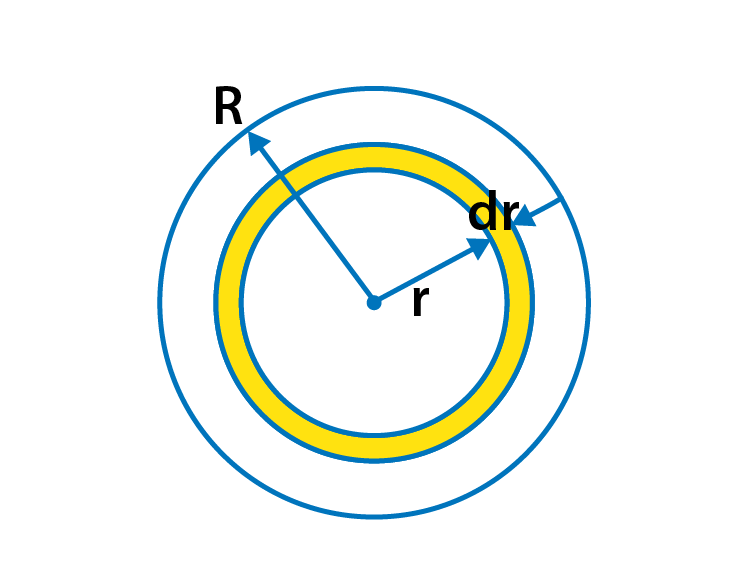
Consider a sphere of radius R with charge density distributed as

ρ(r) = kr for r ≤ R

ρ(r) = 0 for r > R

a) find the electric field at all points r

b) suppose the total charge on the sphere is 2e where e is the electron charge. Where can two protons be embedded such that the force on each of them is zero? Assume that the introduction of the proton does not alter the negative charge distribution

Show solutionHide solution
Worked solution

a)

Exemplar Solutions Physics Class 12 Chapter 1 - 19

S is the sphere with R as the radius. In the above figure, there are two hypothetic spheres of radius r < R and r > R.

When the r < R, the electric field intensity is given as:

E = 1/4ε0 Kr2

When the r > R, the electric field intensity is given as:

E = K/4ε0 R4/r2

b)

Exemplar Solutions Physics Class 12 Chapter 1 - 20

The two protons are kept symmetrically opposite to each other along the diameter. The charge on the sphere is given as:

K = 2e/πR4

The attractive forces between the proton 1 and proton 2 are given as:

F1 = eE = -eKr2/4ε0

F2 = e2/4πε0 (2r)2

Using the net force on the proton, we can calculate the distance between the protons, ‘r’ as follows

r = R/(8)1/4

Q1.28Written answer

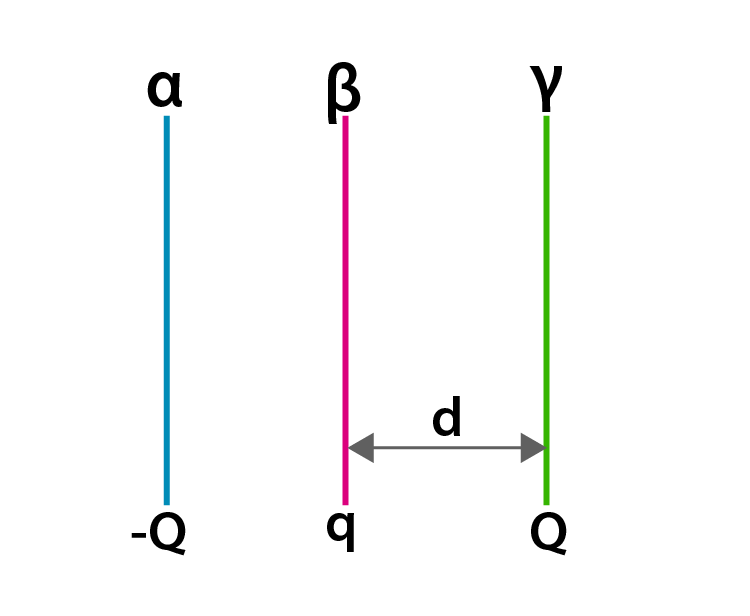
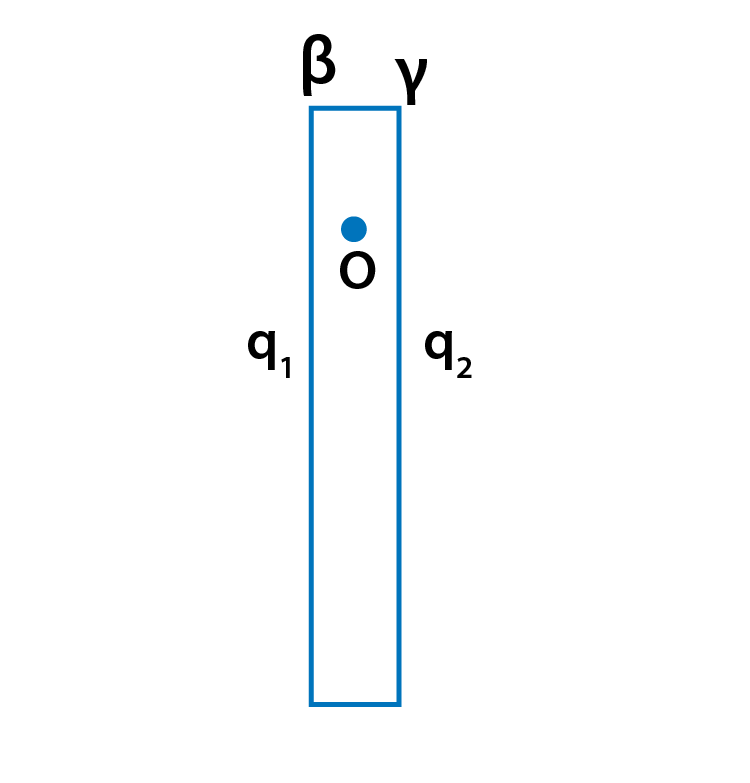
Two fixed, identical conducting plates (α and β), each of surface area S are charged to –Q and q respectively, where Q > q > 0. A third identical plate (γ), free to move is located on the other side of the plate with charge q at a distance d. The third plate is released and collides with the plate β. Assume the collision is elastic and the time of collision is sufficient to redistributed charge among β and γ.

a) find the electric field acting on the plate γ before collision

b) find the charges on β and γ after the collision

c) find the velocity of the plate γ after the collision and at a distance d from the plate β

Exemplar Solutions Physics Class 12 Chapter 1 - 21

Exemplar Solutions Physics Class 12 Chapter 1 - 22

Show solutionHide solution
Worked solution

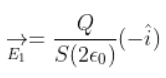
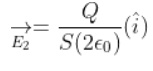
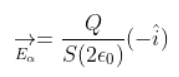
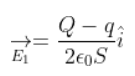
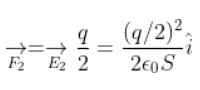
a) The electric field at plate γ due to plate α is

Exemplar Solutions Class 12 Chapter 1 Img 25

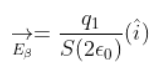
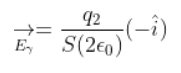
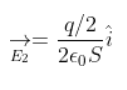
The electric field at plate γ due to plate β is

Exemplar Solutions Class 12 Chapter 1 Img 24

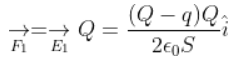
Adding both the equations, we get

Exemplar Solutions Class 12 Chapter 1 Img 23if Q > q

b) Electric field at O due to plate α,

Exemplar Solutions Class 12 Chapter 1 Img 22

Electric field at O due to plate β,

Exemplar Solutions Class 12 Chapter 1 Img 21

Electric field at O due to plate γ,

Exemplar Solutions Class 12 Chapter 1 Img 20

Exemplar Solutions Physics Class 12 Chapter 1 - 23

Solving the equations, we get

q1 = (Q + q/2) = charge on plate β

q1 = (q/2) = charge on plate γ

c) Let v be the velocity and d be the distance from plate β after collision.

The mass on the plate γ is m and the KE is equal to the work done by the electric field.

Following is the equation after collision

Exemplar Solutions Class 12 Chapter 1 Img 19

After collision, the electric field at γ is

Exemplar Solutions Class 12 Chapter 1 Img 18

Forces on the plate are given as

Exemplar Solutions Class 12 Chapter 1 Img 17

Exemplar Solutions Class 12 Chapter 1 Img 16

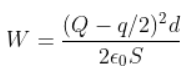
Therefore, the work done is given as

Exemplar Solutions Class 12 Chapter 1 Img 15

Therefore, velocity is given as

Exemplar Solutions Class 12 Chapter 1 Img 14

Q1.29Written answer

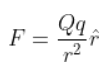
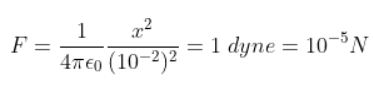
There is another useful system of units, besides the SI/mks A system called the cgs system. In this system Columb’s law is given by

Exemplar Solutions Class 12 Chapter 1 Img 13

Where the distance r is measured in cm, F in dynes and the charges in electrostatic units where 1 es unit of charge = 1/[3] × 10-9 C. The number [3] actually arise from the speed of light in vacuum which is now taken to be exactly given by c = 2.99792458 × 10⁸ m/s. An approximate value of c then is c = [3] × 108 m/s.

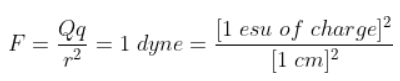
a) show that the Columb’s law is cgs units yields 1 esu of charge = 1 (dyne)1/2 cm. Obtain the dimensions of units of charge in terms of mass M, length L and time T. Show that it is given in terms of fractional powers of M and L

b) Write 1 csu of charge = xC where x is a dimensionless number. Show that this gives

1/4πε0 = 10-9/x2 N.m2/C2

With x = 1/[3] × 109 Nm2/C2

Show solutionHide solution
Worked solution

a) According to the given relation,

Exemplar Solutions Class 12 Chapter 1 Img 12

1 esu of charge = F1/2 . L

= [MLT2]1/2 [L]

= [M1/2L3/2T-1]

Therefore, the charge in the CGS unit can be represented in terms of fractional powers that is 1/2 for M and 3/2 for L.

b) The force between charges is given as

Exemplar Solutions Class 12 Chapter 1 Img 11

Therefore,

1/4πε0 = 10-9/x2 Nm2/C2

x = 1/|3|.109

Substituting the values we get, the force between the charges as

8.987….. ×109 Nm2/C2

Q1.30Written answer

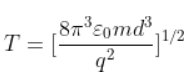
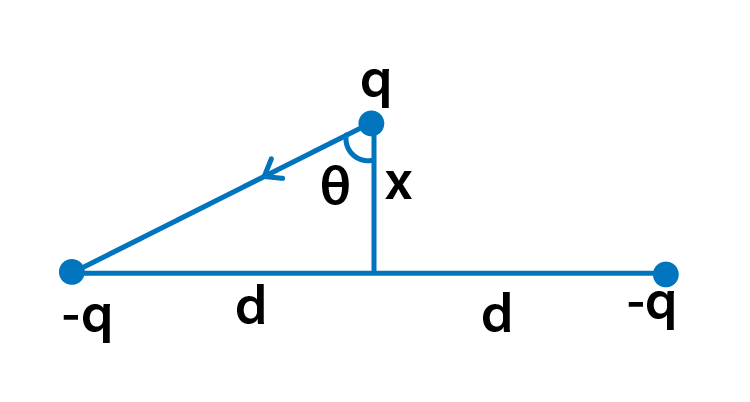
Two charges –q each are fixed separated by distance 2d. A third charge q of mass m placed at the mid-point is displaced slightly by x perpendicular to the line joining the two fixed charged as shown in the figure. Show that q will perform simple harmonic oscillation of time period.

Exemplar Solutions Class 12 Chapter 1 Img 10

Exemplar Solutions Physics Class 12 Chapter 1 - 24

Show solutionHide solution
Worked solution

Exemplar Solutions Physics Class 12 Chapter 1 - 25

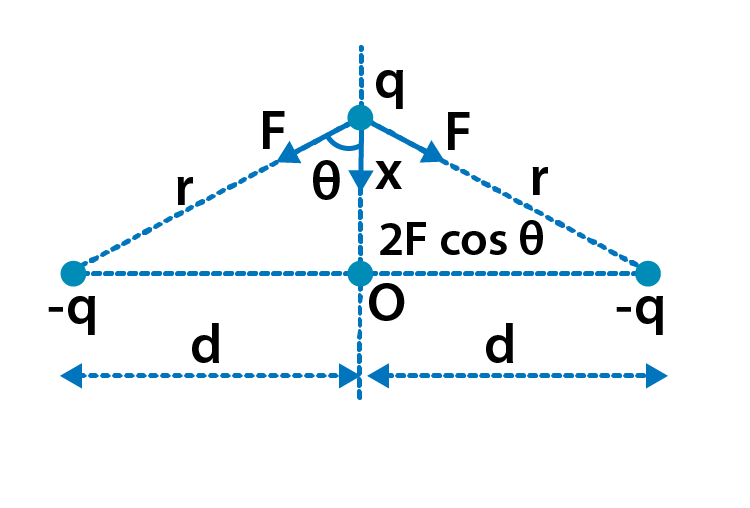
The charge q is displaced by x perpendicular to the line which joins the two fixed charges. The net force on the charge q is towards O. The charge has simple harmonic motion and charge q is proportional to the distance from the centre O.

The net force on the charge is Fnet = 2 F cos θ

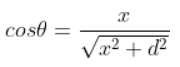
Where cos θ is given as

Exemplar Solutions Class 12 Chapter 1 Img 9

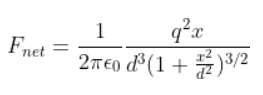
Substituting the values, we get Fnet as

Exemplar Solutions Class 12 Chapter 1 Img 8

Since x < < d, Fnet = Kx

Time period is given as:

Exemplar Solutions Class 12 Chapter 1 Img 7

Exemplar Solutions Class 12 Chapter 1 Img 6