My Cart
Your Cart 0

    Your cart is empty.

  • Total (Amount) ₹0.00
NCERT Exemplar · Class 12 · Physics

Chapter 1: Electric Charges and Fields

Practice each question, then open the answer or worked solution.

Questions

31 questions
Q1.11Multiple choice

Consider a region inside which there are various types of charges but the total charge is zero. At points outside the region

Show solutionHide solution
Worked solution

The correct answers are

c) the dominant electric field is proportional to 1/r3 for large r, where r is the distance from an origin in this region

d) the work done to move a charged particle along a closed path, away from the region, will be zero
Q1.12Written answer

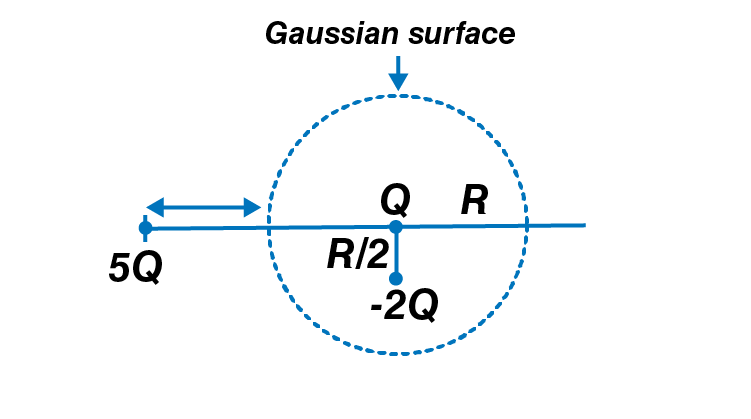
Refer to the arrangement of charges in the figure and a Gaussian surface of radius R with Q at the centre. Then

Exemplar Solutions Physics Class 12 Chapter 1 - 6

a) total flux through the surface of the sphere is –Q/ε0

b) field on the surface of the sphere is –Q/4πε0R2

c) flux through the surface of the sphere due to 5Q is zero

d) field on the surface of the sphere due to -2Q is the same everywhere

Show solutionHide solution
Worked solution

The correct answers are

a) total flux through the surface of the sphere is –Q/ε0

c) flux through the surface of the sphere due to 5Q is zero

Q1.13Written answer

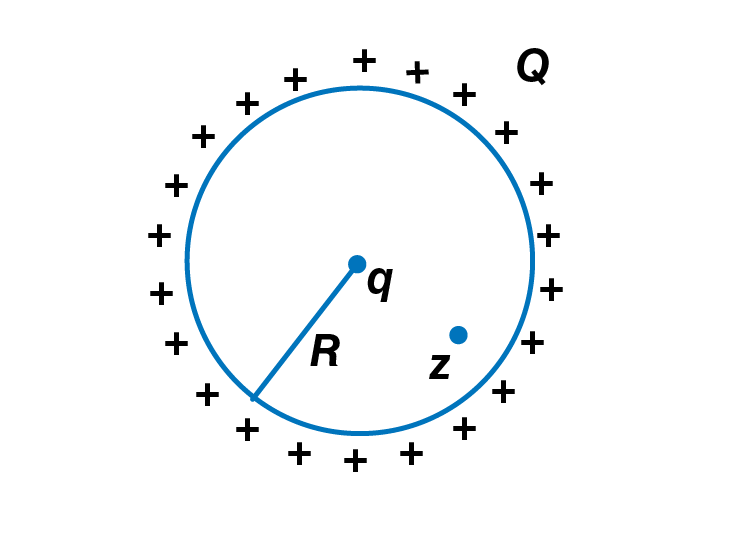
A positive charge Q is uniformly distributed along a circular ring of radius R. A small test charge q is placed at the centre of the ring. Then

Exemplar Solutions Physics Class 12 Chapter 1 - 7

a) if q > 0 and is displaced away from the centre in the plane of the ring., it will be pushed back towards the centre

b) if q < 0 and is displaced away from the centre in the plane of the ring, it will never return to the centre and will continue moving till it hits the ring

c) if q < 0, it will perform SHM for small displacement along the axis

d) q at the centre of the ring is in an unstable equilibrium within the plane of the ring for q > 0

Show solutionHide solution
Worked solution

The correct answers are

a) if q > 0 and is displaced away from the centre in the plane of the ring., it will be pushed back towards the centre

b) if q < 0 and is displaced away from the centre in the plane of the ring, it will never return to the centre and will continue moving till it hits the ring

d) q at the centre of the ring is in an unstable equilibrium within the plane of the ring for q > 0

Very Short Answers
Q1.14Written answer

An arbitrary surface encloses a dipole. What is the electric flux through this surface?

Show solutionHide solution
Worked solution

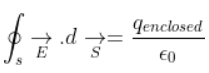
According to Gauss law, for an enclosed surface, the electric flux is given as:

Exemplar Solutions Class 12 Chapter 1 Img 29

The net charge on the dipole is given as –q and +q whose sum is equal to zero.

Q1.15Written answer

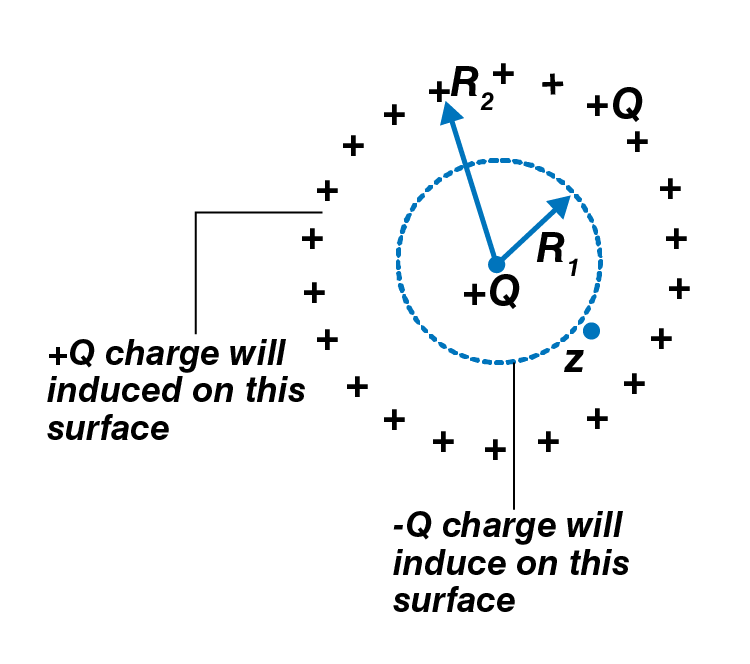
A metallic spherical shell has an inner radius R1 and outer radius R2. A charge Q is placed at the centre of the spherical cavity. What will be surface charge density on

a) the inner surface

b) the outer surface

Show solutionHide solution
Worked solution

Exemplar Solutions Physics Class 12 Chapter 1 - 8

Q is the charge which is kept at the centre of the spherical cavity. –Q is the charge that is induced in the inner surface and –Q on the outer surface.

σ is the surface charge density

a) σ1 is the surface charge density on the inner surface = Charge/Area =
Exemplar Solutions Class 12 Chapter 1 Img 28

b) σ2 is the surface charge density on the outer surface =
Exemplar Solutions Class 12 Chapter 1 Img 27

Q1.16Written answer

The dimensions of an atom are of the order of an Angstrom. Thus there must be large electric fields between the protons and electrons. Why, then is the electrostatic field inside a conductor zero?

Show solutionHide solution
Worked solution

The electrostatic field inside a conductor is zero as the dimensions of the atom are in the order of an Angstrom and the electrostatic field inside the conductor is caused by the presence of the excess charges.

Q1.17Written answer

If the total charge enclosed by a surface is zero, does it imply that the electric field everywhere on the surface is zero? Conversely, if the electric field everywhere on a surface is zero, does it imply that net charge inside is zero.

Show solutionHide solution
Worked solution

The total charge enclosed by a surface is zero, it doesn’t imply that the electric field everywhere on the surface is zero and the field may be normal to the surface. Also, the conversely it does imply that the electric field everywhere on the surface is zero.

Q1.18Written answer

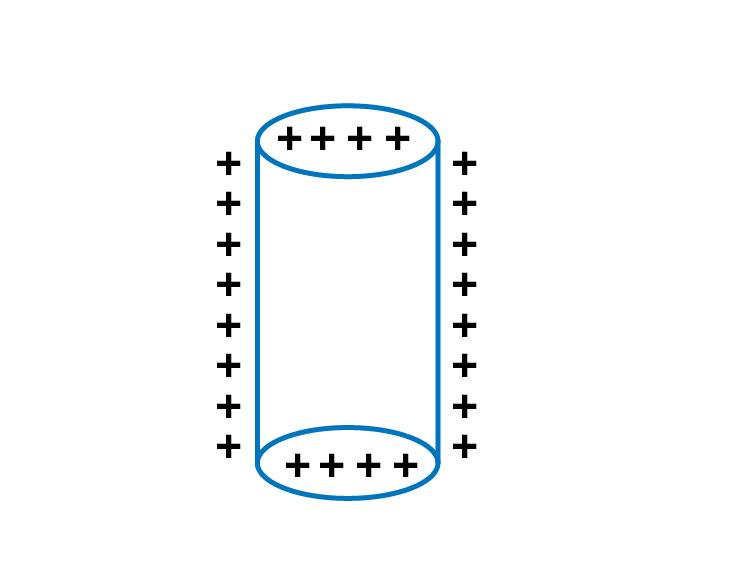
Sketch the electric field lines for a uniformly charged hollow cylinder shown in the figure.

Exemplar Solutions Physics Class 12 Chapter 1 - 9

Show solutionHide solution
Worked solution

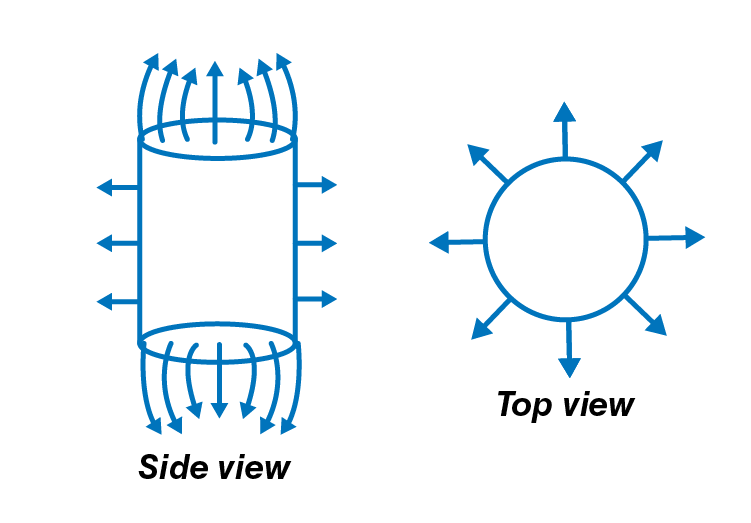
Following are the side view and top view of the electric field lines for a uniformly charged hollow cylinder.

Exemplar Solutions Physics Class 12 Chapter 1 - 10

Q1.19Written answer

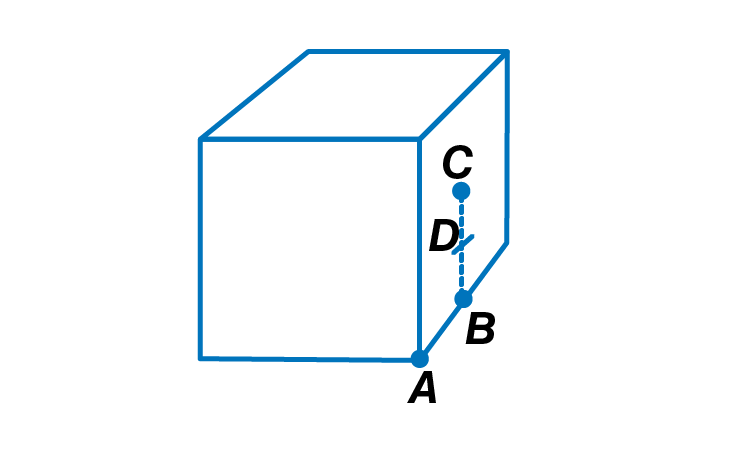
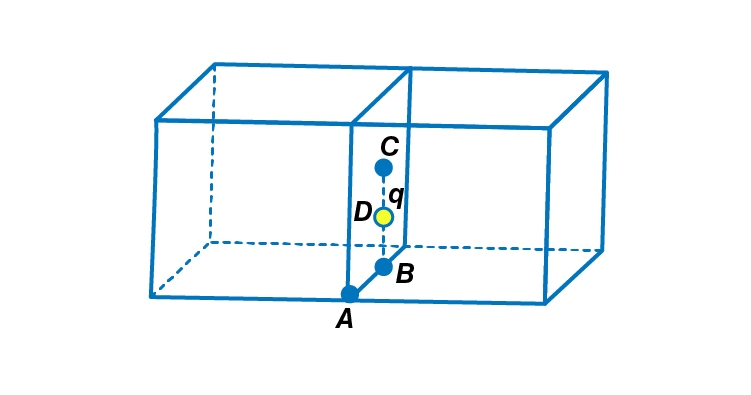
What will be the total flux through the faces of the cube with a side of length a if a charge q is placed at

Exemplar Solutions Physics Class 12 Chapter 1 - 11

a) A: a corner of the cube

b) B: mid-point of an edge of the cube

c) C: centre of a face of the cube

d) D: mid-point of B and C

Show solutionHide solution
Worked solution

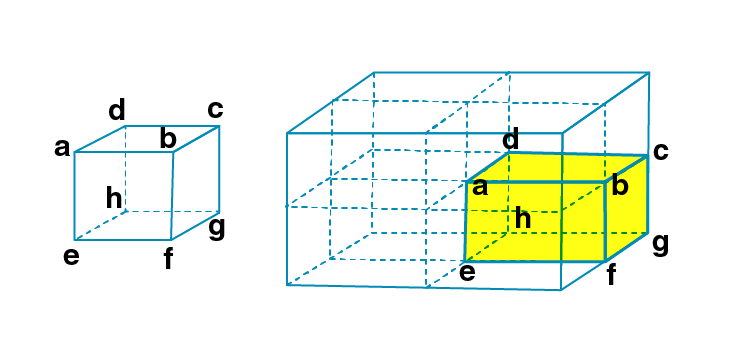
a) When we consider the charged particle to be placed at the centre of the cube whose side is 2a, then the charge is equally distributed among 8 cubes. Therefore, the total flux through the faces of the cube = q/8ε0

Exemplar Solutions Physics Class 12 Chapter 1 - 12

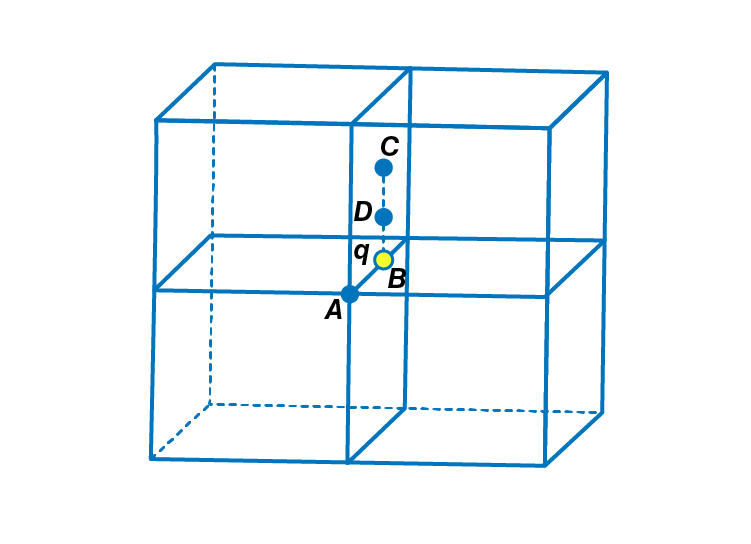
b) When the charge is placed at B, the charge is equally distributed among the 4 cubes. Therefore, the total flux through the four faces is given as = q/4ε0

Exemplar Solutions Physics Class 12 Chapter 1 - 13

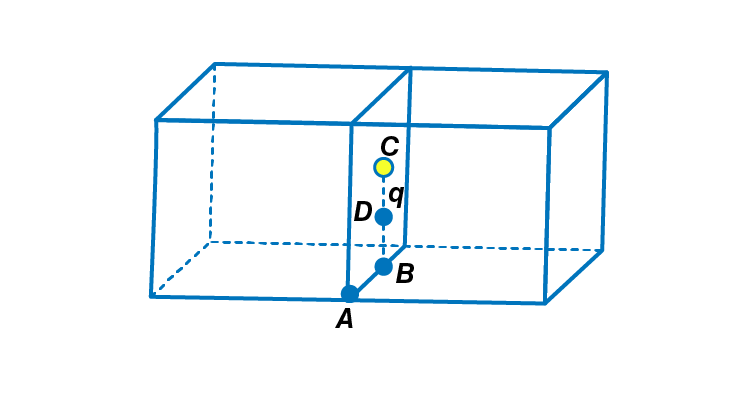
c) When the charge is placed at C, the charge is shared among 2 cubes equally. Therefore, the total flux through these faces is given as = q/2ε0

Exemplar Solutions Physics Class 12 Chapter 1 - 14

d) When the charge is placed at D, the charge is distributed among two cubes and therefore, the total flux is given as = q/2ε0

Exemplar Solutions Physics Class 12 Chapter 1 - 15

Short Answers
Q1.20Written answer

A paisa coin is made up of Al-Mg alloy and weighs 0.75 g. It has a square shape and its diagonal measures 17 mm. It is electrically neutral and contains equal amounts of positive and negative charges. Treating the paisa coins made up of only Al, find the magnitude of an equal number of positive and negative charges. What conclusion do you draw from this magnitude?

Show solutionHide solution
Worked solution

1 molar mass M of Al = 6.023 × 10²³ atoms

No.of aluminium atoms in one paise coin = N = 6.023 × 10²³/26.9815 × 0.75 = 1.76 ×10²²

There are 13 protons and 13 electrons on the Al as the charge number is 13

Magnitude of positive and negative charges = 3.48 × 10⁴ C = 34.8 kC