Q11Written answer
If y(x) is a solution of and y (0) = 1, then find the value of y(π/2).
Show solutionHide solution
Worked solution
Your cart is empty.
Practice each question, then open the answer or worked solution.
If y(x) is a solution of and y (0) = 1, then find the value of y(π/2).
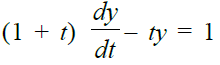
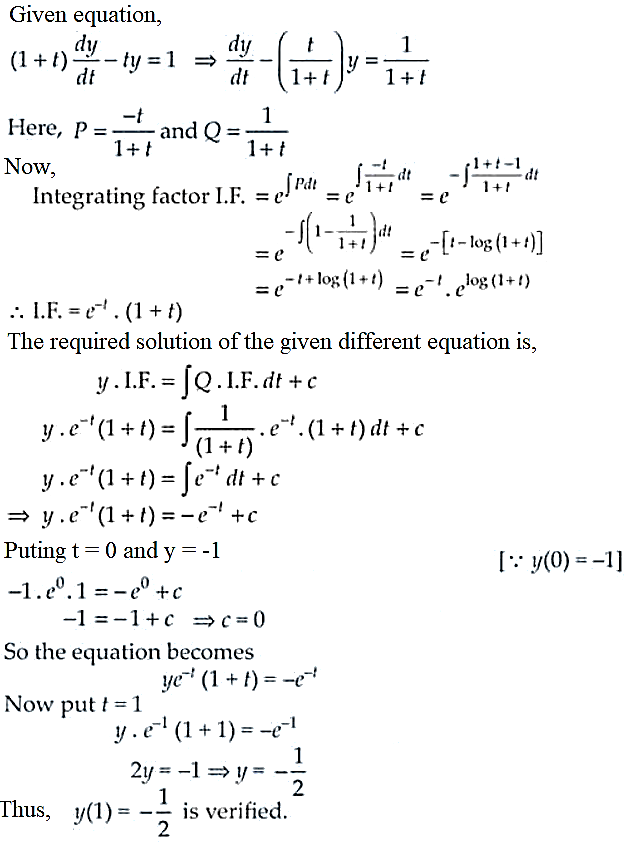
If y(t) is a solution of and y (0) = – 1, then show that y (1) = -1/2.
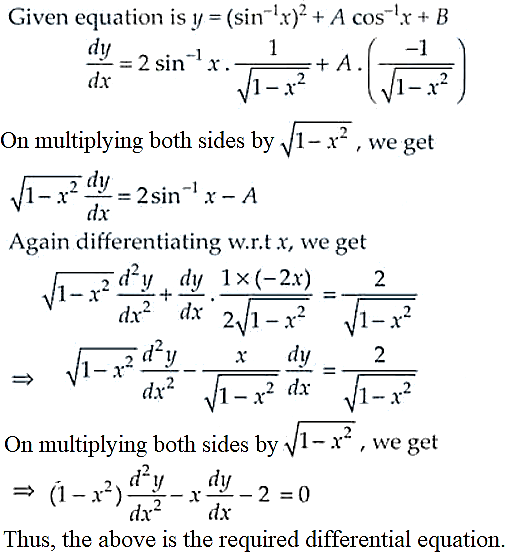
Form the differential equation having y = (sin–1x)2 + A cos–1x + B, where A and B are arbitrary constants, as its general solution.
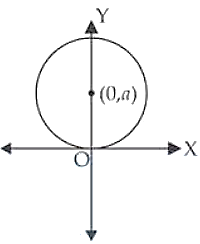
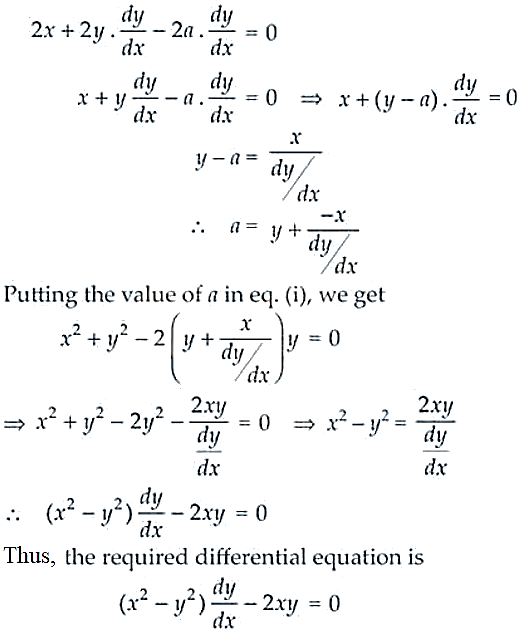
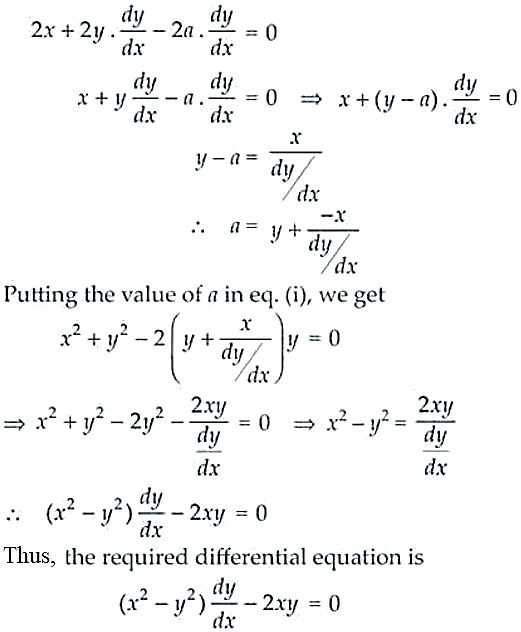
Form the differential equation of all circles which pass through origin and whose centres lie on y-axis.
The equation of circles which pass through the origin and whose centre lies on the y-axis is given by,
(x – 0)2 + (y – a)2 = a2, where (0, a) is the centre
x2 + y2 + a2 – 2ay = a2
 x2 + y2 – 2ay = 0 ……… (i)
Differentiating both sides w.r.t. x, we get
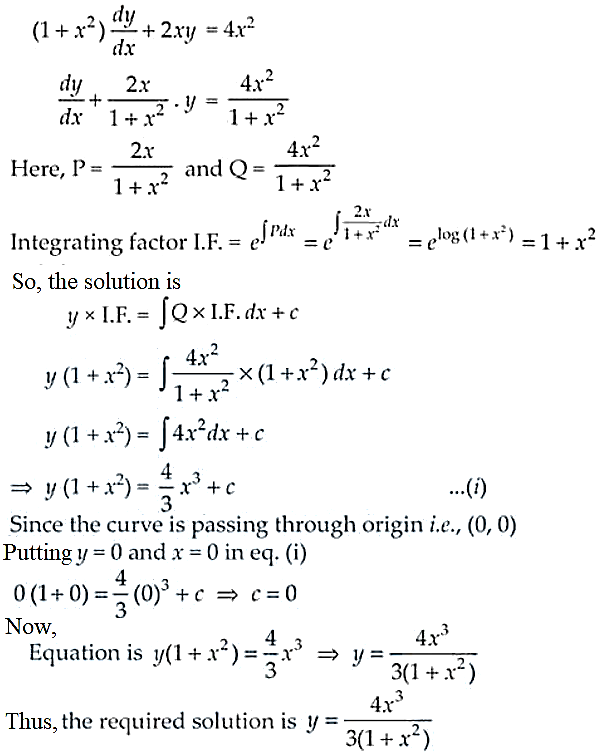
Find the equation of a curve passing through origin and satisfying the differential equation

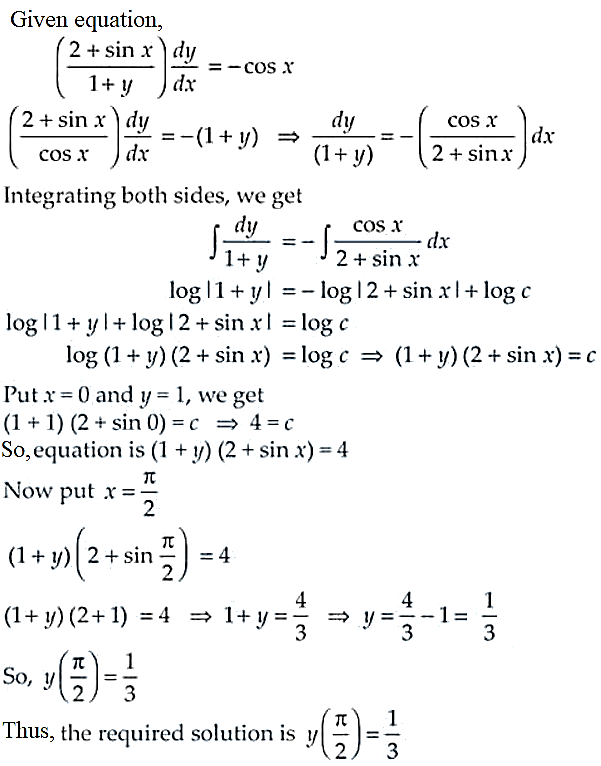
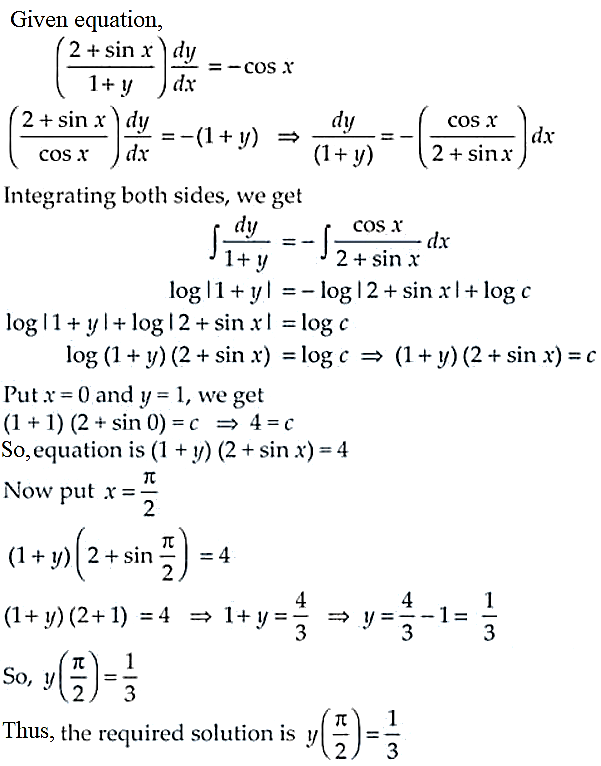
Given equation,
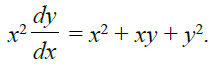
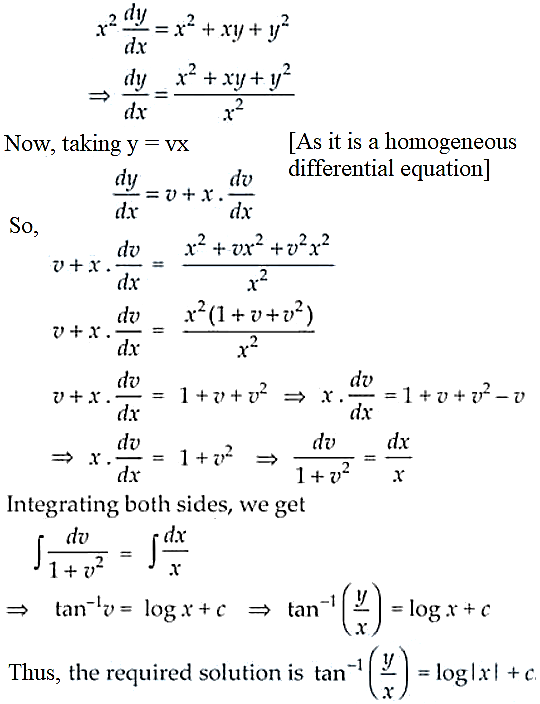
Solve:
Given equation,
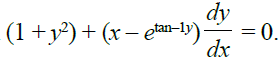
Find the general solution of the differential equation
Given differential equation,
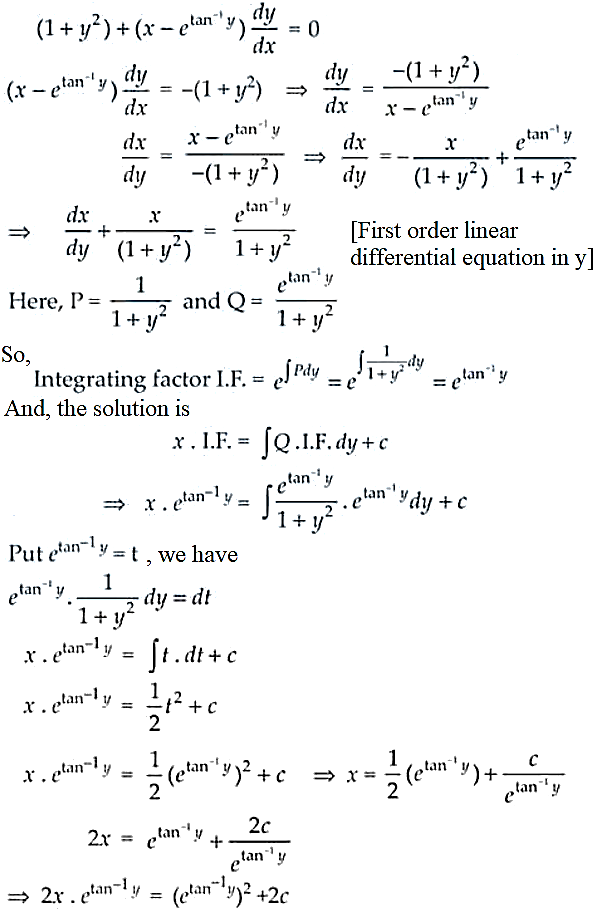
Thus, the above is the required solution of the given differential equation.
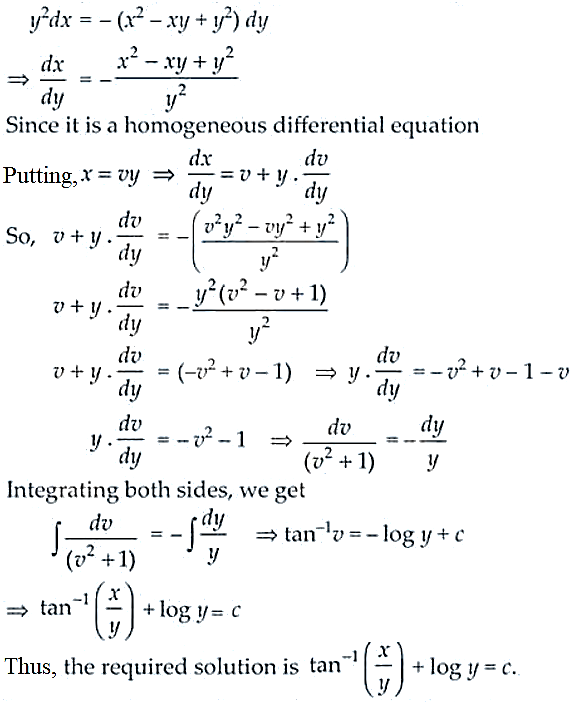
Find the general solution of y2dx + (x2 – xy + y2) dy = 0.
Given equation, y2dx + (x2 – xy + y2) dy = 0

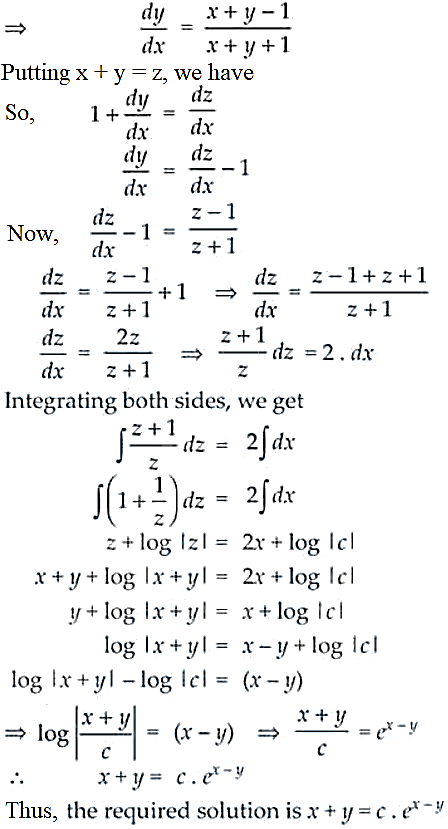
Solve : (x + y) (dx – dy) = dx + dy. [Hint: Substitute x + y = z after separating dx and dy]
Given differential equation, (x + y) (dx – dy) = dx + dy
(x + y) dx – (x – y) dy = dx + dy
– (x + y) dy – dy = dx – (x + y) dx
– (x + y + 1) dy = – (x + y – 1) dx

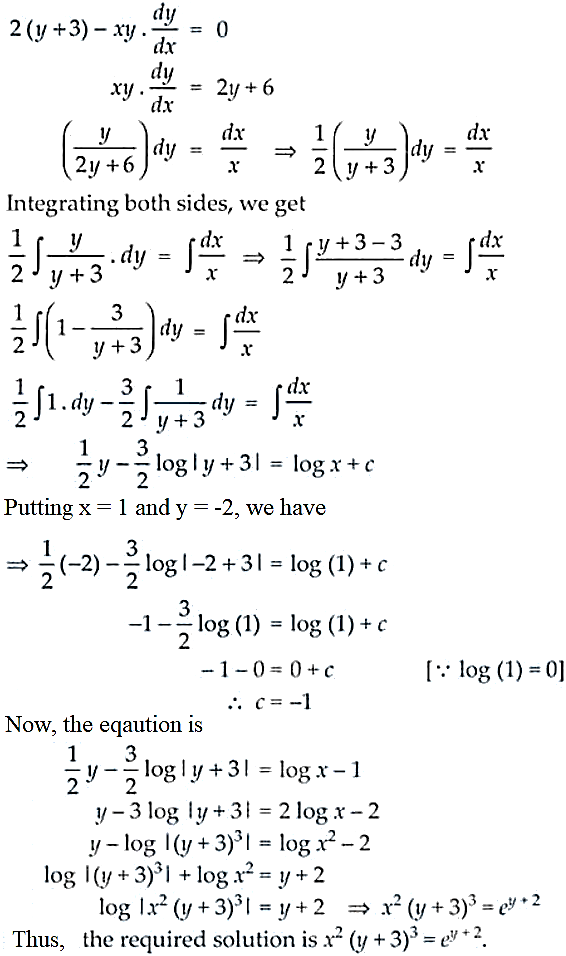
Solve : 2 (y + 3) – xy dy/dx = 0, given that y(1) = -2.
Given differential equation, 2 (y + 3) – xy dy/dx = 0