My Cart
Your Cart 0

    Your cart is empty.

  • Total (Amount) ₹0.00
NCERT Exemplar · Class 12 · Maths

Chapter 6: Application of Derivatives

Practice each question, then open the answer or worked solution.

Questions

32 questions
Q1Written answer

A spherical ball of salt is dissolving in water in such a manner that the rate of decrease of the volume at any instant is proportional to the surface. Prove that the radius is decreasing at a constant rate.

Show solutionHide solution
Worked solution

Given, a spherical ball of salt

Then, the volume of ball V = 4/3 πr3 where r = radius of the ball

Now, according to the question we have

dV/dt ∝ S, where S = surface area of the ball
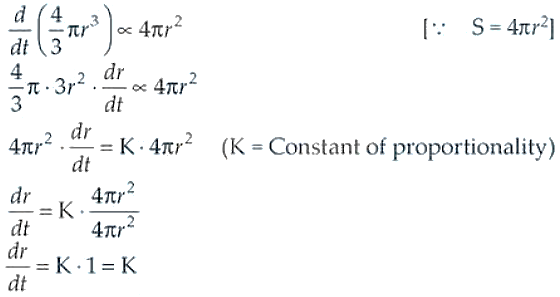
NCERT Exemplar Solutions Class 12 Mathematics Chapter 6 - 1

Therefore, the radius of the ball is decreasing at constant rate.
Q2Written answer

If the area of a circle increases at a uniform rate, then prove that perimeter varies inversely as the radius.

Show solutionHide solution
Worked solution

We know that the area of circle, A = πr2, where r = radius of the circle

And, perimeter = 2πr

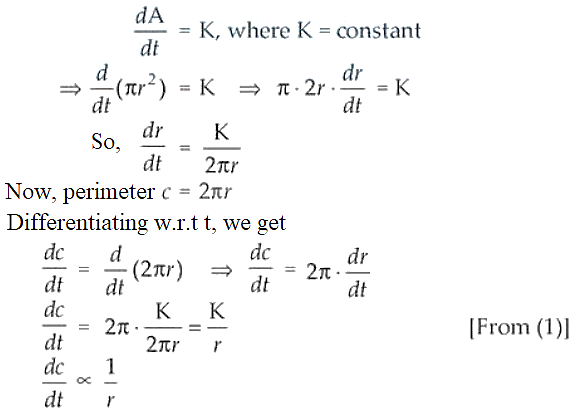
According to the question, we have

NCERT Exemplar Solutions Class 12 Mathematics Chapter 6 - 2

Therefore, it’s seen that the perimeter of the circle varies inversely as the radius of the circle.

Q3Written answer

A kite is moving horizontally at a height of 151.5 meters. If the speed of kite is

10 m/s, how fast is the string being let out; when the kite is 250 m away from

the boy who is flying the kite? The height of boy is 1.5 m.

Show solutionHide solution
Worked solution

Given,

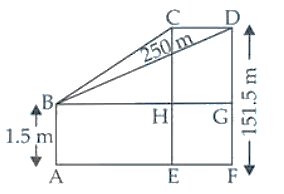
NCERT Exemplar Solutions Class 12 Mathematics Chapter 6 - 3Height of the kite(h) = 151.5 m

Speed of the kite(V) = 10 m/s

Let FD be the height of the kite and AB be the height of the kite and AB be the height of the boy.

Now, let AF = x m

So, BG = AF = x

And, dx/dt = 10 m/s

From the figure, it’s seen that

GD = DF – GF = DF – AB

= (151.5 – 1.5) m = 150 m [As AB = GF]

Now, in ∆ BDG

BG2 + GD2 = BD2 (By Pythagoras Theorem)

x2 + (150)2 = (250)2

x2 + 22500 = 62500

x2 = 62500 – 22500 = 40000

x = 200 m

Let initially the length of the string be y m

So, in ∆ BDG

BG2 + GD2 = BD2

x2 + (150)2 = y2

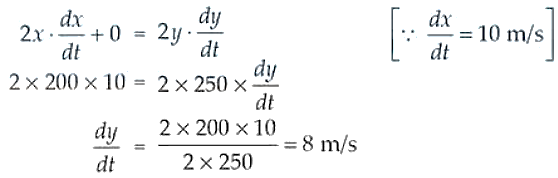
Differentiating both sides w.r.t., t, we have

NCERT Exemplar Solutions Class 12 Mathematics Chapter 6 - 4

Therefore, the rate of change of the length of the string is 8 m/s.

Q4Written answer

Two men A and B start with velocities v at the same time from the junction of

two roads inclined at 45° to each other. If they travel by different roads, find

the rate at which they are being separated.

Show solutionHide solution
Worked solution

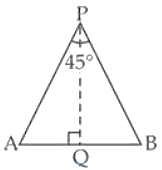
Let’s consider P to be any point at which the two roads are inclined at an angle of 45o.

Now, two men A and B are moving along the roads PA and PB respectively with same speed ‘V’.

NCERT Exemplar Solutions Class 12 Mathematics Chapter 6 - 5And, let A and B be their final positions such that AB = y
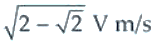
∠APB = 45o and they move with the same speed.

So, ∆APB is an isosceles triangle.

Now, draw PQ ⊥ AB.

We have, AB = y

So, AQ = y/2 and PA = PA = x (assumption)

And, ∠APQ = ∠BPQ = 45o/2 = 22.5o

Now, in right ∆APQ

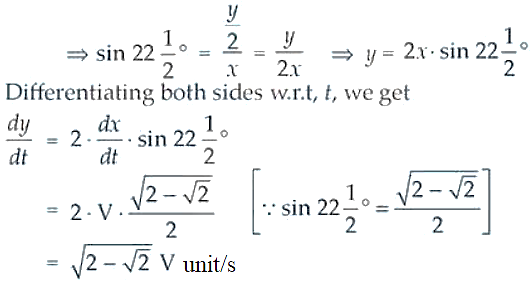
sin 22.5o = AQ/AP

NCERT Exemplar Solutions Class 12 Mathematics Chapter 6 - 6

Therefore, the rate of their separation is
NCERT Exemplar Solutions Class 12 Mathematics Chapter 6 - 7

Q5Written answer

Find an angle q, 0 < q < /2, which increases twice as fast as its sine.

Show solutionHide solution
Worked solution

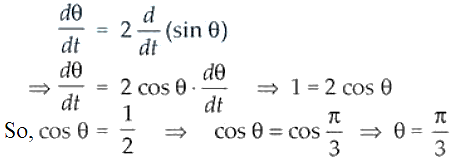
According to the question, we have

NCERT Exemplar Solutions Class 12 Mathematics Chapter 6 - 8

Therefore, the required angle is π/3.

Q6Written answer

Find the approximate value of (1.999)5.

Show solutionHide solution
Worked solution

(1.999)5 = (2 – 0.001)5

Let x = 2 and ∆x = -0.001

Also, let y = x5

Differentiating both sides w.r.t, x, we get

dy/dx = 5x4 = 5(2)4 = 80

Now, ∆y = (dy/dx). ∆x = 80. (-0.001) = -0.080

And, (1.999)5 = y + ∆y

= x5 – 0.080 = (2)5 – 0.080 = 32 – 0.080 = 31.92

Therefore, approximate value of (1.999)5 is 31.92

Q7Written answer

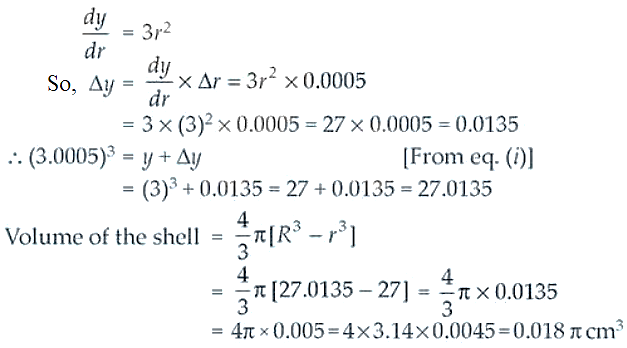
Find the approximate volume of metal in a hollow spherical shell whose internal and external radii are 3 cm and 3.0005 cm, respectively.

Show solutionHide solution
Worked solution

Given,

The internal radius r = 3 cm

And, external radius R = r + ∆r =3.0005 cm

∆r = 3.0005 – 3 = 0.0005 cm

Let y = r3 ⇒ y + ∆y = (r + ∆r)3 = R3 = (3.0005)3

Differentiating both sides w.r.t., r, we get

NCERT Exemplar Solutions Class 12 Mathematics Chapter 6 - 11

Therefore, the approximate volume of the metal in the shell is 0.018π cm3

NCERT Exemplar Solutions Class 12 Mathematics Chapter 6 - 9
NCERT Exemplar Solutions Class 12 Mathematics Chapter 6 - 10

Q8Written answer

A man, 2m tall, walks at the rate of m/s towards a street light which is m above

the ground. At what rate is the tip of his shadow moving? At what rate is the length of the

NCERT Exemplar Solutions Class 12 Mathematics Chapter 6 - 12

shadow changing when he is m from the base of the light?

Show solutionHide solution
Worked solution

Let AB is the height of street light post and CD is the height of the man such that

AB = 5(1/3) = 16/3 m and CD = 2 m

Let BC = x length (the distance of the man from the lamp post)

And CE = y is the length of the shadow of the man at any instant.

It’s seen from the figure that,

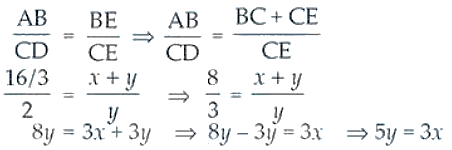
∆ ABE ~ ∆ DCE [by AAA similarity criterion]

Now, taking ratio of their corresponding sides, we have

NCERT Exemplar Solutions Class 12 Mathematics Chapter 6 - 13

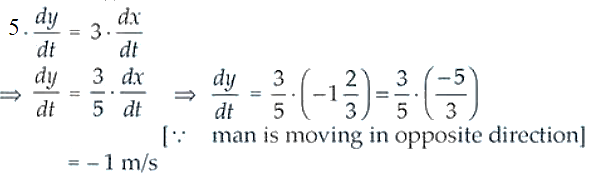
Differentiating both sides w.r.t, t, we have

NCERT Exemplar Solutions Class 12 Mathematics Chapter 6 - 14

So, the length of shadow is decreasing at the rate of 1 m/s.

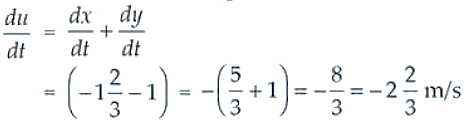
Now, let u = x + y

(where, u = distance of the tip of shadow from the light post)

On differentiating both sides w.r.t. t, we get

NCERT Exemplar Solutions Class 12 Mathematics Chapter 6 - 15
NCERT Exemplar Solutions Class 12 Mathematics Chapter 6 - 16

Therefore, the tip of the shadow is moving at the rate of m/s towards the light post and the length of shadow decreasing at the rate of 1 m/s.

Q9Written answer

A swimming pool is to be drained for cleaning. If L represents the number of litres of water in the pool t seconds after the pool has been plugged off to drain and L = 200 (10 – t)2. How fast is the water running out at the end of 5 seconds? What is the average rate at which the water flows out during the first 5 seconds?

Show solutionHide solution
Worked solution

Given, L = 200(10 – t)2 where L represents the number of liters of water in the pool.

On differentiating both the sides w.r.t, t, we get

dL/dt = 200 x 2(10 – t) (-1) = -400(10 – t)

But, the rate at which the water is running out

= -dL/dt = 400(10 – t)

Now, rate at which the water is running after 5 seconds will be

= 400 x (10 – 5) = 2000 L/s (final rate)

T = 0 for initial rate

= 400 (10 – 0) = 4000 L/s

So, the average rate at which the water is running out is given by

= (Initial rate + Final rate)/ 2 = (4000 + 2000)/ 2 = 6000/2 = 3000 L/s

Therefore, the required rate = 3000 L/s

Q10Written answer

The volume of a cube increases at a constant rate. Prove that the increase in its surface area varies inversely as the length of the side.

Show solutionHide solution
Worked solution

Let’s assume x to be the length of the cube.

So, the volume of the cube V = x3 …. (1)

Given that, dV/dt = K

Now, on differentiating the equation (1) w.r.t. t, we get

dV/dt = 3x2. dx/dt = K (constant)

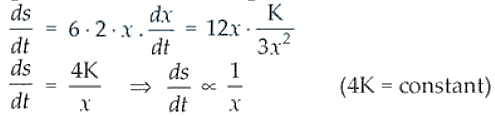
So, dx/dt = K/3x2

Now,

Surface area of the cube, S = 6x2

Differentiating both sides w.r.t. t, we get

NCERT Exemplar Solutions Class 12 Mathematics Chapter 6 - 17

Therefore, the surface area of the cube varies inversely as the length of the side.