Which of the following is the principal value branch of cosec-1 x?
(a) (-π/2, π/2) (b) [0, π] – {π/2} (c) [-π/2, π/2] (d) [-π/2, π/2] – {0}
Show solutionHide solution
(d) [-π/2, π/2] – {0}
As the principal branch of cosec-1 x is [-π/2, π/2] – {0}.
Your cart is empty.
Practice each question, then open the answer or worked solution.
Which of the following is the principal value branch of cosec-1 x?
(a) (-π/2, π/2) (b) [0, π] – {π/2} (c) [-π/2, π/2] (d) [-π/2, π/2] – {0}
(d) [-π/2, π/2] – {0}
As the principal branch of cosec-1 x is [-π/2, π/2] – {0}.
If 3 tan-1 x + cot-1 x = π, then x equals
(a) 0 (b) 1 (c) -1 (d) ½
(b) 1
Given, 3 tan-1 x + cot-1 x = π
2 tan-1 x + tan-1 x + cot-1 x = π
2 tan-1 x + π/2 = π (As tan-1 + cot-1 = π/2)
2 tan-1 x = π/2
tan-1 x = π/4
x = 1
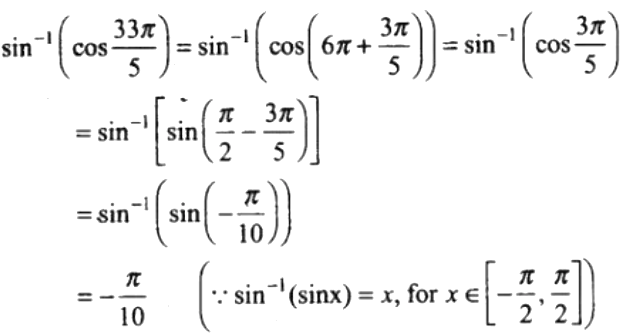
The value of sin-1 cos 33π/5 is
(a) 3π/5 (b) -7π/5 (c) π/10 (d) -π/10
(d) -π/10

The domain of the function cos-1 (2x – 1) is
(a) [0, 1] (b) [-1, 1] (c) [-1, 1] (d) [0, π]
(a) [0, 1]
Since, cos-1 x is defined for x ∈ [-1, 1]
So, f(x) = cos-1 (2x – 1) is defined if
-1 ≤ 2x – 1 ≤ 1
0 ≤ 2x ≤ 2
Hence,
0 ≤ x ≤ 1
The domain of the function by f(x) = sin-1 √(x – 1) is
(a) [1, 2] (b) [-1, 1] (c) [0, 1] (d) none of these
(a) [1, 2]
We know that, sin-1 x is defined for x ∈ [-1, 1]
So, f(x) = sin-1 √(x – 1) is defined if
0 ≤ √(x – 1) ≤ 1
0 ≤ x – 1 ≤ 1
1 ≤ x ≤ 2
Hence,
x ∈ [1, 2]
If cos (sin-1 2/5 + cos-1 x) = 0, then x is equal to
(a) 1/5 (b) 2/5 (c) 0 (d) 1
(b) 2/5
Given,
cos (sin-1 2/5 + cos-1 x) = 0
So, this can be rewritten as
sin-1 2/5 + cos-1 x = cos-1 0
sin-1 2/5 + cos-1 x = π/2
cos-1 x = π/2 – sin-1 2/5
cos-1 x = cos-1 2/5 [Since, cos-1 x + sin-1 x = π/2]
Hence,
x = 2/5
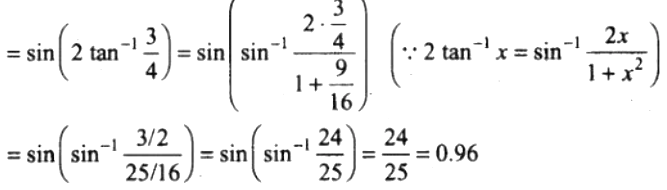
The value of sin (2 tan-1(0.75)) is equal to
(a) 0.75 (b) 1.5 (c) 0.96 (d) sin 1.5
(c) 0.96
We have, sin (2 tan-1(0.75))
