Solve the equation cos (tan-1 x) = sin (cot-1 3/4).
Show solutionHide solution
Given equation, cos (tan-1 x) = sin (cot-1 3/4)
Taking L.H.S,
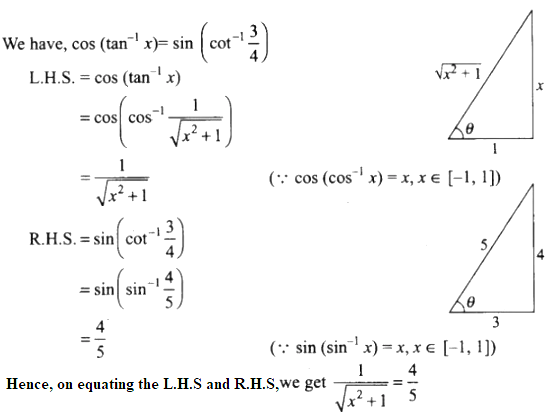
On squaring on both sides,
16(x2 + 1) = 25
16x2 + 16 = 25
16x2 = 9
x2 = 9/16
Therefore, x = ± 3/4
Your cart is empty.
Practice each question, then open the answer or worked solution.
Solve the equation cos (tan-1 x) = sin (cot-1 3/4).
Given equation, cos (tan-1 x) = sin (cot-1 3/4)
Taking L.H.S,

On squaring on both sides,
16(x2 + 1) = 25
16x2 + 16 = 25
16x2 = 9
x2 = 9/16
Therefore, x = ± 3/4
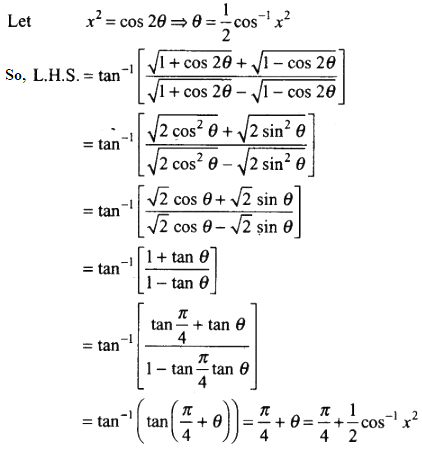
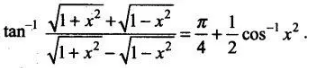
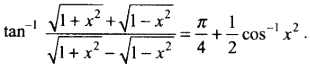
Prove that

Taking L.H.S,

= R.H.S
– Hence Proved
Find the simplified form of cos-1 [3/5 cos x + 4/5 sin x], x ∈ [-3π/4, π/4].
We have,
cos-1 [3/5 cos x + 4/5 sin x], x ∈ [-3π/4, π/4]
Now, let cos α = 3/5
So, sin α = 4/5 and tan α = 4/3
cos-1 [3/5 cos x + 4/5 sin x]
⇒ cos-1 [3/5 cos x + 4/5 sin x] = cos-1 [cos α cos x + sin α sin x]
= cos-1 [cos (α – x)]
= α – x
= tan-1 4/3 – x
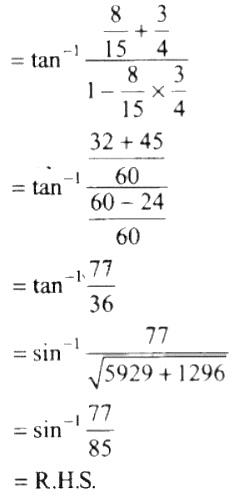
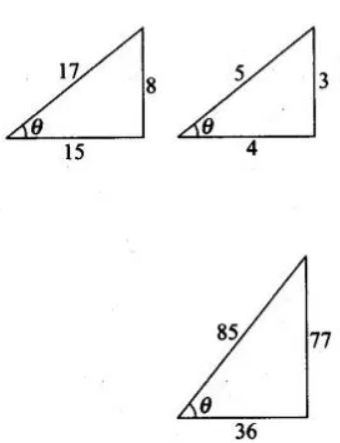
Prove that sin-1 8/17 + sin-1 3/5 = sin-1 77/85
Taking the L.H.S,
= sin-1 8/17 + sin-1 3/5
= tan-1 8/15 + tan-1 3/4

– Hence proved
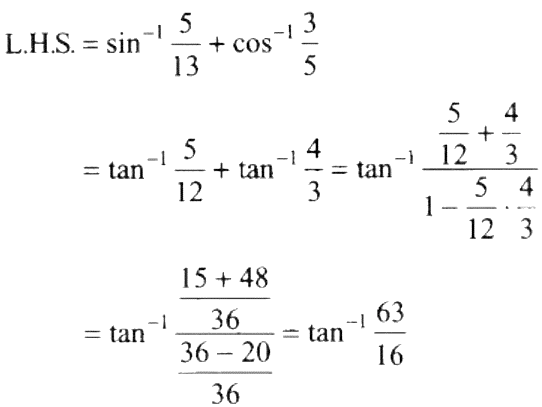
Show that sin-1 5/13 + cos-1 3/5 = tan-1 63/16
Here, sin-1 5/13 = tan-1 5/12
And,
cos-1 3/5 = tan-1 4/3
Taking the L.H.S, we have

Thus, L.H.S = R.H.S
– Hence Proved
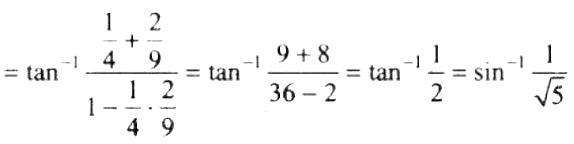
Prove that tan-1 1/4 + tan-1 2/9 = sin-1 1/√5
Taking the LHS,
tan-1 1/4 + tan-1 2/9

= RHS
– Hence Proved
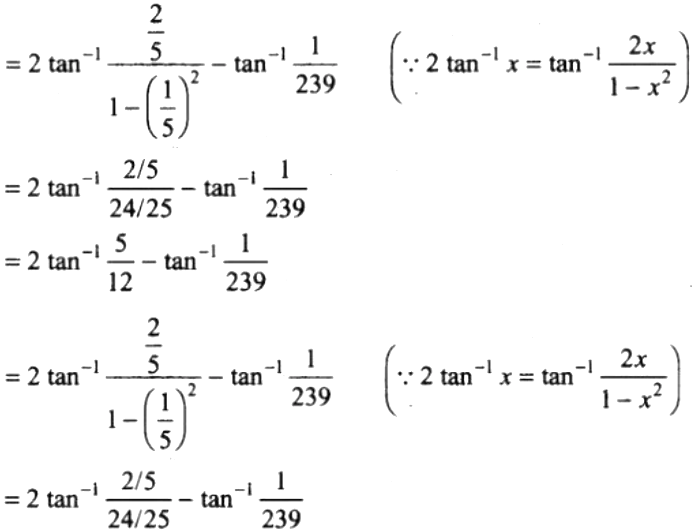
Find the value of 4 tan-1 1/5 – tan-1 1/239
4 tan-1 1/5 – tan-1 1/239
= 2 (tan-1 1/5) – tan-1 1/239

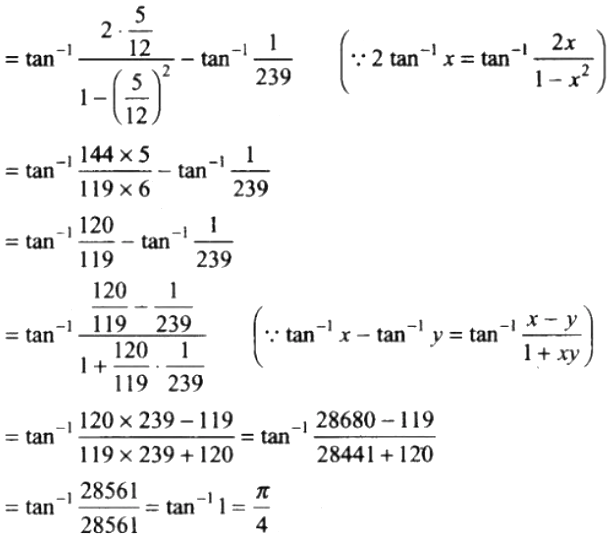
= 2 tan-1 5/12 – tan-1 1/239

Thus,
4 tan-1 1/5 – tan-1 1/239 = π/4
Show that tan-1 (1/2 sin-1 3/4) = (4 – √7)/ 3 and justify why the other value (4 + √7)/ 3 is ignored.
We have, tan-1 (1/2 sin-1 3/4)
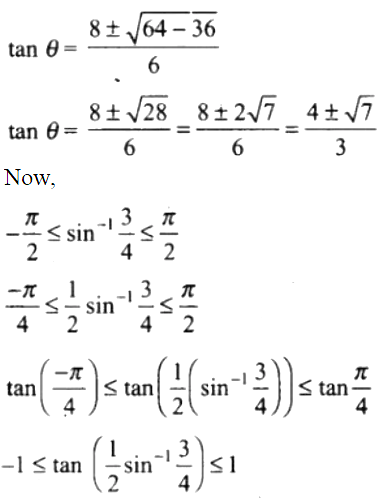
Let ½ sin-1 ¾ = θ ⇒ sin-1 ¾ = 2θ ⇒ sin 2θ = ¾
2 tan θ/ 1 + tan2 θ = ¾
3 tan2 θ – 8 tan θ + 3 = 0

Hence,

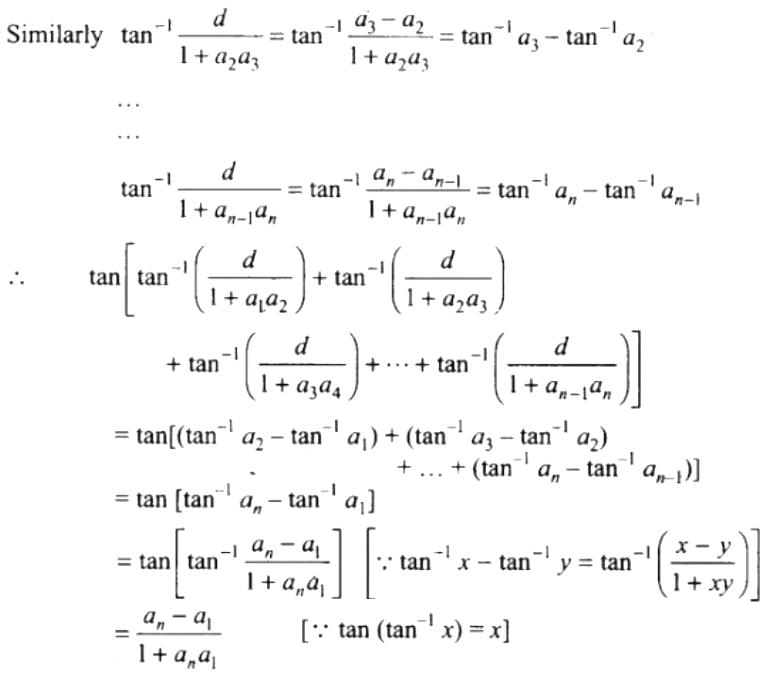
If a1, a2, a3, …., an is an arithmetic progression with common difference d, then evaluate the following expression.

As a1, a2, a3, …., an is an arithmetic progression with common difference d.
d = a2 – a1 = a3 – a2 = a4 – a3 = …… = an – an-1
So,


Which of the following is the principal value branch of cos-1 x?
(a) [-π/2, π/2] (b) (0, π) (c) [0. π] (d) [0, π] – {π/2}
(c) [0. π]
As we know that the principal value branch cos-1 x is [0, π].