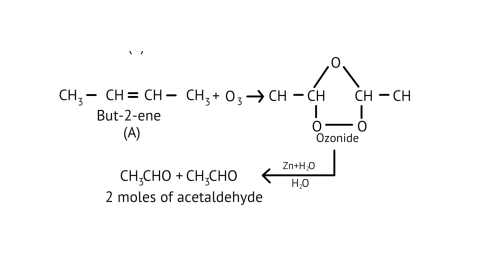
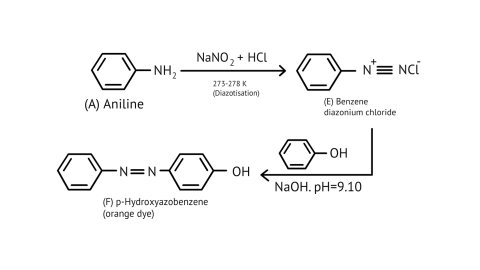
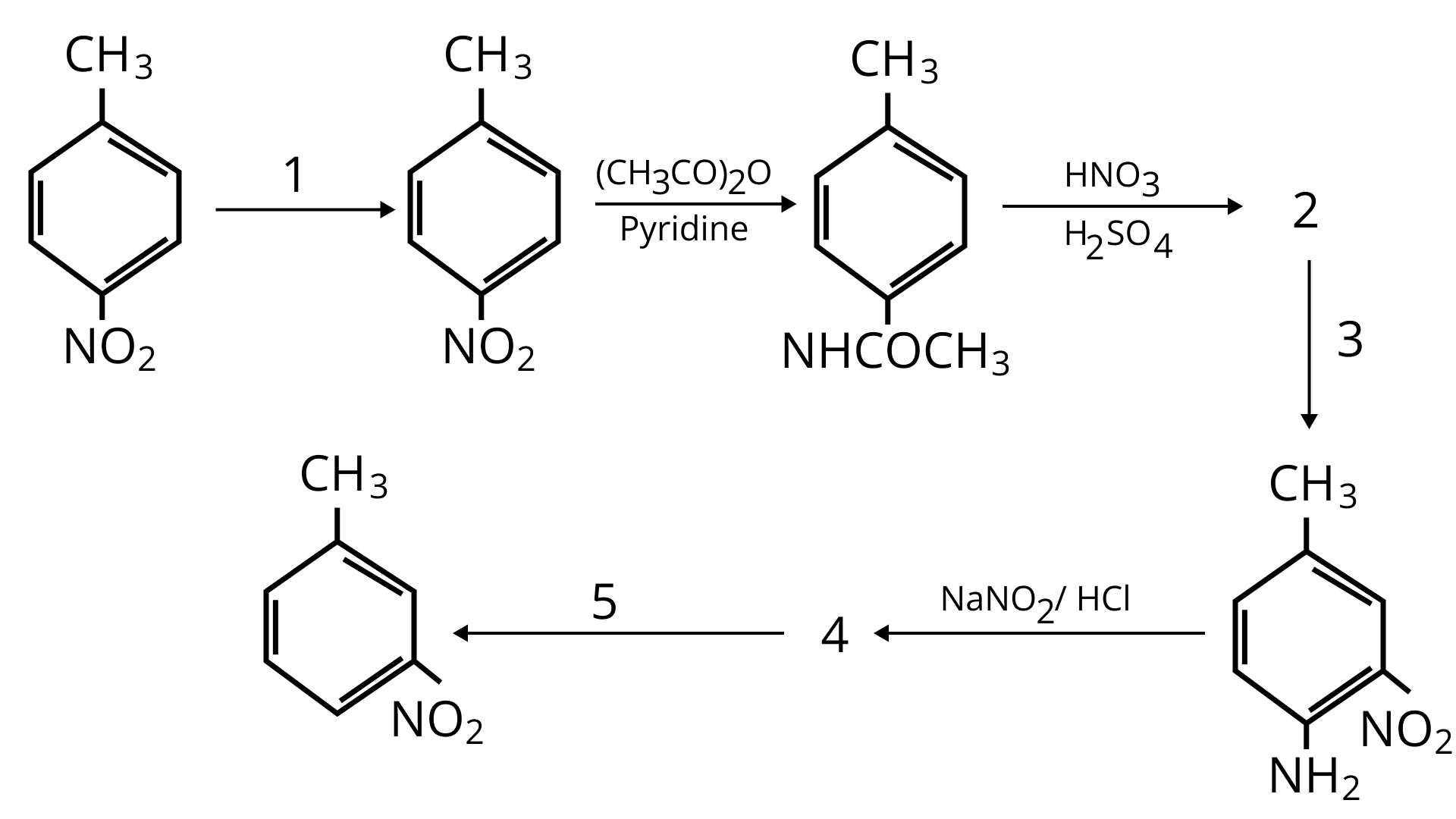
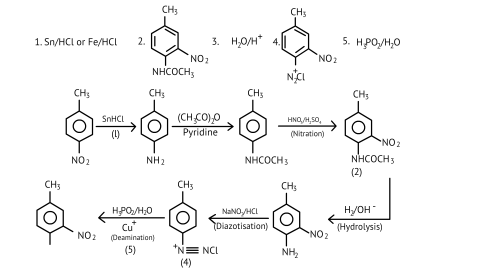
A hydrocarbon ' $\mathrm{A}$ ', $\left(\mathrm{C}_{4} \mathrm{H}_{8}\right)$ on reaction with $\mathrm{HCl}$ gives a compound ' $\mathrm{B}$ ' $\left(\mathrm{C}_{4} \mathrm{H}_{9} \mathrm{Cl}\right)$, which on reaction with $1 \mathrm{~mol}$ of $\mathrm{NH}_{3}$ gives compound ' $\mathrm{C}$ ', $\left(\mathrm{C}_{4} \mathrm{H}_{11} \mathrm{~N}\right) .$ On reacting with $\mathrm{NaNO}_{2}$ and $\mathrm{HCl}$ followed by treatment with water, compound ' $\mathrm{C}$ ' yields an optically active alcohol, ' $D$ '. Ozonolysis of ' $A$ ' gives 2 moles of acetaldehyde. Identify compounds 'A' to 'D'. Explain the reactions involved.
Show solutionHide solution
Ans:
$\underset{\text { (A) }}{\mathrm{C}_{4} \mathrm{H}_{8}} \stackrel{\mathrm{HCl}}{\longrightarrow} \underset{\text { (B) }}{\mathrm{C}_{4} \mathrm{H}_{9} \mathrm{Cl}} \stackrel{\mathrm{NH}_{3}}{\longrightarrow} \underset{\text { (C) }}{\mathrm{C}_{4} \mathrm{H}_{1,} \mathrm{~N} \text { or } \mathrm{C}_{4} \mathrm{H}_{9} \mathrm{NH}_{2}}$(ii)
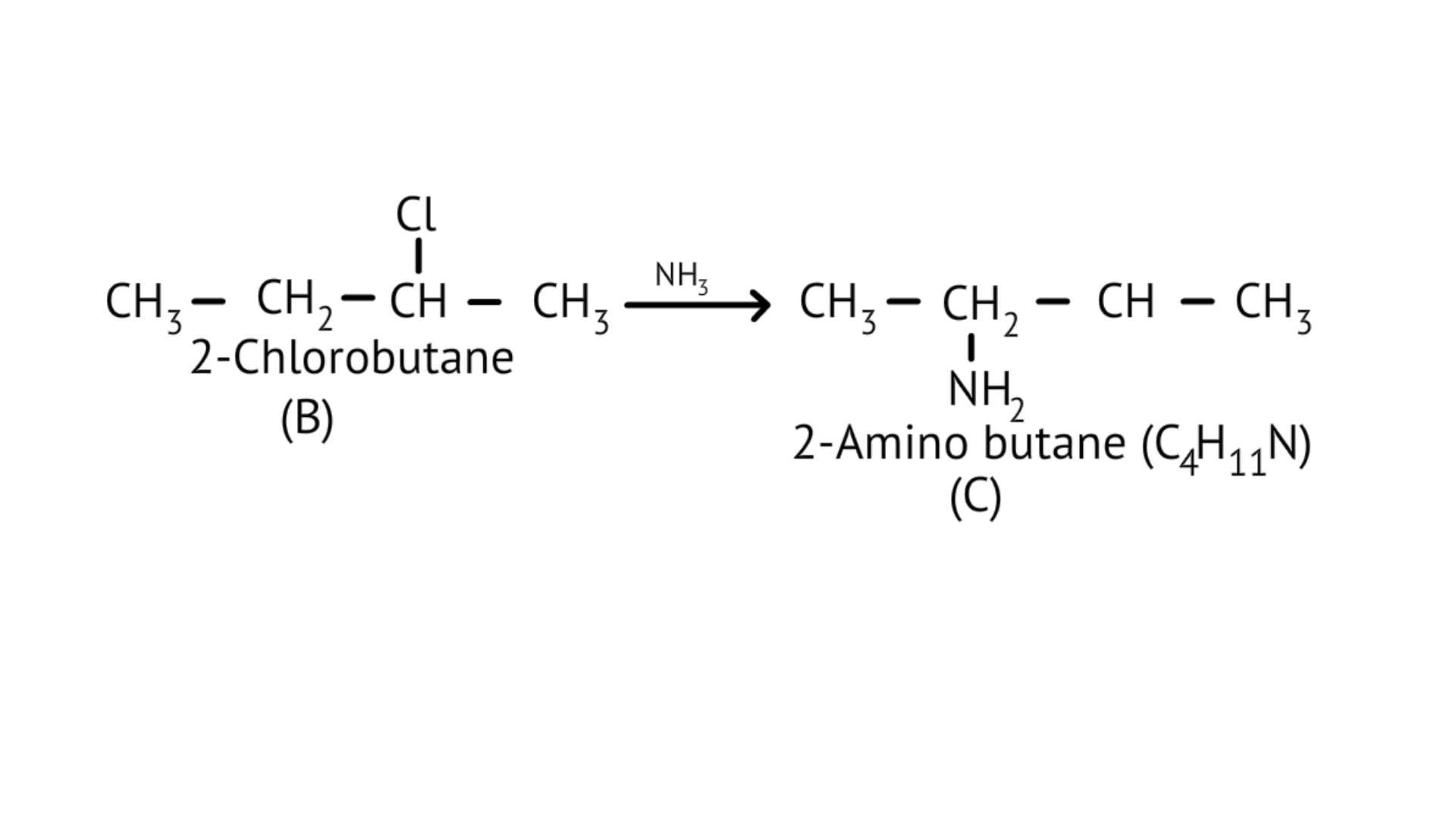
(iii)
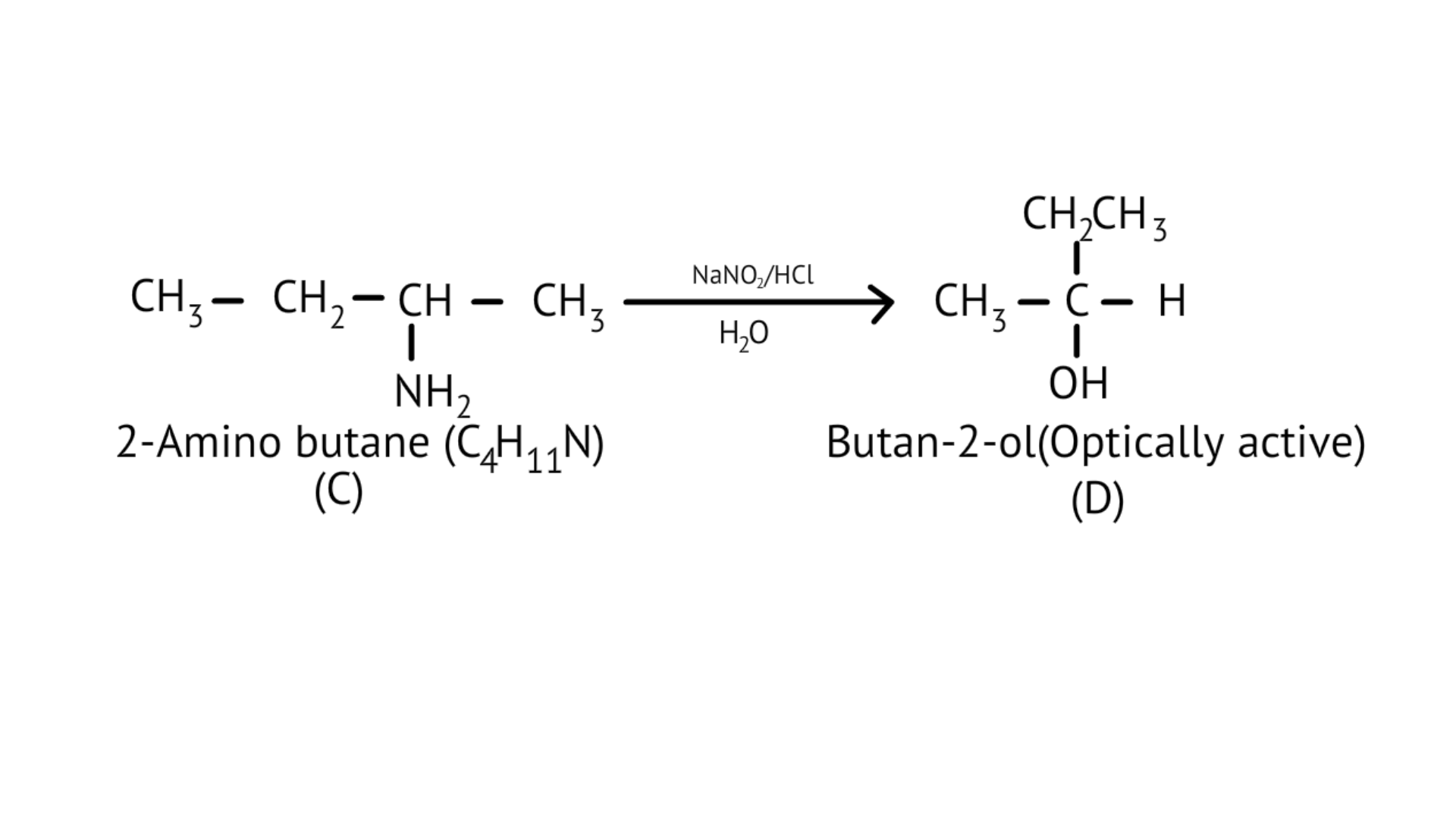
(iii)