My Cart
Your Cart 0

    Your cart is empty.

  • Total (Amount) ₹0.00
NCERT Exemplar · Class 12 · Chemistry

Chapter 13: Amines

Practice each question, then open the answer or worked solution.

Short Answer Questions

37 questions
Q38Written answer

Which is the role of $\mathrm{HNO}_{3}$ in the nitrating mixture used for nitration of benzene?

Show solutionHide solution
Worked solution

Ans:

In the nitrating mixture of conc. $\mathrm{H}_{2} \mathrm{SO}_{4}+$ conc. $\mathrm{HNO}_{3}, \mathrm{HNO}_{3}$ act as base to generate the nitronium ion which is an initiation species for the nitration reaction.

$\mathrm{HNO}_{3}+\mathrm{H}_{2} \mathrm{SO}_{4} \longrightarrow \underset{\text { Electrophile }}{\mathrm{NO}_{2}^{+}}+\underset{4}{\mathrm{HSO}_{4}^{-}}+\mathrm{H}_{2} \mathrm{O}$



Q39Written answer

Why is $-\mathrm{NH}_{2}$ group of aniline acetylated before carrying out nitration?

Show solutionHide solution
Worked solution

Ans:

As $-\mathrm{NH}_{2}$ is a strong activating group, the aniline will readily undergo electrophilic substitution reaction, and it is difficult to cease reaction at the mono substitution stage. So, direct acetylation of aniline is not possible as it undergoes oxidation. 

Therefore, the activating group $-\mathrm{NH}_{2}$ is protected by an acetylation process and then followed by the nitration reaction to obtain a monosubstituted nitrated product. 

The acetylated complex formed utilises the lone pair of nitrogen and is less available for donation, this helps to carry out the nitration reaction easily. 


seo images


Q40Written answer

What is the product when $\mathrm{C}_{6} \mathrm{H}_{5} \mathrm{CH}_{2} \mathrm{NH}_{2}$ reacts with $\mathrm{HNO}_{2}$ ?

Show solutionHide solution
Worked solution

Ans: When Benzyl amine is treated with nitrous acid, firstly BDC is formed which is unstable and decomposes to Benzyl alcohol. 

$\underset{\text { Benzyl amine }}{\mathrm{C}_{6} \mathrm{H}_{5} \mathrm{CH}_{2} \mathrm{NH}_{2}}+\mathrm{HONO} \stackrel{\mathrm{HCl}}{\longrightarrow} \underset{\text { Benzyl alcohol }}{\longrightarrow} \underset{6}{\mathrm{H}_{5} \mathrm{CH}_{2} \mathrm{OH}}+\mathrm{N}_{2}+\mathrm{H}_{2} \mathrm{O}$


Q41Written answer

What is the best reagent to convert nitrile to primary amine?

Show solutionHide solution
Worked solution

Ans: On treatment of nitriles with strong reducing agents such as lithium aluminium hydride in ether or sodium metal in alcohol, primary amines are obtained. 

$\underset{\text { Alkyl nitrile }}{R-\cdots} \mathrm{CN}+4[\mathrm{H}] \frac{\mathrm{Na} / \mathrm{C}_{2} \mathrm{H}_{5} \mathrm{OH}}{\text { or } \mathrm{Li} \mathrm{Ah}_{4} / \mathrm{ether}} \longrightarrow R-\mathrm{Cl}_{2} \mathrm{NH}_{2}$


Q42Written answer

Give the structure of ‘A’ in the following reaction.


seo images


Show solutionHide solution
Worked solution

Ans:


seo images


seo images


Q43Written answer

What is Hinsberg reagent?

Show solutionHide solution
Worked solution

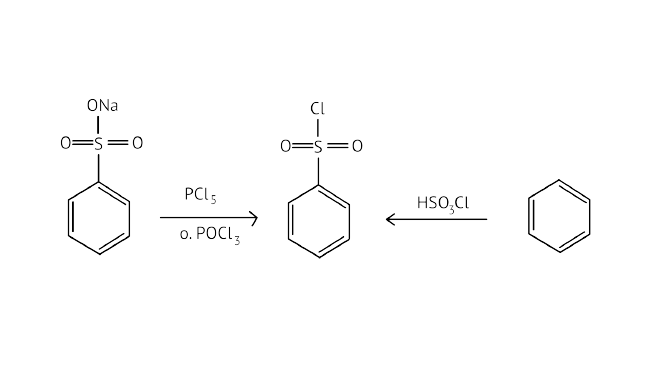
Ans: Hinsberg's reagent is also known as benzenesulphonyl chloride ($\mathrm{C}_{6} \mathrm{H}_{5} \mathrm{SO}_{2} \mathrm{Cl}$). When it reacts with primary and secondary amines, it produces sulphonamides. Allowing secondary and tertiary amines to react with Hinsberg's reagent allows them to be distinguished (benzenesulphonyl chloride $\mathrm{C}_{6} \mathrm{H}_{5} \mathrm{SO}_{2} \mathrm{Cl}$). Secondary amines react with Hinsberg's reagent to form an alkali-insoluble product. N, N-diethylamine, for example, reacts with Hinsberg's reagent to form N,N-diethylbenzenesulphonamide, which is insoluble in alkalis. Tertiary amines, on the other hand, are unaffected by Hinsberg's reagent.


seo images


Q44Written answer

Why is benzene diazonium chloride not stored and is used immediately after its preparation?

Show solutionHide solution
Worked solution

Ans: The reaction of aniline with nitrous acid at 273-278 K produces benzene diazonium chloride. The reaction of sodium nitrite with hydrochloric acid produces nitrous acid in the reaction mixture. Diazotisation is the process of converting primary aromatic amines into diazonium salts. Because of its instability, the diazonium salt is generally not stored or used immediately after preparation.

The crystalline solid benzene diazonium chloride is colorless.

It is easily soluble in water and stable at room temperature, but it reacts with water when warmed.

In the dry state, it decomposes easily.


Q45Written answer

Why does acetylation of $-\mathrm{NH}_{2}$ group of aniline reduce its activating effect?

Show solutionHide solution
Worked solution

Ans: As $-\mathrm{NH}_{2}$ is a strong activating group, the aniline will readily undergo electrophilic substitution reaction, and it is difficult to cease reaction at the mono substitution stage. 

Therefore, the activating group $-\mathrm{NH}_{2}$ is protected by an acetylation process.

The acetylated complex formed utilizes the lone pair of nitrogen and are less available for donation, this helps to carry out the nitration reaction easily. 


Q46Written answer

Explain why is $\mathrm{MeNH}_{2}$ stronger base than $\mathrm{MeOH}$?

Show solutionHide solution
Worked solution

Ans: As the electronegativity of oxygen is more than the electronegativity of a nitrogen atom, the $\mathrm{O}-\mathrm{H}$ bond is more polar than the $\mathrm{N}-\mathrm{H}$ bond, therefore $\mathrm{MeOH}$ is stronger acid than $\mathrm{MeNH}_{2}$ or $\mathrm{MeNH}_{2} 2$ is stronger base than $\mathrm{MeOH}$.


Q47Written answer

What is the role of pyridine in the acylation reaction of amines?

Show solutionHide solution
Worked solution

Ans: Amides are the byproducts of the acylation reaction. The reaction is carried out in the presence of a stronger base than the amine, such as pyridine, which removes the formed HCl and shifts the equilibrium to the right.