Q58Written answer
Identify A and B in the following reaction.

Show solutionHide solution
Worked solution
Ans:

Your cart is empty.
Practice each question, then open the answer or worked solution.
Identify A and B in the following reaction.
Ans:
How will you carry out the following conversions?
(i) toluene $\rightarrow$ p-toluidine
(ii) p-toluidine diazonium chloride $\rightarrow$ p-toluic acid
Ans:

Ans:

Write following conversions:
(i) nitrobenzene $\rightarrow$ acetanilide
(ii) acetanilide $\rightarrow$ p-nitroaniline
Ans:
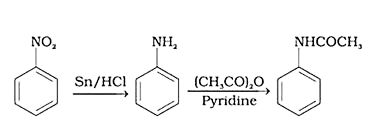
Ans:

A solution contains 1 g mol each of p-toluene diazonium chloride and p-nitrophenyl diazonium chloride. To this 1 g mol of alkaline solution of phenol is added. Predict the major product. Explain your answer.
Ans:
This is an example of an electrophilic aromatic substitution reaction. phenol generates phenoxide ion in alkaline medium, which is more electron-rich than phenol and thus more reactive to electrophilic attack. In this reaction, the electrophile is an aryldiazonium cation.
The faster the reaction, the stronger the electrophile.
The cation p-nitrophenyldiazonium is a stronger electrophile than the cation p-toluene diazonium.
As a result, it preferentially couples with phenol.

How will you bring out the following conversion?

Ans:


How will you carry out the following conversion?

Ans:

How will you carry out the following conversion?

Ans:

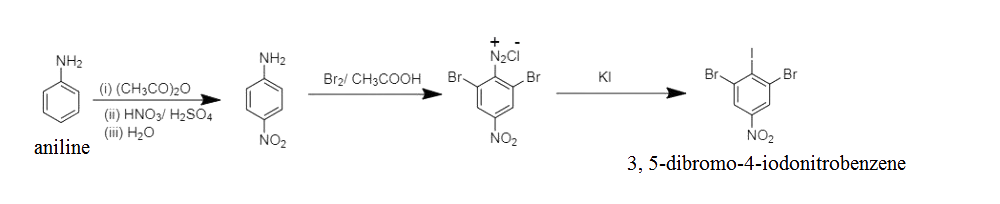
How will you carry out the following conversion?
(i)

(ii)

Ans:

Ans:
Match the reactions given in Column I with the statements given in Column II.
Column I | Column II |
(i) Ammonolysis | (a) Amine wth lesser number of carbon atoms |
(ii)Gabriel phthalimide synthesis | (B) Detection test for primary amines. |
(iii) Hoffmann Bromide reaction | (c) Reaction of phthalimide with KOH and R-X |
(iv) Carbylamine reaction | (d) Reaction of aljylhalides with $\mathrm{NH}_{3}$ |
Ans: (i)-(d), (ii)-(c), (iii)-(a), (iv)-(B)
Ammonolysis: $\mathrm{R}-\mathrm{X}+\mathrm{NH}_{3} \rightarrow \mathrm{RNH}_{2}+\mathrm{HCl}$
Carbylamine reaction:

Hoffmann bromamide reaction:
$\left(\mathrm{C}_{6} \mathrm{H}_{5}\right)\left(\mathrm{CH}_{3}\right) \mathrm{CH}-\mathrm{CONH}_{2} \frac{\mathrm{Br} 2 / \mathrm{NaOH}}{\underset{\text { reaction }}{\text { Hoffmannmbromamide }}}\left(\mathrm{C}_{6} \mathrm{H}_{5}\right)\left(\mathrm{CH}_{3}\right) \mathrm{CH}-\mathrm{NH}_{2}$
Match the compounds given in Column I with the items given in Column II.
Column I | Column II |
(i) Benzene sulphonyl chloride | (a) Zwitter ion |
(ii) Sulphanilic acid | (B) Hinsberg reagent |
(iii) Alkyl diazonium salts | (c) Dyes |
(iv) Aryl diazonium salts | (d) Conversion to alcohols |
Ans:
Column I | Column II |
(i) Benzene sulphonyl chloride | (B) Hinsberg reagent |
(ii) Sulphanilic acid | (a) Zwitter ion |
(iii) Alkyl diazonium salts | (d) Conversion to alcohols |
(iv) Aryl diazonium salts | (c) Dyes |
In the following questions, a statement of Assertion (A) followed by a statement of Reason (R) is given. Choose the correct answer out of the following choices:
(a) Both Assertion and Reason are wrong.
(B) Both Assertion and Reason are correct but Reason is not the correct explanation of Assertion.
(c) Assertion is correct but Reason is wrong.
(d) Both Assertion and Reason are correct and Reason is the correct explanation of Assertion.
(e) Assertion is wrong but Reason is correct.