My Cart
Your Cart 0

    Your cart is empty.

  • Total (Amount) ₹0.00
NCERT Exemplar · Class 12 · Biology

Chapter 3: Human Reproduction

Practice each question, then open the answer or worked solution.

Short Answer Questions

10 questions
Q1Written answer

A human female experiences two major changes, menarche and menopause during her life. Mention the significance of both the events.

Show solutionHide solution
Worked solution

Ans: In a human female, the two major changes menarche and menopause are both related to the menstrual cycle of the female. While menarche represents the onset of menstruation, occurring when a female acquires puberty and gets her first menses, the menopause is an event marking the cessation of menstrual cycle. Generally, menarche occurs around 9-15 years of age and begins the age of reproductive activeness in the female i.e., the female is now a woman of reproductive age under government regulations. On the other hand, menopause occurs at around 45-55 years of age when the woman stops having menses and the bleeding stops. From here on, the female cannot give birth to a child through natural means. The eggs are deteriorated or already used up when menopause arrives. 

Q2Written answer

a) How many spermatozoa are formed from one secondary spermatocyte?

b) Where does the first cleavage division of zygote take place?

Show solutionHide solution
Worked solution

Ans: A primary sperm cell first goes through its meiosis or the reduction division to form two identical and haploid cells called secondary spermatocytes with a ploidy of n=23 chromosomes each.  This secondary spermatocyte then undergoes a second meiosis to give rise to four identical and haploid sperm cells (n). Each of these four sperm cells differentiate to produce spermatozoa.


Ans: First division or cleavage which is a mitotic division in a zygote begins approximately 30 hours after fertilization has occurred. It is seen when the zygote moves through the isthmus of the oviduct towards the uterus for implantation.


Q3Written answer

Corpus luteum in pregnancy has a long life. However, if fertilization does not take place, it remains active only for 10-12 days. Explain.

Show solutionHide solution
Worked solution

Ans: Corpus luteum is a yellowish mass formed by the leftover graafian follicle after ovulation has occurred in the ovary and the secondary oocyte released. This corpus luteum secretes progesterone in very high quantities which is used to maintain the uterine endometrial lining as the thick, glandular lining. In the presence of fertilization, zygote is formed in the oviduct which hence, does not pass out of the uterus, and gets implanted instead. This leads to longer life of corpus luteum as the newly formed zygote cannot produce progesterone on its own and the hormone is required to keep the endometrium healthy for the zygote. This function is satisfied by the persisting corpus luteum.


Q4Written answer

What is fetal ejection reflex? Explain how it leads to parturition?

Show solutionHide solution
Worked solution

Ans: Parturition is the process of delivery of a newborn or a fetus, in simple words but for parturition to occur, many other processes are responsible and help to make a successful childbirth. Fetal ejection reflex is one of those important initial processes which is observed at the time of delivery. It is the initial mild contraction of the uterus which is caused by the placenta after the baby is fully developed in the womb. This reflex leads to release of oxytocin from the maternal pituitary gland which further intensifies the contractions leading to parturition finally.


Q5Written answer

Except for the endocrine function, what are the other functions of placenta?

Show solutionHide solution
Worked solution

Ans: Placenta serves the endocrine function primarily by releasing many hormones, mainly progesterone but placenta has many other non-endocrine functions as well:

  • It acts as a structural and functional connection between the developing embryo and the body of the mother.

  • It supplies nutrition, oxygenated blood, antibodies and various other things to the fetus in the womb.

  • It also helps in taking away the waste products or excretory material from the fetus and removes the waste from the body of embryo including carbon dioxide. 


Q6Written answer

Why do doctors recommend breastfeeding during the initial period of infant growth?

Show solutionHide solution
Worked solution

Ans: Breast milk especially in the first 6 months after birth of a newborn is the exclusive feed that should be provided to the infant. Colostrum produced during the initial few days after delivery of the baby is extremely healthy for the baby and helps in building immunity, providing nutrition and strengthening the newborn. Breast milk has antibodies, required nutrients and various other elements required for an infant. This is the reason a newborn should be given breast milk unless otherwise advised by a medical professional.


Q7Written answer

What are the events that take place in the ovary and uterus during the follicular phase of the menstrual cycle?

Show solutionHide solution
Worked solution

Ans: There are a number of events that occur in the ovaries and uterus during the follicular phase of the menstrual cycle:

(a) One of the many primary follicles lying in the ovary develops to become a fully mature Graafian follicle.

(b) Endometrium in the uterus is proliferated, thick and glandular to receive a zygote in case fertilization occurs.

(c) Growing follicles when developing and undergoing maturation during the follicular phase produce a lot of estrogen which peak right before the middle of the cycle when it leads to LH and FSH surge which causes ovulation.


Q8Written answer

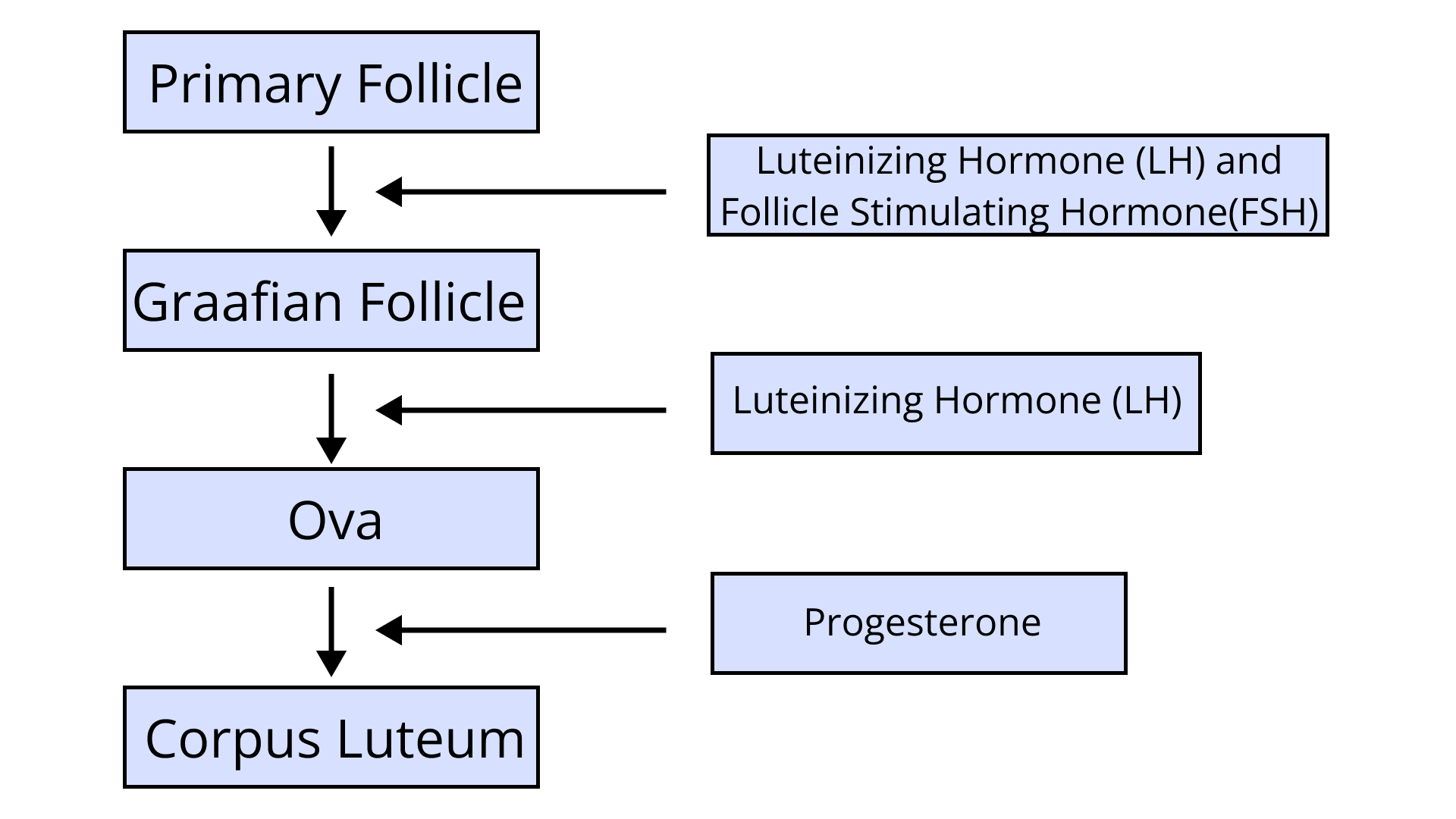
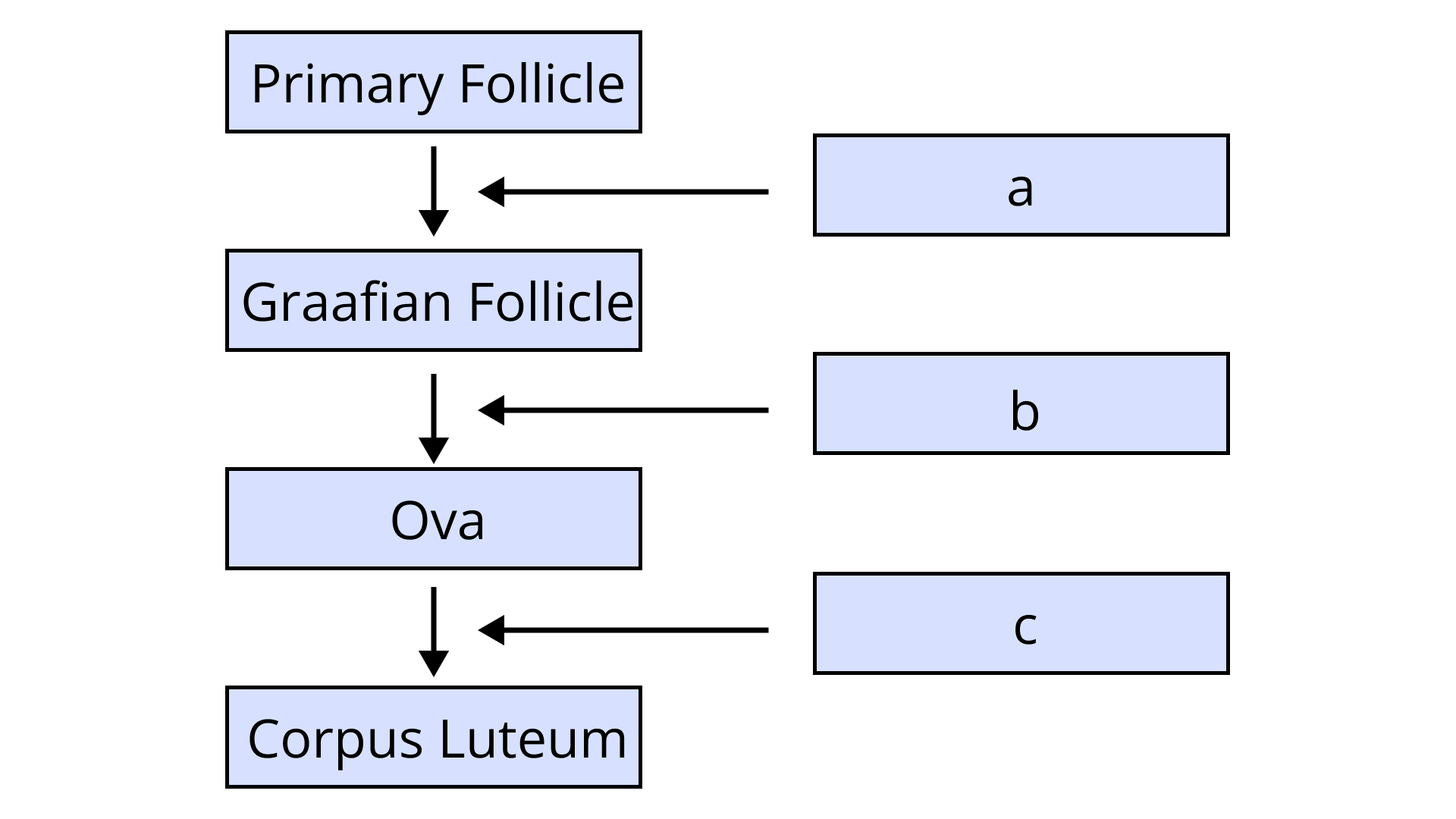
Given below is a flow chart showing ovarian changes during menstrual cycle. Fill in the spaces giving the name of the hormones responsible for the events shown.

seo images
Show solutionHide solution
Worked solution

Ans:

seo images


Q9Written answer

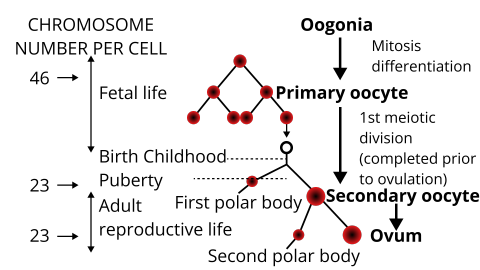
Give a schematic labelled diagram to represent oogenesis (without descriptions)

Show solutionHide solution
Worked solution

Ans:

seo images


Q10Written answer

What are the changes in the oogonia during the transition of a primary follicle to Graafian follicle?

Show solutionHide solution
Worked solution

Ans: Various changes occur in the oogonia as they transition from a primary follicle into a mature graafian follicle containing secondary oocyte:

(a) Each of the primary oocytes is surrounded by a single layer of granulosa cells called theca and this is known as the primary follicle.

(b) This primary follicle becomes surrounded by another layer of granulosa cells and a new theca if formed making it the secondary follicle.

(c) Secondary follicles soon develop to form the tertiary follicle which is characterized by a fluid-filled cavity; the antrum.  At this stage, the primary oocyte inside the follicle undergoes second meiosis to form the secondary oocyte and a small polar body on the periphery.

(d) Tertiary follicle then transforms into a mature Graafian follicle during this phase.  A new layer called the zona pellucida can then be seen surrounding the newly formed secondary oocyte.