My Cart
Your Cart 0

    Your cart is empty.

  • Total (Amount) ₹0.00
NCERT Exemplar · Class 12 · Biology

Chapter 1: Reproduction in Organisms

Practice each question, then open the answer or worked solution.

Long Answer Questions

6 questions
Q1Written answer

Enumerate the differences between asexual and sexual reproduction.

Show solutionHide solution
Worked solution

Ans: 

Asexual reproduction

Sexual reproduction

1. A single parent is involved in this kind of reproduction.

1. Two parents of opposite sex are involved in this kind of reproduction.

2. Gamete’s production does not occur.

2. Gamete’s production occurs.

3. Reductional division or meiosis does not occur.

3. Reductional division or meiosis occurs.

4. Fusion of gametes is not there.

4. Fusion of gametes is there.

5. It is the less efficient method of reproduction.

5.It is the most efficient method of reproduction.


Q2Written answer

Describe the types of asexual reproduction exhibited by unicellular organisms?

Show solutionHide solution
Worked solution

Ans: Asexual reproduction is the kind of reproduction which does not involves the fusion of gametes. This type of reproduction involves only one parent & the offspring is the exact copy of them. There are different types of asexual reproduction in unicellular organisms such as-:

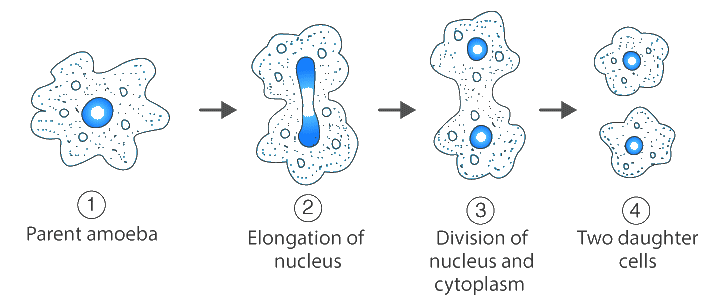
1. Binary fission-: In this kind of reproduction the parental cell divides into two daughter cells that can act as the individual organism in future. The example includes Amoeba.


seo images


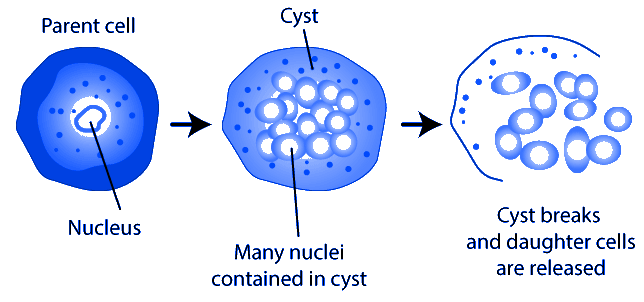
2. Multiple fission-: In this kind of reproduction the parent cell's nucleus divides into multiple nuclei & forms the cyst around the mother cell. The cyst helps the mother cell to survive in unfavorable conditions & as soon as the favorable conditions arrives the cyst degenerates & each nuclei acts as the daughter individual. The example includes Plasmodium.


seo images


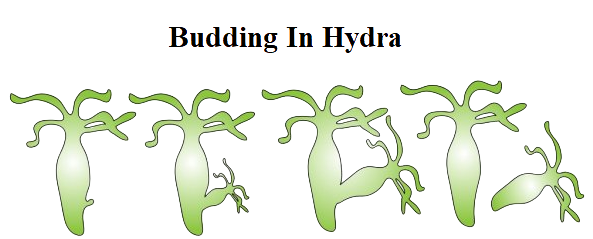
3. Budding-: In this reproduction a bud is developed on the parental cell surface. As the time passes the bud grows in size & ultimately detached from the parental body that acts as the new individual in the upcoming future.


seo images


Q3Written answer

Do all the gametes formed from a parent organism have the same genetic composition (identical DNA copies of the parental genome)? Analyze the situation with the background of gametogenesis and provide or give suitable explanation.

Show solutionHide solution
Worked solution

Ans: No, all the gametes formed from a parent organism does have the same genetic composition. This is because sexual reproduction involves the fusion of gametes that comes either from two different individuals of opposite sexes or the same individual provided with both the sexes. The process of formation of gametes is called gametogenesis.

1. The haploid parents such as Monera, fungi, algae and bryophytes produce gametes by mitotic division. The gametes, despite being formed from a single parent, do not have the same genetic composition due to error in DNA copying or mutation. 

2. In diploid organisms like pteridophytes, gymnosperms, angiosperms and most of the animals including human beings produce gametes by meiosis. Each individual has a 50% genome contribution from both the parents. During meiosis the no. of chromosomes become half (haploid) in the gametes, so there is random distribution  of chromosomes so that each gametes receives a  unique combination of chromosomes from the parent. In addition, crossing over in meiosis results in exchange of genetic material between the homologous chromosomes and creates recombined chromosomes that are not found in the parents.


Q4Written answer

Although sexual reproduction is a long drawn, energy-intensive complex form of reproduction, many groups of organisms in Kingdom Animalia and Plantae prefer this mode of reproduction. Give at least three reasons for this.

Show solutionHide solution
Worked solution

Ans: Sexual reproduction is the process of reproduction which involves the fusion of gametes that comes either  from two different individuals of opposite sexes or the same individual provided with both the sexes. Most of the animals specially the higher animals prefer sexual mode of reproduction because-:

1. Sexual reproduction contributes to the variation in the gene pool thus ensures the survival of fittest.

2. The offspring that are produced by this method contain the characteristics of both the parents. In most of the cases the offspring is superior to the parental generation in terms of adaptation & survival.

3. The chances of survival in this kind of reproduction is more because of the presence of variations that acts as the source of evolution.


Q5Written answer

Differentiate between & site an example for each type.

(a) Oestrus and Menstrual cycles 

(b) Oviparity and Vivipary

Show solutionHide solution
Worked solution

Ans:

Oestrus cycle

Menstrual cycle

1. Females show irresistible sexual urges.

1. Females do not show irresistible sexual urges.

2. Bleeding does not occur in this case.

2. Bleeding occurs in this case.

3. This cycle is comparatively simpler in nature.

3. This cycle is very complex in nature and consists of various stages such as menstrual phase, proliferative phase & secretory phase.

4. It occurs in cows, pigs, sheep etc.

4. It occurs in monkeys, apes & humans.

Ans:

Oviparity

Viviparity

1. In this mode an animal lays eggs.

1. In this mode an animal gives birth to young ones.

2. The eggs are protected by a hard calcareous shell.

2. The eggs are not protected by a hard calcareous shell.

3. In this mode the development of offspring occurs outside the female body.

3. In this mode the development of offspring occurs inside the female body.

4. The chances of survival are less in this mode.

4. The chances of survival are more in this mode.

5. The example includes birds & most of the reptiles.

5. The example includes mostly mammals except few like monotremes egg laying mammals.


Q6Written answer

Rose plants produce large, attractive bisexual flowers but they seldom produce fruits. On the other hand, a tomato plant produces plenty of fruits though they have small flowers. Analyse the reasons for failure of fruit formation in rose. Both these plants - rose and tomato - both selected by human beings for different characteristics, the rose for its flower and tomato for its fruit. Roses, being vegetatively propagated, do not need to produce seeds.

Show solutionHide solution
Worked solution

Ans: Rose plants produce large, attractive bisexual flowers, but they seldom produce fruits. The reasons for failure of fruit formation in rose can be-:

(i) They may not produce viable pollen, hence, fertilization can’t take place.

(ii) They may have non-functional eggs.

(iii) They may have defective and non-functional ovules, which act as the female gametophyte generator.

(iv) They may be genetically self-incompatible that fails them to produce seed.

(v) Internal barrier which restricts the pollen tube growth or fertilization.

Therefore, due to its distinct characteristics in flower and fruit formation ability, humans select rose plants for flower and propagate by vegetative methods. On the other hand, tomatoes are selected to utilize the fruits as vegetables and propagated by seeds only.

Importance of NCERT Class 12 Biology Chapter 1- Reproduction in Organisms

In the present time, we frequently get to see Class 12 students that are stressed about their future and to take on great universities. For CBSE board assessment as well they need to beat in the different competitions like NEET and AIIMS.


Concepts that are involved in the NCERT Exemplar for Class 12 Biology Chapter 1 - Reproduction in Organism:


The important concepts that are involved in the NCERT Exemplar for Class 12 Biology Chapter 1 - Reproduction in Organism can be provided as follows:


  • Sexual Reproduction: Sexual reproduction is a type of reproduction that involves the combination of male and female gametes. These gametes are formed by two individual organisms of opposite sex and are then fused together in order to form the zygote. This type of reproduction is considered to be slower than that of the asexual reproduction. 

  • Asexual Reproduction: This is the type of reprodcution where even a single organism can give rise to another offspring. These organisms are not so different from their parents and are hence identical to each other. Cloning is only possible in this type of reproduction. This is a faster process than the sexual reproduction.