My Cart
Your Cart 0

    Your cart is empty.

  • Total (Amount) ₹0.00
NCERT Exemplar · Class 12 · Biology

Chapter 1: Reproduction in Organisms

Practice each question, then open the answer or worked solution.

Very Short Answer Questions

15 questions
Q1Written answer

Mention two inherent characteristics of Amoeba and yeast that enable them to reproduce asexually.

Show solutionHide solution
Worked solution

Ans: Inherent characteristics of Amoeba and yeast that enable them to reproduce asexually are-:

1. They are unicellular in nature.

2. They are provided with simple body organization.

Q2Written answer

Why do we refer to offspring formed by asexual method of reproduction as clones?

Show solutionHide solution
Worked solution

Ans: Clone is defined as the photocopy of anything or any individual.

Asexual reproduction is the kind of reproduction which does not involves the fusion of gametes. In this kind of reproduction only one parent is involved. There is no event of variation or the crossing-over that creates the differences among the offsprings. Hence, offsprings formed by asexual reproduction referred as clones.


Q3Written answer

Although potato tuber is an underground part, it is considered as a stem. Give two reasons.

Show solutionHide solution
Worked solution

Ans: Although potato tuber is an underground part but still it is considered as a stem because-: 

1. Presence of nodes (eyes).

2. Presence of scaly leaves.


Q4Written answer

Between an annual and a perennial plant, which one has a shorter juvenile phase? Give one reason.

Show solutionHide solution
Worked solution

Ans: Perineal plants are those that regrow every season while annual plants are those that grow for one season only & then die off. The annual plant has to complete their life cycle in the single season hence, annual plants have a shorter juvenile phase in comparison to perennial plants.


Q5Written answer

Rearrange the following events of sexual reproduction in the sequence in which they occur in a flowering plant:

embryogenesis, fertilization, gametogenesis, pollination.

Show solutionHide solution
Worked solution

Ans: The correct sequence of the events in flowering plants are-:

Gametogenesis→ Pollination→ Fertilization→ Embryogenesis

Gametogenesis-: It is the event which involves the formation of gametes.

Pollination-: It is the event which involves the dispersal of pollens (male gametes).

Fertilization-: It is defined as the fusion of gametes.

Embryogenesis-: It is defined as the development of an embryo.


Q6Written answer

The probability of fruit set in a self-pollinated bisexual flower of a plant is far greater than a dioecious plant. Explain.

Show solutionHide solution
Worked solution

Ans: This is because in the case of a self-pollinated flower a plant does not depend upon pollinating agents to carry out the process of pollination while a dioecious depends upon pollinating agents that may be some time not available.


Q7Written answer

Is the presence of large number of chromosomes in an organism a hindrance to sexual reproduction? Justify your answer by giving suitable reasons.

Show solutionHide solution
Worked solution

Ans: No, this is not true. The no. of chromosomes never decides the mode of reproduction. For example, there are 8 chromosomes in the somatic cells of fruit fly while there are 360 chromosomes in case of butterflies, but both the organisms reproduce by the sexual mode only.


Q8Written answer

Is there a relationship between the size of an organism and its life span? Give two examples in support of your answer.

Show solutionHide solution
Worked solution

Ans: No, there is no relationship between the size of an organism and its life span. This thing can be clear by following table-:

Name of Plant

Life span

Name of animal

Life span

Banyan tree

200-300 yrs.

Elephant

70 yrs.

Peepal

2000-3000yrs.

Giant Tortoise

152 yrs.

Both banyan tree & peepal tree are approximately the same in size, still there is the huge difference between their life span similarly there is the huge difference in the size of elephant & tortoise but if we observe carefully the life span of tortoise is much longer than the elephant.


Q9Written answer

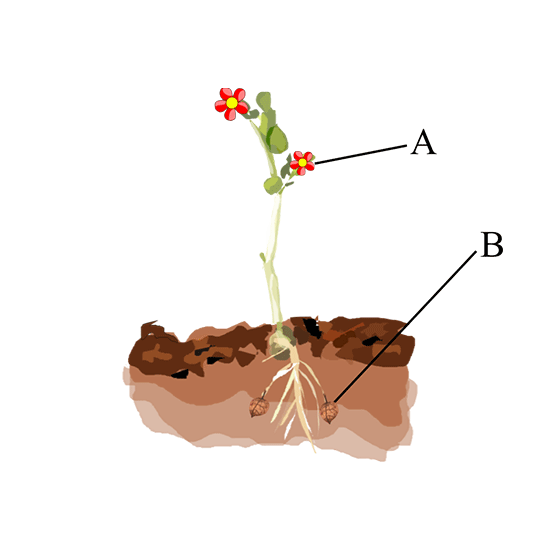
In the figure given below the plant bears two different types of flowers marked ‘A’ and ‘B’. Identify the types of flowers and state the type of pollination that will occur in them.


seo images


Show solutionHide solution
Worked solution

Ans: ‘A’ represents the chasmogamous flower while ‘B’ represents the cleistogamous flower. 

Chasmogamous flower

Cleistogamous flower.

1.This kind of flowers are open type. Anther & stigma are exposed.

1. These kinds of flowers are closed.

2.This kind of flowers can go either for self-pollination or cross pollination.

2. This kind of flower undergoes self-pollination only.

3.External agencies are required to carry out the process of pollination.

3. No external agencies are required because the flowers are bisexual in nature.


Q10Written answer

Give reasons as to why cell division cannot be a type of reproduction in multicellular organisms.

Show solutionHide solution
Worked solution

Ans: Multicellular organisms are provided with complex body organization. There is the division of labor. One cannot produce the different types of tissues by mitosis only. Hence, cell division cannot be a type of reproduction in multicellular organisms.