Q1Written answer
Prove that
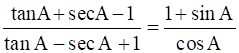
Show solutionHide solution
Worked solution
According to the question,
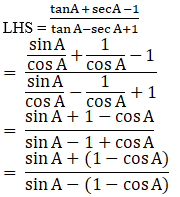
Using the identity,
sin2A + cos2A = 1, we get,
sin A + (1 – cos A).
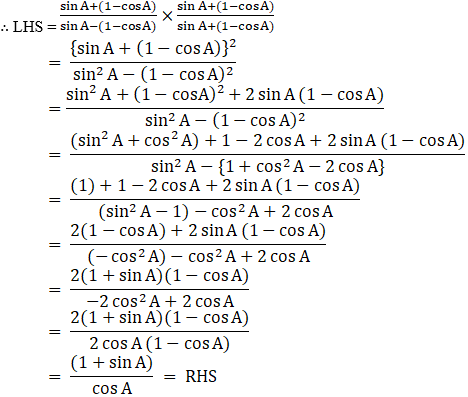
Hence, L.H.S = R.H.S
Your cart is empty.
Practice each question, then open the answer or worked solution.
Prove that
According to the question,
Using the identity,
sin2A + cos2A = 1, we get,
sin A + (1 – cos A).
Hence, L.H.S = R.H.S
If [2sinα / (1+cosα+sinα)] = y, then prove that [(1– cosα+sinα) / (1+sinα)] is also equal to y.

According to the question,
y =2sinα /(1+cosα+sinα)
Multiplying numerator and denominator by (1 – cos α + sin α),
We get,
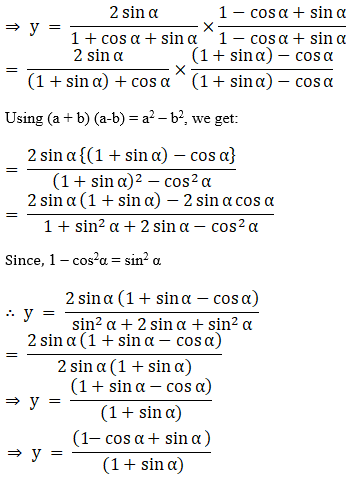
Hence Proved
If m sin θ = n sin (θ + 2α), then prove that
tan (θ + α) cot α = (m + n)/(m – n)
[Hints: Express sin(θ + 2α) / sinθ = m/n and apply componendo and dividend]
According to the question,
m sin θ = n sin (θ + 2α)
To prove:
tan (θ + α)cot α =(m + n)/(m – n)
Proof:
m sin θ = n sin (θ + 2α)
⇒ sin(θ + 2α) / sinθ = m/n
Applying componendo-dividendo rule, we have,
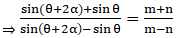
By transformation formula of T-ratios,
We know that,
sin A + sin B = 2 sin ((A+B)/2) cos ((A – B)/2)
And,
sin A – sin B = 2 cos ((A+B)/2) sin ((A – B)/2)
On applying the formula, we get,
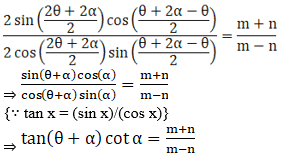
Therefore, tan (θ + α) cot α = (m + n)/(m – n)
Hence Proved
If  where α lie between 0 and π/4, find value of tan 2α
[Hint: Express tan 2α as tan (α + β + α – β]
According to the question,
cos(α + β) = 4/5 …(i)
We know that,
sin x = √(1 – cos2x)
Therefore,
sin (α + β) = √(1 – cos2(α + β))
⇒ sin (α + β) = √(1 – (4/5)2) = 3/5 …(ii)
Also,
sin(α – β) = 5/13 {given} …(iii)
we know that,
cos x = √(1 – sin2x)
Therefore,
cos (α – β) = √(1 – sin2(α – β))
⇒ cos (α – β) = √(1 – (5/13)2) = 12/13 …(iv)
Therefore,
tan 2α = tan (α + β + α – β)
We know that,
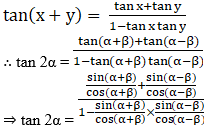
From equation i, ii, iii and iv we have,
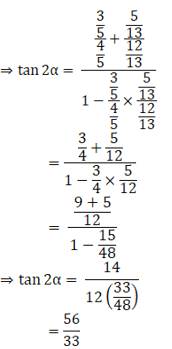
Hence, tan 2α = 56/33
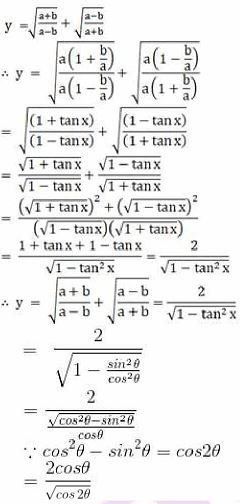
If tanx = b/a then find the value of
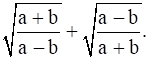
According to the question,
tan x = b/a
Let,
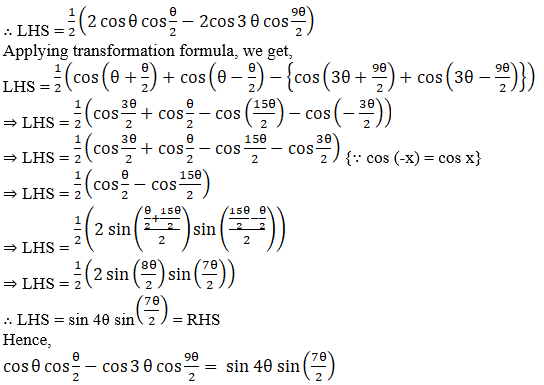
Prove that cos θ cos θ/2 – cos 3θ cos 9θ/2 = sin7θ sin4θ
[Hint: Express L.H.S. = ½ [2cos θcos θ/2 – 2cos 3θ cos 9θ / 2]
Using transformation formula, we get,
2 cos A cos B = cos(A + B) + cos (A – B)
-2 sin A sin B = cos(A + B) – cos (A – B)
Multiplying and dividing the expression by 2.
If a cos θ + b sin θ = m and a sin θ – b cos θ = n, then show that a2 + b2 = m2 + n2.
According to the question,
a cos θ + b sin θ = m …(i)
a sin θ – b cos θ = n …(ii)
Squaring and adding equation 1 and 2, we get,
(a cos θ + b sin θ)2 + (a sin θ – b cos θ)2 = m2 + n2
⇒ a2cos2θ + b2sin2θ + 2ab sin θ cos θ + a2sin2θ + b2cos2θ – 2ab sin θ cos θ = m2 + n2
⇒ a2cos2θ + b2sin2θ + a2sin2θ + b2cos2θ = m2 + n2
⇒ a2(sin2θ + cos2θ) + b2(sin2θ + cos2θ) = m2 + n2
Using, sin2θ + cos2θ = 1,
We get,
⇒ a2 + b2 = m2 + n2
Find the value of tan 22°30’.
[Hint: Let θ = 45°, use 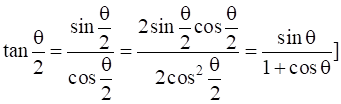
Let, θ = 45°
As we need to find: tan 22°30’ = tan (θ/2)
We know that,
sin θ = cos θ = 1/√2 (for θ = 45°)
Since,
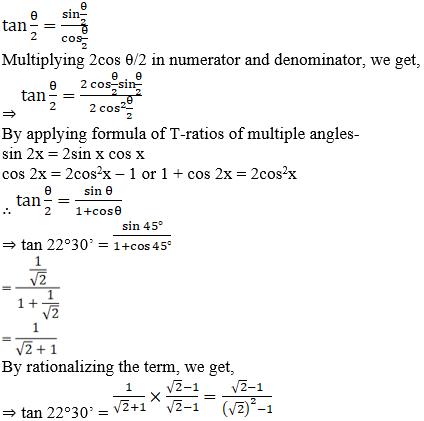
Therefore, tan 22°30’ = √2 – 1
Prove that sin 4A = 4sinA cos3A – 4 cosA sin3A.
sin 4A = sin (2A + 2A)
We know that,
sin(A + B) = sin A cos B + cos A sin B
Therefore, sin 4A = sin 2A cos 2A + cos 2A sin 2A
⇒ sin 4A = 2 sin 2A cos 2A
From T-ratios of multiple angle,
We get,
sin 2A = 2 sin A cos A and cos 2A = cos2A – sin2A
⇒ sin 4A = 2(2 sin A cos A)(cos2A – sin2A)
⇒ sin 4A = 4 sin A cos3A – 4 cos A sin3A
Hence, sin 4A = 4 sin A cos3A – 4 cos A sin3A
If tan θ + sin θ = m and tan θ – sin θ = n, then prove that m2 – n2 = 4 sin θ tan θ
[Hint: m + n = 2tanθ, m – n = 2 sin θ, then use m2 – n2 = (m + n)(m – n)]
According to the question,
tan θ + sin θ = m …(i)
tan θ – sin θ = n …(ii)
Adding equation i and ii,
2 tan θ = m + n …(iii)
Subtracting equation ii from i,
We get,
2sin θ = m – n …(iv)
Multiplying equations (iii) and (iv),
2sin θ (2tan θ) = (m + n)(m – n)
⇒ 4 sin θ tan θ = m2 – n2
Hence,
m2 – n2 = 4 sin θ tan θ