My Cart
Your Cart 0

    Your cart is empty.

  • Total (Amount) ₹0.00
NCERT Exemplar · Class 11 · Biology

Chapter 9: Biomolecules

Practice each question, then open the answer or worked solution.

LONG ANSWER TYPE QUESTIONS

5 questions
Q1Written answer

Formation of the enzyme-substrate complex (ES) is the first step in catalysed reactions. Describe the other steps until the formation of the product.

Show solutionHide solution
Worked solution

1. In the first step, the substrate binds to the active site of the enzyme which fits into the active site

2. The binding of the substrate will help the enzyme to alter its shape and will fit more tightly

3. The active site of the enzyme breaks the chemical bond of the substrate thus forming a new enzyme product

4. The product will be released by the enzymes in the reaction and the free enzyme is ready to bind the substrate of another molecule and once again run through the catalytic cycle.
Q2Written answer

What are the different classes of enzymes? Explain any two with the type of reaction they catalyse.

Show solutionHide solution
Worked solution

There are different classes of enzymes. They are Oxidoreductase, Transferase, Hydrolase, Lysates, Isomerase, ligases.

a) Oxidoreductase:

These are the enzymes which help in simultaneous oxidation and reduction of two substrates.

S reduced + S’reduced → S oxidized + S’ oxidized

b) Hydrolases:

These enzymes facilitate the hydrolysis of a molecule.

Sucrose → Glucose + Fructose

Q3Written answer

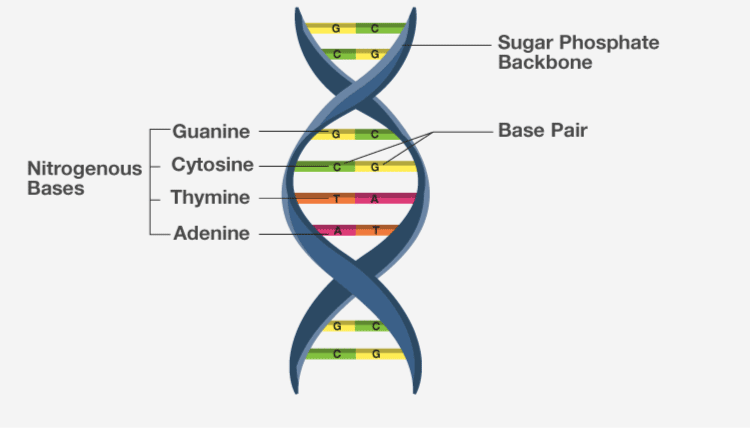
Nucleic acids exhibit secondary structure. Describe through Watson Crick Model.

Show solutionHide solution
Worked solution

DNA is made up of two polypeptide chains, arranged in a double helix. The backbone is of sugar-phosphate while the nitrogenous bases are present on the inner side. These nitrogenous bases pairs to each other by H bonds. This H bond confers for the stability of helix.

NCERT Exemplar Solutions of Class 11 Biology Chapter 9 Biomolecules-3

Q4Written answer

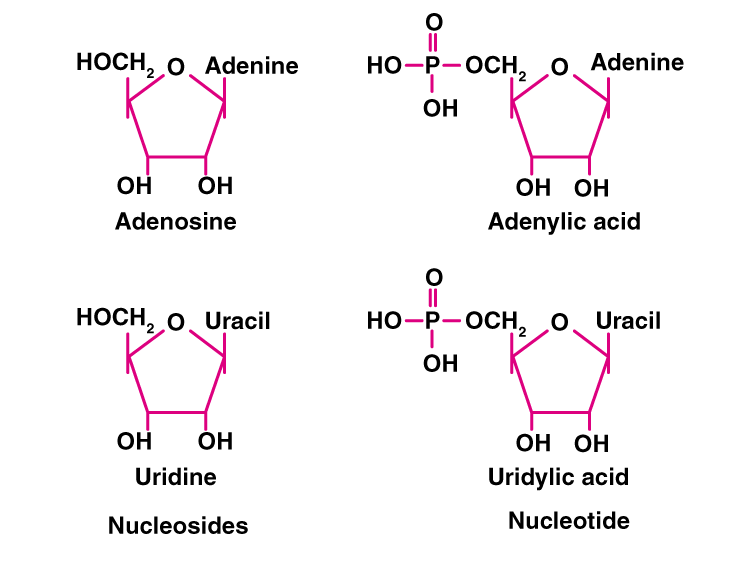
What is the difference between a nucleotide and nucleoside? Give two examples of each with their structure.

Show solutionHide solution
Worked solution

Nucleotides are the monomers of nucleic acid and are formed of nucleoside and phosphate group. Whereas nucleosides are the constituent of nucleotides. Adenosine, guanosine, thymidine, uridine and cytidine are nucleosides. Adenylic acid, thymidylic acid, guanylic acid, uridylic acid and cacodylic acid are nucleotides.

NCERT Exemplar Solutions of Class 11 Biology Chapter 9 Biomolecules-4

Q5Written answer

Describe various forms of lipid with a few examples.

Show solutionHide solution
Worked solution

Lipids are classified into three categories:

Simple lipids, compound lipids and derivatives.

Simple lipids are the esters of fatty acids eg: Triglycerol, fats and wax

Compound lipids are with an additional group other than fats and alcohols. An example is phospholipids, glycolipids

When lipids consist of hydrocarbon ring and the long chain of hydrocarbons they are called derivatives

Examples of Steroids, Cholesterol.

Biomolecules can be defined as molecules present in different organisms, which are responsible for a whole host of biological processes. Different processes, such as cell division and development, are run by biomolecules. Some types of biomolecules are as follows.

  1. Metabolites
  2. Hormones
  3. Neurotransmitters
  4. Vitamins
  5. Lipids and Fatty acids