My Cart
Your Cart 0

    Your cart is empty.

  • Total (Amount) ₹0.00
NCERT Exemplar · Class 11 · Biology

Chapter 5: Morphology of Flowering Plants

Practice each question, then open the answer or worked solution.

LONG ANSWER TYPE QUESTIONS

8 questions
Q1Written answer

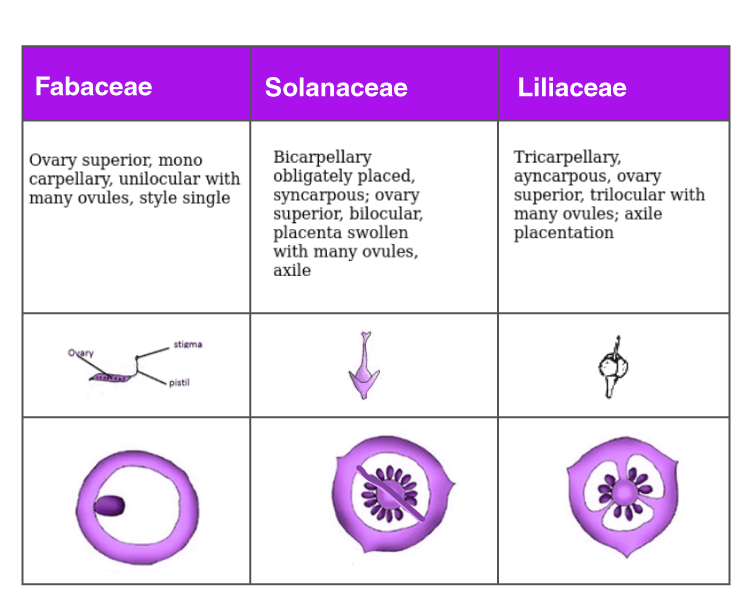
Distinguish between families Fabaceae, Solanaceae, Liliaceae based on gynoecium characteristics (with figures). Also, write the economic importance of any one of the above family.

Show solutionHide solution
Worked solution

NCERT Exemplar Solutions of Class 11 Biology Chapter 5 Morphology of Flowering Plants-7

Q2Written answer

Describe various stem modifications associated with food storage, climbing and protection.

Show solutionHide solution
Worked solution

i) Food storage – Underground stems of potato, ginger, turmeric, Samarkand, Colocasia are modified to store food in them.

ii) Climbing – Stem tendrils which develop from axillary buds, are slender and spirally coiled and help plants to climb such as in gourds (cucumber, pumpkins, watermelon) and grapevines.

iii) Protection – Axillary buds of stems may also get modified into woody, straight and pointed thorns. Thorns are found in many plants such as Citrus, Bougainvillea.

Q3Written answer

Stolon, offset and rhizome are different forms of stem modifications. How can these modified forms of stem be distinguished from each other?

Show solutionHide solution
Worked solution

Stolon is underground stems which spread to new niches and when old plants die, new are formed. It is a creeper.

Offset is a lateral branch with short internodes and each node bearing a rosette of leaves and tuft of roots is found in aquatic plants.

The rhizome is an underground stem growing parallel to soil surface which is differentiated from roots in having scale leaves and auxiliary buds and helps in vegetative propagation.

Q4Written answer

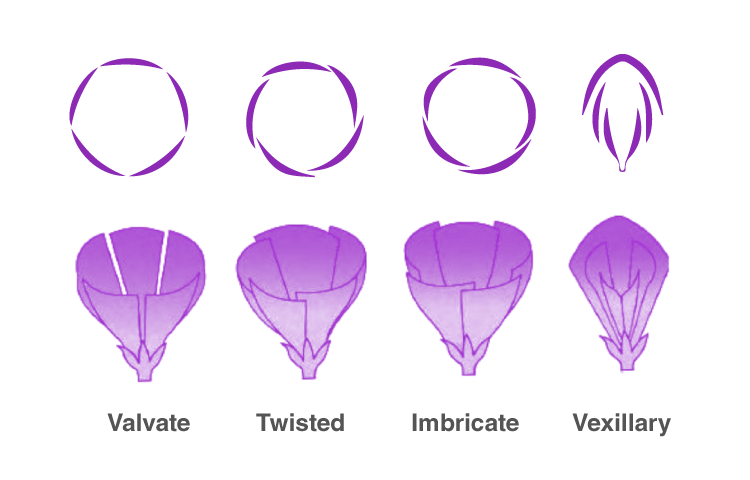
The mode of arrangements of sepals or petals in a floral bud is known as aestivation. Draw the various types of aestivation possible for a typical pentamerous flower.

Show solutionHide solution
Worked solution

Solution;

There are 4 types of aestivation.

i. Valvate

When sepals or petals in a whorl just touch one another at the margin, without overlapping, as in Calotropis, it is said to be valvate.

ii. Twisted

If one margin of the appendage overlaps that of the next one and so on as in china rose, lady’s finger and cotton, it is called twisted.

iii. Imbricate

If the margins of sepals or petals overlap one another but not in any particular direction as in Cassia and Gulmohar, the aestivation is called imbricate.

iv. Vexillary

In pea and bean flowers, there are five petals, the largest (standard) overlaps the two lateral petals (wings) which in turn overlap the two smallest anterior petals (keel); this type of aestivation is known as vexillary.

NCERT Exemplar Solutions of Class 11 Biology Chapter 5 Morphology of Flowering Plants-8

Q5Written answer

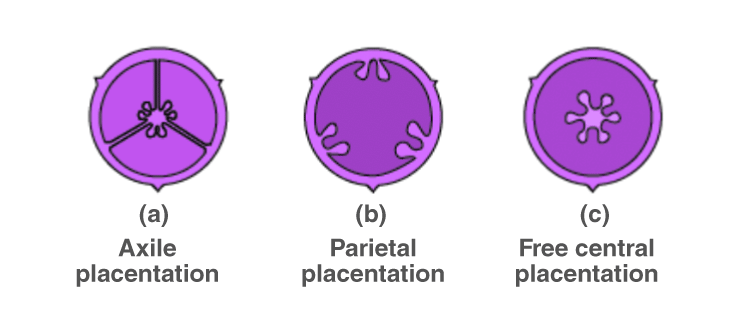
The arrangement of ovules within the ovary is known as placentation. What does the term placenta refer to? Name and draw various types of placentations in the flower as seen in T.S. or V.S.

Show solutionHide solution
Worked solution

NCERT Exemplar Solutions of Class 11 Biology Chapter 5 Morphology of Flowering Plants-9

The mode of attachment of ovule to the placenta is known as placentation which is of the following types: Parental, Marginal, Axile, Free central and Basal.

Q6Written answer

Sunflower is not a flower. Explain.

Show solutionHide solution
Worked solution

Sunflower is not a flower but a type of inflorescence called capitulum in which the receptacle is flattened. The whole cluster of florets gets surrounded by bracts, known as an involucre. Two kinds of florets are recognised in sunflowers:

(i) Ray Florets – Arranged on the rim of a receptacle having distinct yellow and strap-shaped petals. These florets are female, sterile and are always zygomorphic and may be arranged in one or more whorls.

(ii) Disc florets – Grouped in the centre, bisexual and actinomorphic.

Q7Written answer

How do you distinguish between hypogeal germination and epigeal germination? What is the role of the cotyledon (s) and the endosperm in the germination of seeds?

Show solutionHide solution
Worked solution

Role of Cotyledons and Endosperm in the germination of seeds –

They contain reserved food materials. When seed imbibes water, enzymes get activated, hydrolyze reserve food material and make it available for the germinating seed.

Hypogeal germination is when epicotyl grows first, and the only plumule is pushed out of the soil. The cotyledons remain non-green and non-photosynthetic.

In Epigeal germination, hypocotyl grows first. It pushes cotyledons and other parts of the seed out of the soil. Cotyledons become green and photosynthetic.

Q8Written answer

Seeds of some plants germinate immediately after shedding from the plants, while in other plants they require a period of rest before germination. The latter phenomenon is called dormancy. Give the reasons for seed dormancy and some methods to break it.

Show solutionHide solution
Worked solution

Reasons for seed dormancy –

• Impermeable and hard seed coat

• Presence of chemical inhibitors like abscisic acid

• Immature embryo

Methods to break seed dormancy are –

• Washing away of inhibitors due to rain

• Maturation of embryo

• Inactivation of growth inhibitors due to heat or cold treatment.

• Weakening and decomposition of seed coat by microorganisms.

The morphology of flowering plants is the science that deals with the structure and form of the various flowering plants in the plant kingdom. The study of these plants is termed botany, which involves the study of forms, positions, and external features.

The major parts of a flowering plant are listed below:

  1. The Root
  2. The Stem
  3. The Leaf
  4. Flower
Important Concepts Covered in Chapter 5 Morphology of Flowering Plants
  1. The Root
    1. Regions of the Root
    2. Modifications of Root
  2. The Stem
    1. Modifications of Stem
  3. The Leaf
    1. Venation
    2. Types of Leaves
    3. Phyllotaxy
    4. Modifications of Leaves
  4. The Inflorescence
  5. The Flower
    1. Parts of a Flower
  6. The Fruit
  7. The Seed
    1. Structure of a Dicotyledonous Seed
    2. Structure of Monocotyledonous Seed
  8. Semi-technical Description of a Typical Flowering Plant
  9. Description of Some Important Families
    1. Fabaceae
    2. Solanaceae
    3. Liliaceae