My Cart
Your Cart 0

    Your cart is empty.

  • Total (Amount) ₹0.00
NCERT Exemplar · Class 11 · Biology

Chapter 5: Morphology of Flowering Plants

Practice each question, then open the answer or worked solution.

SHORT ANSWER TYPE QUESTIONS

14 questions
Q1Written answer

Give two examples of roots that develop from different parts of the

angiosperms plant other than the radicle.

Show solutionHide solution
Worked solution

Solution: Banyan tree – roots develop from the lower nodes of the stem. They are prop roots which grow downwards and touch the soil. They are meant for support.

Sugarcane – roots arise from the lower nodes of the stem and enter the soil. They are stilt roots which are meant to provide strength to the plant.

Q2Written answer

The essential functions of roots are anchorage and absorption of water and minerals in the terrestrial plant. What functions are associated with the roots of aquatic plants? How are the roots of aquatic plants and terrestrial plants different?

Show solutionHide solution
Worked solution

The aquatic plants don’t have to face problems in obtaining water. Therefore the main function of the roots of aquatic plants is anchorage.

Aquatic plants Terrestrial plants
Roots are either absent or underdeveloped

Vascular bundles are not well developed

Modifies to carry out photosynthesis food storage, and exchange of gases

Roots are well developed

Vascular bundles are well developed

Provide anchorage and help in the absorption of nutrients from the soil

Q3Written answer

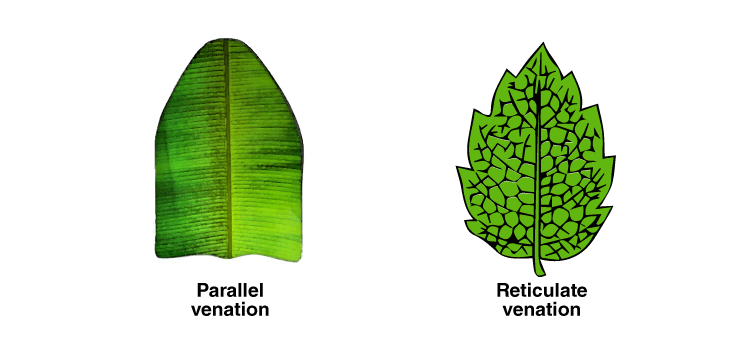
Draw diagrams of a typical monocot and dicot leave to show their venation pattern.

Show solutionHide solution
Worked solution

NCERT Exemplar Solutions of Class 11 Biology Chapter 5 Morphology of Flowering Plants-4

Q4Written answer

A typical angiosperm flower consists of four floral parts. Give the names of the floral parts and their arrangements sequentially.

Show solutionHide solution
Worked solution

Calyx – It is the outermost whorl of the flower and the members are called sepals which are green, leaf-like and protect the flower in the bud stage.

Corolla – It is composed of petals. Petals are usually brightly coloured to attract insects for pollination.

Androecium – It is composed of stamens. Each stamen which represents the male reproductive organ, consists of a stalk or a filament and an anther.

Gynoecium – It is the female reproductive part of the flower and is made up of one or more carpels. A carpel consists of three parts, namely stigma, style and ovary.

Q5Written answer

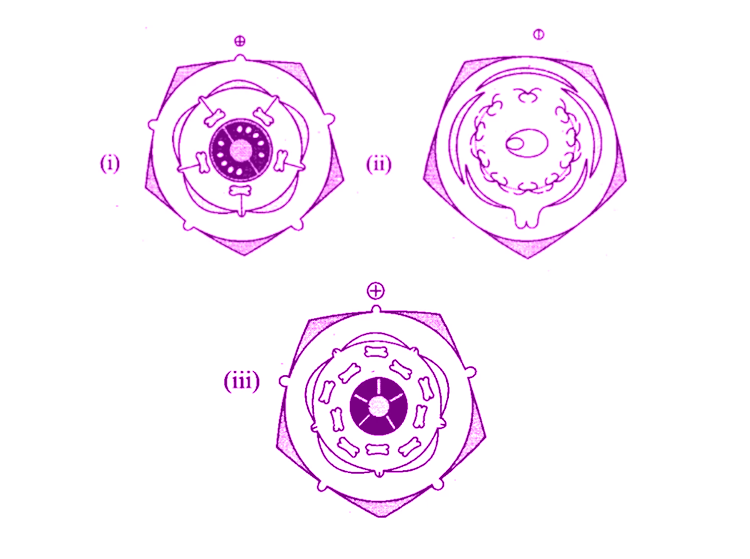
Given below are the floral formulae of some plants. Draw floral diagrams from these formulae.

NCERT Exemplar Solutions of Class 11 Biology Chapter 5 Morphology of Flowering Plants-5

Show solutionHide solution
Worked solution

NCERT Exemplar Solutions of Class 11 Biology Chapter 5 Morphology of Flowering Plants-6

Q6Written answer

Reticulate venation is found in dicot leaves while in monocot leaves venation is of parallel type. Mention one exception to this generalization.

Show solutionHide solution
Worked solution

Similar and Dioscorea are monocots having reticulate venation. Calophyllum and Eryngium are dicots parallel venation.

Q7Written answer

You have heard about several insectivorous plants that feed on insects. Nepenthes or the pitcher plant is one such example, which usually grows in shallow water or marshlands. What part of the plant is modified into a ‘pitcher’? How does this modification help the plant for food even though it can photosynthesize like any other green plant?

Show solutionHide solution
Worked solution

The pitcher plant can’t photosynthesize like other green plants so it gets its food from the insects as these insects are a good source of Nitrogen for the insectivorous plants.

Q8Written answer

Mango and coconut are ‘drupe’ type of fruits. In mango, fleshy mesocarp is edible. What is the edible part of coconut? What does milk of tender coconut represent?

Show solutionHide solution
Worked solution

The edible part of the coconut is the endosperm. The milk of tender coconut represents the oily endosperm in liquid form. Later it gets deposited along the walls of endocarp and forms edible flesh.

Q9Written answer

How can you differentiate between free central and axile placentation?

Show solutionHide solution
Worked solution

When the placenta is axial and the ovules are attached to it in a multilocular ovary, the placentation is said to be axile. Examples – china rose, tomato and lemon.

When the ovules are borne on the central axis and septa are absent, the placentation is called free central. Examples – Dianthus and Primrose.

Q10Written answer

Tendrils are found in the following plants. Identify whether they are stem tendrils or leaf tendrils. a.Cucumber

b. Peas

c. Pumpkins

d. Grapevine

e. Watermelons

Show solutionHide solution
Worked solution

a. Cucumber – Stem tendrils

b. Peas – Leaf tendrils

c. Pumpkins – stem tendrils

d. Grapevines – stem tendrils

e. Watermelons – stem tendrils