My Cart
Your Cart 0

    Your cart is empty.

  • Total (Amount) ₹0.00
NCERT Exemplar · Class 11 · Biology

Chapter 14: Respiration in Plants

Practice each question, then open the answer or worked solution.

LONG ANSWER TYPE QUESTIONS

5 questions
Q1Written answer

In the following flow chart, replace the symbols a,b,c and d with appropriate terms. Briefly explain the process and give any two application of it.
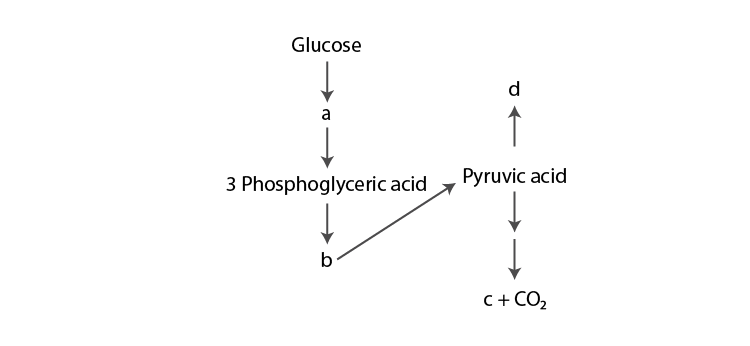
NCERT Exemplar Solution of Class 11 Biology Chapter 14 Respiration in Plants-5

Show solutionHide solution
Worked solution

a = Glyceraldehyde – 3 – phosphate

b = PEP (Phosphoenol pyruvic acid)

c = C2H5OH

d = Lactic acid

The process is fermentation. Aerobic conditions are present in the cell. When there are anaerobic conditions the pyruvic acid gets converted to either lactic acid and it is known as homolactic fermentation. In some micro-organisms which are naturally anaerobic like yeast. They form C2H5OH and release CO2. This is known as alcoholic fermentation.

Application:

i) Fermentation is widely used for the production of alcoholic beverage products like Whisky, Beer, etc.

ii) Fermentation is widely used for the production of acids like citrus acid, lactic acid, alpha-amylase, etc.
Q2Written answer

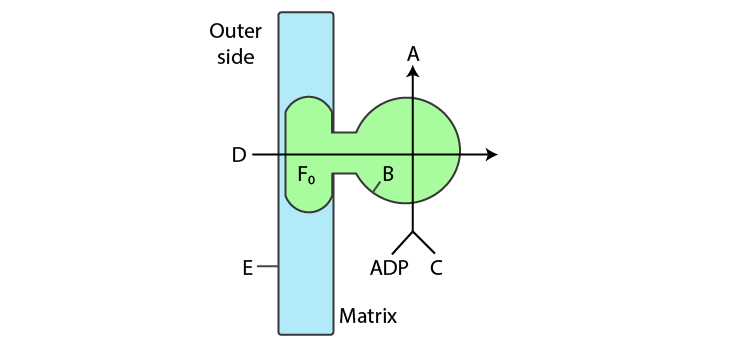
Given below is a diagram showing ATP synthesis during aerobic respiration, replace the symbols A, B, C, D and E by appropriate terms given in the box.

NCERT Exemplar Solution of Class 11 Biology Chapter 14 Respiration in Plants-4

F1, Particle, Pi, 2H+, Inner mitochondrial membrane, ATP, F0 particle, ADP

Show solutionHide solution
Worked solution

A = ATP

B = F1 particle

C = Pi

D = 2H+

E = inner mitochondrial membrane

Q3Written answer

Oxygen is critical for aerobic respiration. Explain its role concerning ETS.

Show solutionHide solution
Worked solution

Oxygen plays a crucial role at the end of ETC because it removes the hydrogen from the electron transport system. It acts as a hydrogen acceptor in the electron transport chain. If oxygen is absent then the transportation of electron will not happen through the coenzymes and there will be no formation of proton pump and ATP will not be produced by oxidative phosphorylation.

Q4Written answer

Enumerate the assumptions that we undertake in making the respiratory balance sheet. Are these assumptions valid for a living system? Compare fermentation and aerobic respiration in this context.

Show solutionHide solution
Worked solution

The metabolic pathway for respiration is sequential as Glycolysis Kreb’s Cycle Electron transport system. Each of them occurs one after the other in sequential order.

i) The NADH which is synthesized during the glycolysis process is taken from the cytoplasm to the mitochondria of the cell, where oxidation occurs along with electron transport.

ii) The intermediate which is formed by the various biochemical respiration pathways is not used as raw material for any other respiration pathway.

iii) Glucose is the sole respiratory substrate, and no other substrate can enter the glycolytic pathway at any particular step of the process.

Fermentation is the partial breakdown of glucose molecule whereas aerobic respiration is the complete oxidation of the glucose molecule.

In fermentation, the end product will be organic compounds whereas in aerobic respiration the end product will be carbon dioxide and water

Q5Written answer

Give an account of Glycolysis. Where does it occur? What is the end product? Trace the fate of these products in both aerobic and anaerobic respiration.

Show solutionHide solution
Worked solution

Glycolysis is the process which involves the splitting of glucose (a 6C compound) into two molecules of pyruvic acid (a 3C compound). It occurs in the cytoplasm of the cell. The end products of glycolysis are two pyruvates (pyruvic acid) molecules, a total of four ATP molecules, and two molecules of NADH. Glycolysis occurs in both aerobic and anaerobic organisms. After glycolysis, if the cells have oxygen, then it goes on to a process known as a citric acid cycle or tricarboxylic cycle. And if there is no oxygen, then the fermentation process occurs.

Through respiration, plants obtain energy. Glucose is one of the major food compounds, which breaks down to form carbon dioxide and water, in the presence of oxygen. Respiration primarily occurs through the leaves and the roots of the plant; it is essential for the survival of plants. Stomata are the tiny pores present on the surface of leaves of plants, through which gas exchange occurs.