My Cart
Your Cart 0

    Your cart is empty.

  • Total (Amount) ₹0.00
NCERT Exemplar · Class 11 · Biology

Chapter 14: Respiration in Plants

Practice each question, then open the answer or worked solution.

SHORT ANSWER TYPE QUESTIONS

23 questions
Q1Written answer

If a person is feeling dizzy, glucose or fruit juice is given immediately, but not a cheese sandwich Explain.

Show solutionHide solution
Worked solution

Glucose or fruit juice is a simpler food product which is easily absorbed and assimilated by the body and it is easily oxidized to form energy
Q2Written answer

What is meant by the statement “aerobic respiration is more efficient.”?

Show solutionHide solution
Worked solution

Aerobic respiration produces more energy as compared to anaerobic respiration. It is a high energy-yielding process. Also, it produces less energy when compared to anaerobic respiration.

Q3Written answer

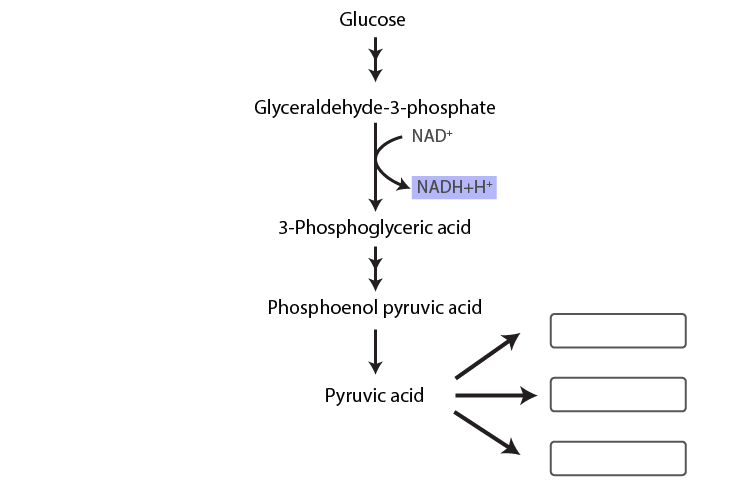
Pyruvic acid is the end product of glycolysis. What are the three metabolic products of pyruvic acid produced under aerobic and anaerobic conditions? Write their name in the space provided in the diagram.

NCERT Exemplar Solution of Class 11 Biology Chapter 14 Respiration in Plants-1

Show solutionHide solution
Worked solution

i) CO2 + H2O

ii) Lactic acid

iii) C2H5OH + CO2

Q4Written answer

The energy yield in terms of ATP is higher in aerobic respiration than anaerobic respiration. Why anaerobic respiration occurs even in organisms that live in aerobic condition like human beings and angiosperms?

Show solutionHide solution
Worked solution

Anaerobic respiration occurs in organisms that live in aerobic condition like human beings when there is intensive exercise or stress on a muscle. In angiosperms, the germination of seeds leads to anaerobic respiration for releasing the energy for the seedling to emerge from the soil.

Q5Written answer

Oxygen is an essential requirement for aerobic respiration but it enters the respiratory process at the end? Discuss.

Show solutionHide solution
Worked solution

Oxygen is an essential factor for aerobic respiration because it removes hydrogen from the electron transport system. It also acts as a hydrogen acceptor. The absence of oxygen will inhibit the passage of electrons through the co-enzymes and also there won’t be a formation of proton pump and ATP will not be produced by oxidative phosphorylation.

Q6Written answer

Respiration is an energy-releasing and enzymatically controlled catabolic process which involves a step-wise oxidative breakdown of organic substances inside living cells.

In this statement about respiration explain the meaning of

1) Step-wise oxidative breakdown, and

2) Organic substances (used as substrates).

Show solutionHide solution
Worked solution

1) Step-wise oxidative breakdown:

The energy will be released in a stepwise manner during cellular respiration which is moderated enzymatically.

2) Organic substances (used as substrates):

Organic substances like carbohydrates used as substrates and oxidized during the respiratory process for releasing energy.

Q7Written answer

Comment on the statement – Respiration is an energy-producing process but ATP is being used in some steps of the process.

Show solutionHide solution
Worked solution

The phosphorylation reaction is the glycolysis process in which glucose is converted to glucose – 6 – phosphate which consumes one ATP.

Although the overall ATP produced by the complete oxidation of the substrate is more than the amount of energy spent on some metabolic processes.

Q8Written answer

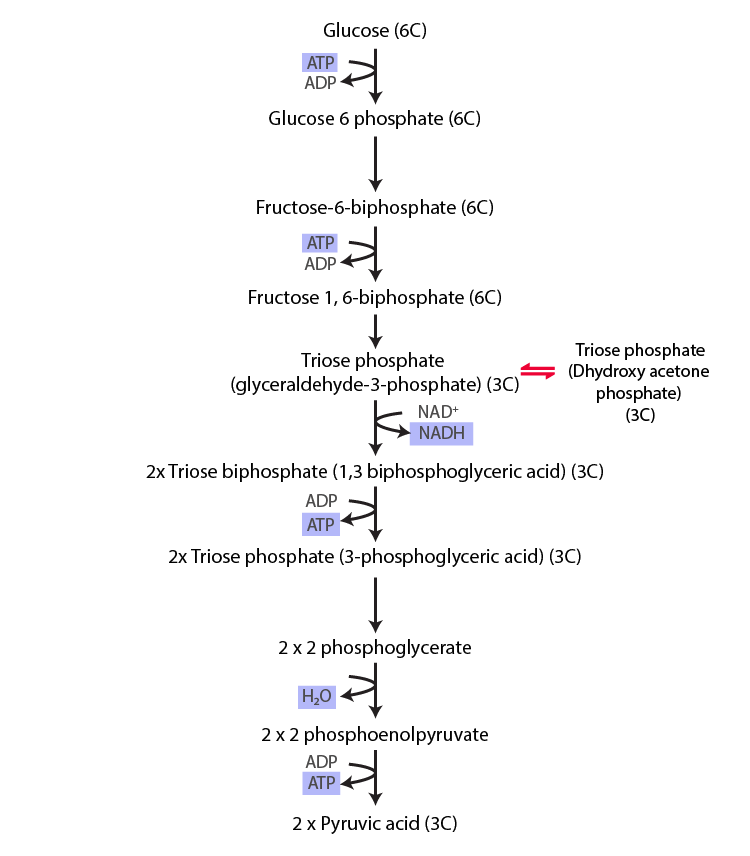
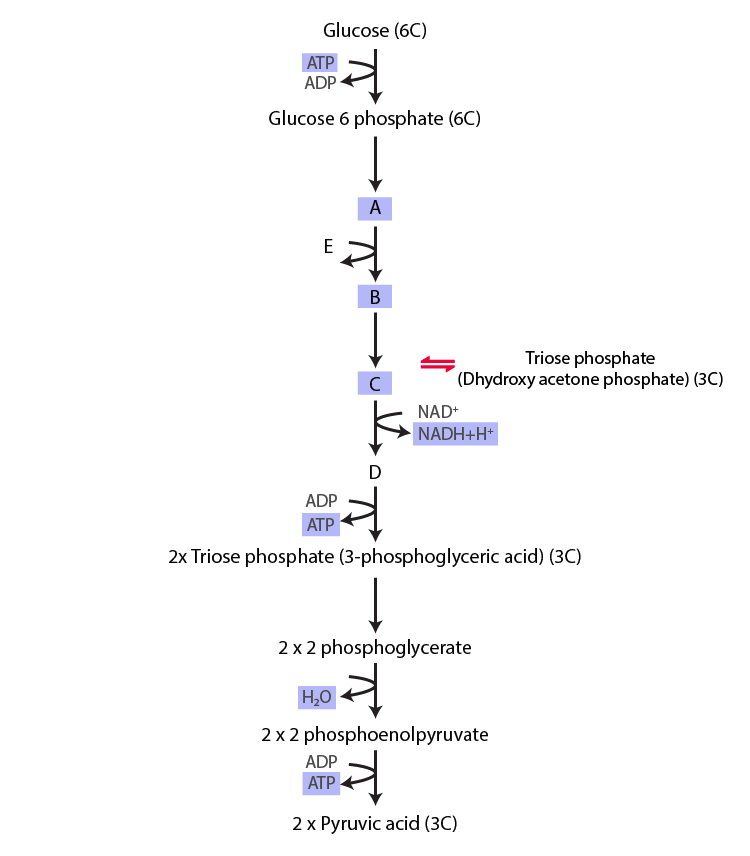
The figure given below shows the steps in glycolysis. Fill in the missing steps A, B, C, D and also indicate whether ATP is being used up or released at step E?

NCERT Exemplar Solution of Class 11 Biology Chapter 14 Respiration in Plants-2

Show solutionHide solution
Worked solution

NCERT Exemplar Solution of Class 11 Biology Chapter 14 Respiration in Plants-3

Q9Written answer

Why is respiratory pathway referred to as an amphibolic pathway? Explain.

Show solutionHide solution
Worked solution

Respiratory pathway referred to as an amphibolic pathway because it comprises of the breakdown of substrates. The fatty acids are broken down into Acetyl CoA. Similarly, glycerol also enters a biochemical pathway and gets broken down into PGAL (3-phosphoglyceraldehyde). The amphibolic pathway involves both anabolic and catabolic pathway. Respiration can cause both the breakdown and synthesis of fatty acids. Thus it can be said to be an amphibolic pathway.

Q10Written answer

We commonly call ATP as the energy currency of the cell. Can you think of some other energy carriers present in a cell? Name any two.

Show solutionHide solution
Worked solution

Some other energy carriers present in a cell are:

GTP (Guanine Triphosphate)

ADP (Adenosine Diphosphate)