My Cart
Your Cart 0

    Your cart is empty.

  • Total (Amount) ₹0.00
NCERT Exemplar · Class 10 · Maths

Chapter 9: Circles

Practice each question, then open the answer or worked solution.

Exercise 9.4

Textbook page 110 · 7 questions
Q1Written answer

If a hexagon ABCDEF circumscribes a circle, prove that AB + CD + EF = BC + DE + FA.

Show solutionHide solution
Worked solution
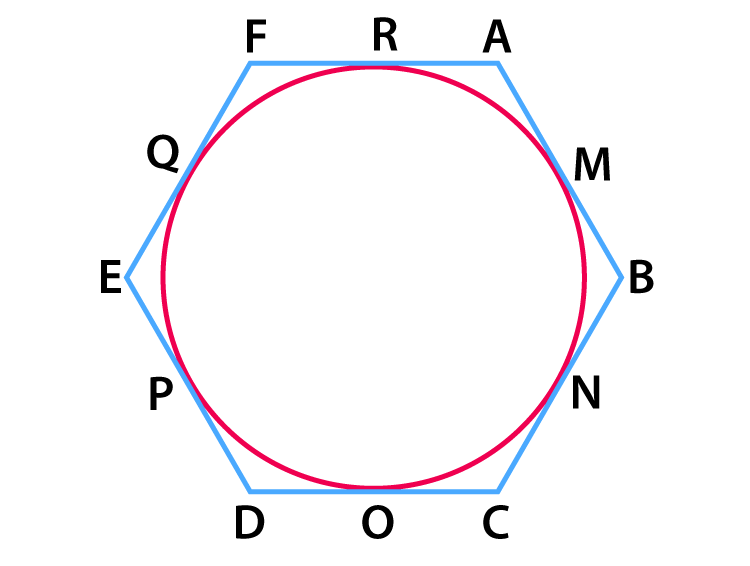
NCERT Exemplar Class 10 Maths Chapter 9 Ex. 9.4 Question 1

According to the question,

A Hexagon ABCDEF circumscribes a circle.

To prove:

AB + CD + EF = BC + DE + FA

Proof:

Tangents drawn from an external point to a circle are equal.

Hence, we have

AM = RA … eq 1 [tangents from point A]

BM = BN … eq 2 [tangents from point B]

CO = NC … eq 3 [tangents from point C]

OD = DP … eq 4 [tangents from point D]

EQ = PE … eq 5 [tangents from point E]

QF = FR … eq 6 [tangents from point F] [eq 1]+[eq 2]+[eq 3]+[eq 4]+[eq 5]+[eq 6]

AM + BM + CO + OD + EQ + QF = RA + BN + NC + DP + PE + FR

On rearranging, we get,

(AM + BM) + (CO + OD) + (EQ + QF) = (BN + NC) + (DP + PE) + (FR + RA)

AB + CD + EF = BC + DE + FA

Hence Proved!
Q2Written answer

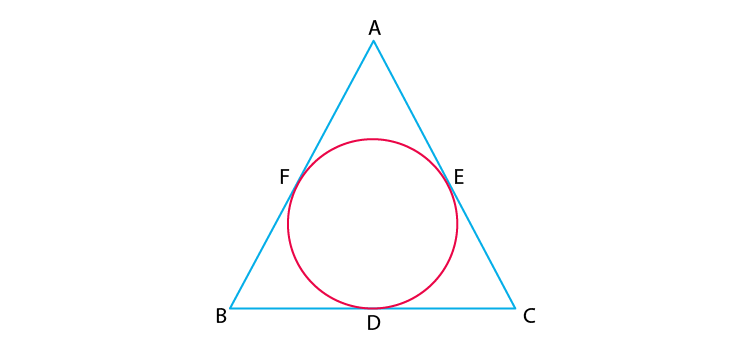
Let s denote the semi-perimeter of a triangle ABC in which BC = a, CA = b, AB = c. If a circle touches the sides BC, CA, AB at D, E, F, respectively, prove that BD = s – b.

Show solutionHide solution
Worked solution

NCERT Exemplar Class 10 Maths Chapter 9 Ex. 9.4 Question 2

According to the question,

A triangle ABC with BC = a, CA = b and AB = c. Also, a circle is inscribed, which touches the sides BC, CA and AB at D, E and F, respectively and s is semi-perimeter of the triangle

To Prove: BD = s – b

Proof:

According to the question,

We have,

Semi Perimeter = s

Perimeter = 2s

2s = AB + BC + AC [1]

As we know,

Tangents drawn from an external point to a circle are equal

So we have

AF = AE [2] [Tangents from point A]

BF = BD [3] [Tangents From point B]

CD = CE [4] [Tangents From point C]

Adding [2] [3] and [4]

AF + BF + CD = AE + BD + CE

AB + CD = AC + BD

Adding BD both side

AB + CD + BD = AC + BD + BD

AB + BC – AC = 2BD

AB + BC + AC – AC – AC = 2BD

2s – 2AC = 2BD [From 1]

2BD = 2s – 2b [as AC = b]

BD = s – b

Hence Proved.

Q3Written answer

From an external point P, two tangents, PA and PB are drawn to a circle with centre O. At one point E on the circle tangent is drawn, which intersects PA and PB at C and D, respectively. If PA = 10 cm, find the perimeter of the triangle PCD.

Show solutionHide solution
Worked solution

According to the question,

From an external point P, two tangents, PA and PB are drawn to a circle with centre O. At a point E on the circle tangent is drawn, which intersects PA and PB at C and D, respectively. And PA = 10 cm

To Find: Perimeter of △PCD

As we know that, Tangents drawn from an external point to a circle are equal.

So we have

AC = CE [1] [Tangents from point C]

ED = DB [2] [Tangents from point D]

Now Perimeter of Triangle PCD

= PC + CD + DP

= PC + CE + ED + DP

= PC + AC + DB + DP [From 1 and 2]

= PA + PB

Now,

PA = PB = 10 cm as tangents drawn from an external point to a circle are equal

So we have

Perimeter = PA + PB = 10 + 10 = 20 cm

Q4Written answer

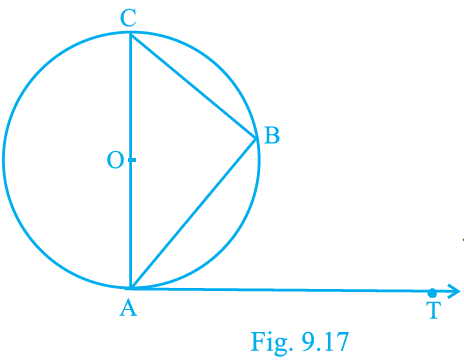
If AB is a chord of a circle with centre O, AOC is a diameter and AT is the tangent at A as shown in Fig. 9.17. Prove that ∠BAT = ∠ACB

NCERT Exemplar Class 10 Maths Chapter 9 Ex. 9.4 Question 4

Show solutionHide solution
Worked solution

According to the question,

A circle with centre O and AC as a diameter and AB and BC as two chords also, AT is a tangent at point A

To Prove: ∠BAT = ∠ACB

Proof:

∠ABC = 90° [Angle in a semicircle is a right angle]

In △ABC By angle sum property of triangle

∠ABC + ∠ BAC + ∠ACB = 180 °

∠ACB + 90° = 180° – ∠BAC

∠ACB = 90 – ∠BAC [1]

Now,

OA ⏊ AT [Tangent at a point on the circle is perpendicular to the radius through point of contact ]

∠OAT = ∠CAT = 90°

∠BAC + ∠BAT = 90°

∠BAT = 90° – ∠BAC [2]

From [1] and [2]

∠BAT = ∠ACB [Proved]

Q5Written answer

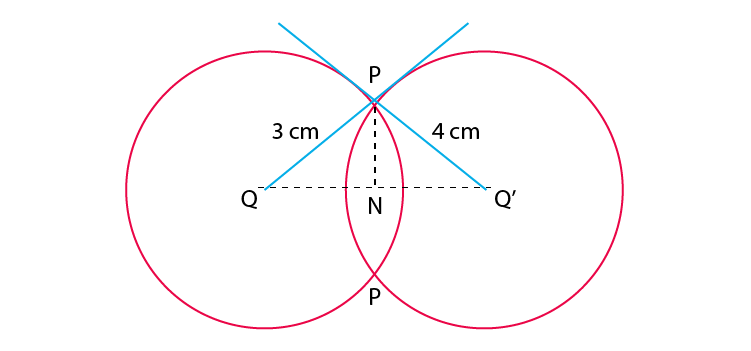
Two circles with centres O and O‘ of radii 3 cm and 4 cm, respectively, intersect at two points P and Q such that OP and O‘P are tangents to the two circles. Find the length of the common chord PQ.

Show solutionHide solution
Worked solution

NCERT Exemplar Class 10 Maths Chapter 9 Ex. 9.4 Question 5

According to the question,

Two circles with centres O and O’ of radii 3 cm and 4 cm, respectively, intersect at two points P and Q, such that OP and O’P are tangents to the two circles and PQ is a common chord.

To Find: Length of common chord PQ

∠OPO’ = 90° [Tangent at a point on the circle is perpendicular to the radius through point of contact]

So OPO is a right-angled triangle at P

Using Pythagoras in △ OPO’, we have

(OO’)2= (O’P)2+ (OP)2

(OO’)2 = (4)2 + (3)2

(OO’)2 = 25

OO’ = 5 cm

Let ON = x cm and NO’ = 5 – x cm

In right angled triangle ONP

(ON)2+ (PN)2= (OP)2

x2 + (PN)2 = (3)2

(PN)2= 9 – x2 [1]

In right angled triangle O’NP

(O’N)2 + (PN)2= (O’P)2

(5 – x)2 + (PN)2 = (4)2

25 – 10x + x2 + (PN)2 = 16

(PN)2 = -x2+ 10x – 9[2]

From [1] and [2]

9 – x2 = -x2 + 10x – 9

10x = 18

x = 1.8

From (1) we have

(PN)2 = 9 – (1.8)2

=9 – 3.24 = 5.76

PN = 2.4 cm

PQ = 2PN = 2(2.4) = 4.8 cm

Q6Written answer

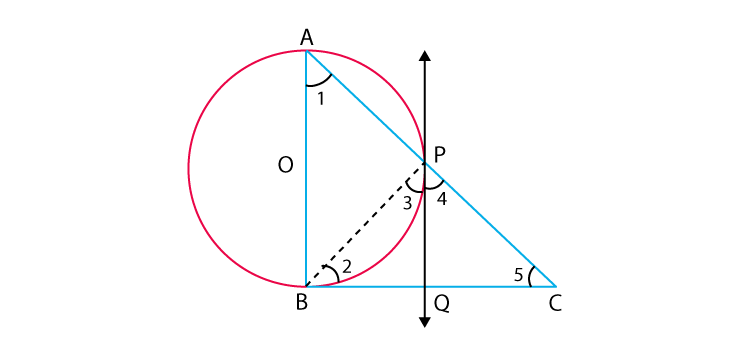
In a right triangle ABC in which ∠B = 90°, a circle is drawn with AB as diameter intersecting the hypotenuse AC and P. Prove that the tangent to the circle at P bisects BC.

Show solutionHide solution
Worked solution

NCERT Exemplar Class 10 Maths Chapter 9 Ex. 9.4 Question 6

According to the question,

In a right angle ΔABC is which ∠B = 90°, a circle is drawn with AB as diameter intersecting the hypotenuse AC at P. Also PQ is a tangent at P

To Prove: PQ bisects BC i.e. BQ = QC

Proof:

∠APB = 90° [Angle in a semicircle is a right-angle]

∠BPC = 90° [Linear Pair]

∠3 + ∠4 = 90 [1]

Now, ∠ABC = 90°

So in △ABC

∠ABC + ∠BAC + ∠ACB = 180°

90 + ∠1 + ∠5 = 180

∠1 + ∠5 = 90 [2]

Now,

∠ 1 = ∠ 3[angle between tangent and the chord equals angle made by the chord in alternate segment]

Using this in [2] we have

∠3 + ∠5 = 90 [3]

From [1] and [3] we have

∠3 + ∠4 = ∠3 + ∠5

∠4 = ∠5

QC = PQ [Sides opposite to equal angles are equal]

But Also PQ = BQ [Tangents drawn from an external point to a circle are equal]

So, BQ = QC

i.e. PQ bisects BC .

Q7Written answer

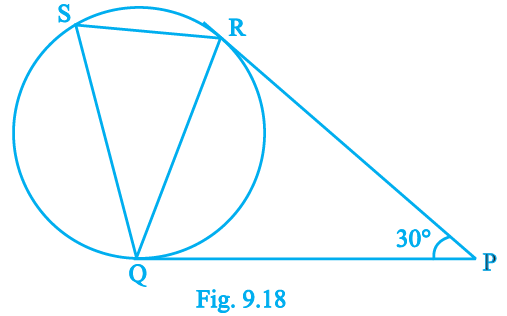
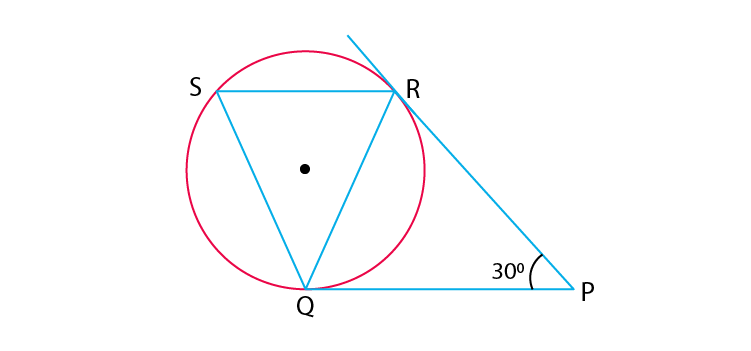
In Fig. 9.18, tangents PQ and PR are drawn to a circle such that ∠RPQ = 30°. A chord RS is drawn parallel to the tangent PQ. Find the ∠RQS.

[Hint: Draw a line through Q and perpendicular to QP.]

NCERT Exemplar Class 10 Maths Chapter 9 Ex. 9.4 Question 7

Show solutionHide solution
Worked solution

NCERT Exemplar Class 10 Maths Chapter 9 Ex. 9.4 Question 7-1

According to the question,

Tangents PQ and PR are drawn to a circle such that ∠RPQ = 30°. A chord RS is drawn parallel to the tangent PQ.

To Find: ∠RQS

PQ = PR [Tangents drawn from an external point to a circle are equal]

∠PRQ = ∠PQR [Angles opposite to equal sides are equal] [1]

In △PQR

∠PRQ + ∠PQR + ∠QPR = 180°

∠PQR + ∠PQR + ∠QPR = 180° [Using 1]

2∠PQR + ∠RPQ = 180°

2∠PQR + 30 = 180

2∠PQR = 150

∠PQR = 75°

∠QRS = ∠PQR = 75° [Alternate interior angles]

∠QSR = ∠PQR = 75° [angle between tangent and the chord equals angle made by the chord in alternate segment]

Now In △RQS

∠RQS + ∠QRS + ∠QSR = 180

∠RQS + 75 + 75 = 180

∠RQS = 30°