My Cart
Your Cart 0

    Your cart is empty.

  • Total (Amount) ₹0.00
NCERT Exemplar · Class 10 · Maths

Chapter 9: Circles

Practice each question, then open the answer or worked solution.

Exercise 9.1

Textbook page 102 · 5 questions
Q1Written answer

If the radii of two concentric circles are 4 cm and 5 cm, then the length of each chord of one circle, which is tangent to the other circle, is

(A) 3 cm (B) 6 cm

(C) 9 cm (D) 1 cm

Show solutionHide solution
Worked solution
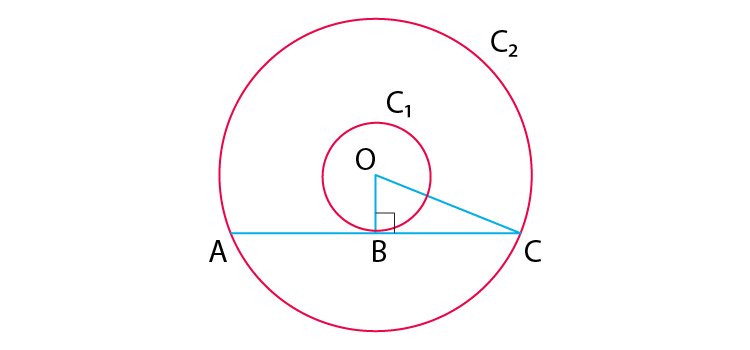
NCERT Exemplar Class 10 Maths Chapter 9 Ex. 9.1 Question 1

According to the question,

OA = 4cm, OB = 5cm

And, OA ⊥ BC

Therefore, OB2 = OA2 + AB2

⇒ 52 = 42 + AB2

⇒ AB = √(25 – 16) = 3cm

⇒ BC = 2AB = 2 × 3cm = 6cm
Q2Written answer

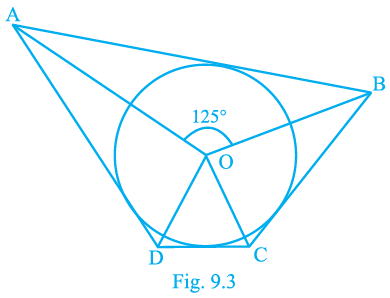
In Fig. 9.3, if AOB = 125°, then COD is equal to

(A) 62.5° (B) 45°

(C) 35° (D) 55°

NCERT Exemplar Class 10 Maths Chapter 9 Ex. 9.1 Question 2

Show solutionHide solution
Worked solution

ABCD is a quadrilateral circumscribing the circle

We know that, the opposite sides of a quadrilateral circumscribing a circle subtend supplementary angles at the center of the circle.

So, we have

∠AOB + ∠COD = 180°

125° + ∠COD = 180°

∠COD = 55°

Q3Written answer

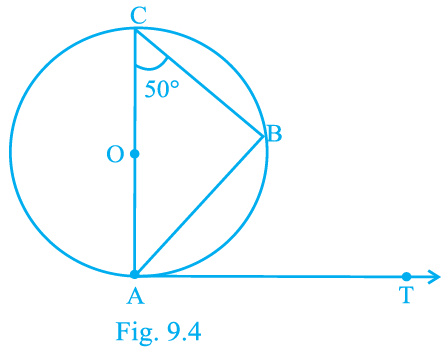
In Fig. 9.4, AB is a chord of the circle and AOC is its diameter such that ACB = 50°. If AT is tangent to the circle at point A, then BAT is equal to

(A) 65° (B) 60°

(C) 50° (D) 40°

NCERT Exemplar Class 10 Maths Chapter 9 Ex. 9.1 Question 3

Show solutionHide solution
Worked solution

According to the question,

A circle with centre O, diameter AC and ∠ACB = 50°

AT is a tangent to the circle at point A

Since, angle in a semicircle is a right angle

∠CBA = 90°

By angle sum property of a triangle,

∠ACB + ∠CAB + ∠CBA = 180°

50° + ∠CAB + 90° = 180°

∠CAB = 40° … (1)

Since tangent to at any point on the circle is perpendicular to the radius through point of contact,

We get,

OA ⏊ AT

∠OAT = 90°

∠OAT + ∠BAT = 90°

∠CAT + ∠BAT = 90°

40° + ∠BAT = 90° [from equation (1)]

∠BAT = 50°

Q4Written answer

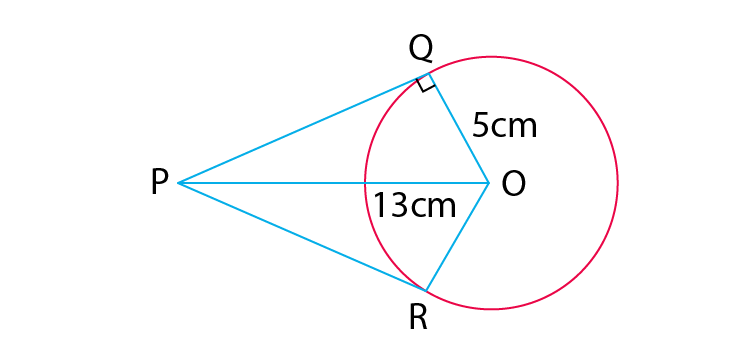
From a point P which is at a distance of 13 cm from the centre O of a circle of radius 5 cm, the pair of tangents PQ and PR to the circle are drawn. Then the area of the quadrilateral PQOR is

(A) 60 cm2 (B) 65 cm2

(C) 30 cm2 (D) 32.5 cm2

Show solutionHide solution
Worked solution

Construction: Draw a circle of radius 5 cm with centre O.

Let P be a point at a distance of 13 cm from O.

Draw a pair of tangents, PQ and PR.

OQ = OR = radius = 5cm …equation (1)

And OP = 13 cm

NCERT Exemplar Class 10 Maths Chapter 9 Ex. 9.1 Question 4

We know that, tangent to at any point on the circle is perpendicular to the radius through point of contact,

Hence, we get,

OQ ⏊ PQ and OR ⏊PR

△POQ and △POR are right-angled triangles.

Using Pythagoras Theorem in △PQO,

(Base)2+ (Perpendicular)2= (Hypotenuse)2

(PQ)2 + (OQ)2= (OP)2

(PQ)2 + (5)2 = (13)2

(PQ)2 + 25 = 169

(PQ)2 = 144

PQ = 12 cm

Tangents through an external point to a circle are equal.

So,

PQ = PR = 12 cm … (2)

Therefore, Area of quadrilateral PQRS, A = area of △POQ + area of △POR

Area of right angled triangle = ½ x base x perpendicular

A = (½ x OQ x PQ) + (½ x OR x PR)

A = (½ x 5 x 12) + (½ x 5 x 12)

A = 30 + 30 = 60 cm2

Q5Written answer

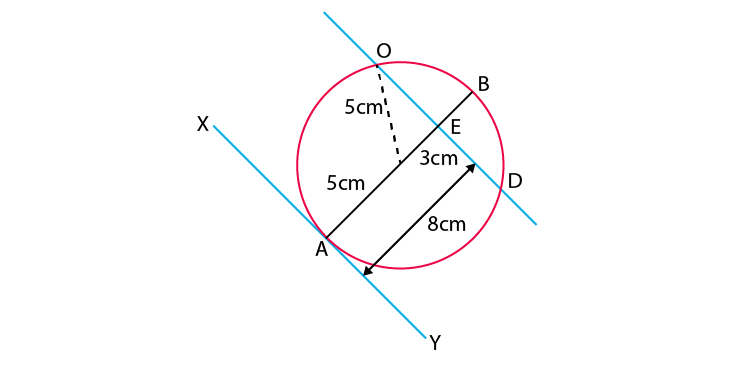
At one end A of a diameter AB of a circle of radius 5 cm, tangent XAY is drawn to the circle. The length of the chord CD parallel to XY and at a distance 8 cm from A is

(A) 4 cm (B) 5 cm

(C) 6 cm (D) 8 cm

Show solutionHide solution
Worked solution

NCERT Exemplar Class 10 Maths Chapter 9 Ex. 9.1 Question 5

According to the question,

Radius of circle, AO=OC = 5cm

AM=8CM

AM=OM+AO

OM =AM-AO

Substituting these values in the equation,

OM= (8-5) =3CM

OM is perpendicular to the chord CD.

In ∆OCM <OMC=90°

By Pythagoras theorem,

OC²=OM²+MC²

Therefore,

CD= 2 ×CM = 8 cm