Q1Written answer
If cosecθ + cotθ = p, then prove that cosθ = (p2 – 1)/ (p2 + 1).
Show solutionHide solution
Worked solution
According to the question,
cosec θ + cot θ = p
Since,
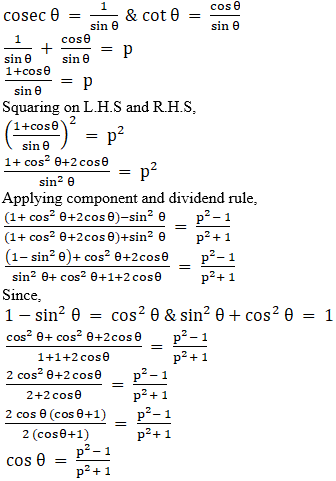
Hence, proved.
Your cart is empty.
Practice each question, then open the answer or worked solution.
If cosecθ + cotθ = p, then prove that cosθ = (p2 – 1)/ (p2 + 1).
According to the question,
cosec θ + cot θ = p
Since,
Hence, proved.
Prove that √(sec2 θ + cosec2 θ) = tan θ + cot θ
L.H.S=
√ (sec2 θ + cosec2 θ)
Since,
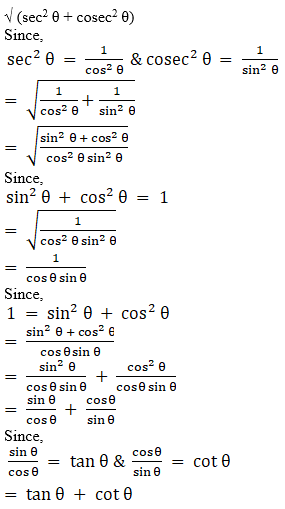
= R.H.S
Hence, proved.
The angle of elevation of the top of a tower from certain point is 30°. If the observer moves 20 metres towards the tower, the angle of elevation of the top increases by 15°. Find the height of the tower.
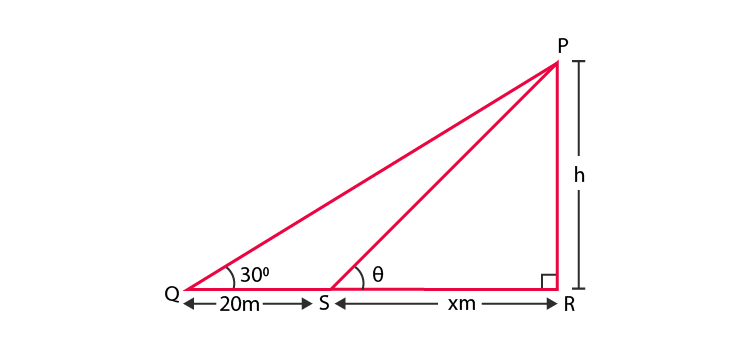
Let PR = h meter, be the height of the tower.
The observer is standing at point Q such that, the distance between the observer and tower is QR = (20+x) m, where
QR = QS + SR = 20 + x
∠PQR = 30°
∠ PSR = θ
In ∆PQR,
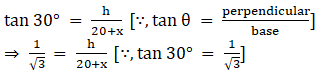
Rearranging the terms,
We get 20 +x = √3h
⇒ x = √3h – 20 …eq.1
In ∆PSR,
tan θ = h/x
Since, angle of elevation increases by 15o when the observer moves 20 m towards the tower.
We have,
θ = 30° + 15° = 45°
So,
tan 45o = h/x
⇒ 1 = h/x
⇒ h = x
Substituting x=h in eq. 1, we get
h = √3 h – 20
⇒ √3 h – h = 20
⇒ h (√3 – 1) = 20
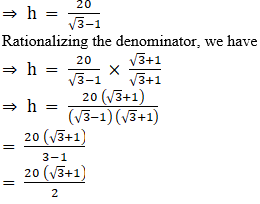
= 10 (√3 + 1)
Hence, the required height of the tower is 10 (√3 + 1) meter.
If 1 + sin2θ = 3sinθ cosθ , then prove that tanθ = 1 or ½.
Given: 1+sin2 θ = 3 sin θ cos θ
Dividing L.H.S and R.H.S equations with sin2 θ,
We get,
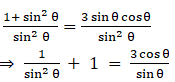
cosec2 θ + 1 = 3 cot θ
Since,
cosec2 θ – cot2 θ = 1 ⇒ cosec2 θ = cot2 θ +1
⇒ cot2 θ +1+1 = 3 cot θ
⇒ cot2 θ +2 = 3 cot θ
⇒ cot2 θ –3 cot θ +2 = 0
Splitting the middle term and then solving the equation,
⇒ cot2 θ – cot θ –2 cot θ +2 = 0
⇒ cot θ(cot θ -1)–2(cot θ +1) = 0
⇒ (cot θ – 1)(cot θ – 2) = 0
⇒ cot θ = 1, 2
Since,
tan θ = 1/cot θ
tan θ = 1, ½
Hence, proved.
Given that sinθ + 2cosθ = 1, then prove that 2sinθ – cosθ = 2.
Given: sin θ +2 cos θ = 1
Squaring on both sides,
(sin θ +2 cos θ)2 = 1
⇒ sin2 θ + 4 cos2 θ + 4sin θcos θ = 1
Since, sin2 θ = 1 – cos2 θ and cos2 θ = 1 – sin2 θ
⇒ (1 – cos2 θ) + 4(1 – sin2 θ) + 4sin θcos θ = 1
⇒ 1 – cos2 θ + 4 – 4 sin2 θ + 4sin θcos θ = 1
⇒ – 4 sin2 θ – cos2 θ + 4sin θcos θ = – 4
⇒ 4 sin2 θ + cos2 θ – 4sin θcos θ = 4
We know that,
a2+ b2 – 2ab = ( a – b)2
So, we get,
(2sin θ – cos θ)2 = 4
⇒ 2sin θ – cos θ = 2
Hence proved.
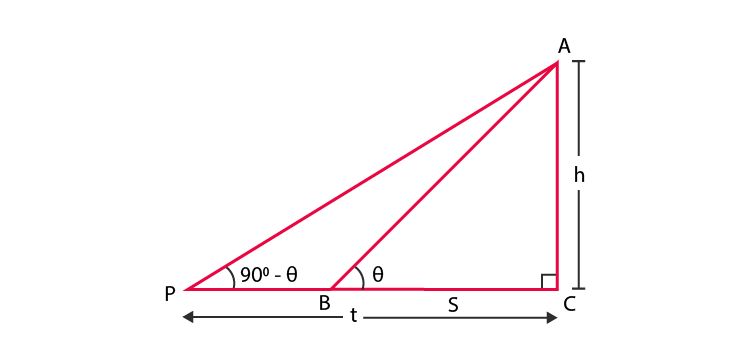
The angle of elevation of the top of a tower from two points distant s and t from its foot are complementary. Prove that the height of the tower is √st .
Let BC = s; PC = t
Let height of the tower be AB = h.
∠ABC = θ and ∠APC = 90° – θ
(∵ the angle of elevation of the top of the tower from two points P and B are complementary)
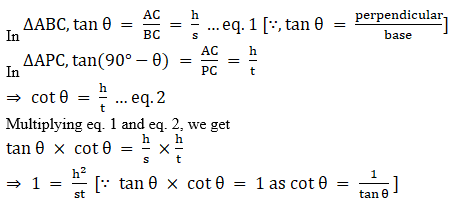
⇒ h2 = st
⇒ h = √st
Hence the height of the tower is √st.
The shadow of a tower standing on a level plane is found to be 50 m longer when Sun’s elevation is 30° than when it is 60°. Find the height of the tower.
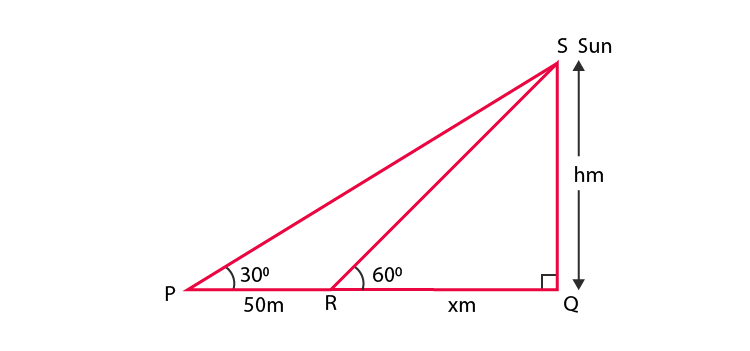
Let SQ = h be the tower.
∠SPQ = 30° and ∠SRQ = 60°
According to the question, the length of shadow is 50 m long hen angle of elevation of the sun is 30° than when it was 60°. So,
PR = 50 m and RQ = x m
So in ∆SRQ, we have
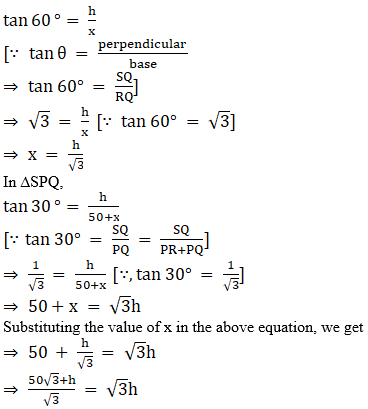
⇒ 50√3+h = 3h
⇒ 50√3 = 3h – h
⇒ 3h – h = 50√3
⇒ 2h = 50√3
⇒ h = (50√3)/2
⇒ h = 25√3
Hence, the required height is 25√3 m.
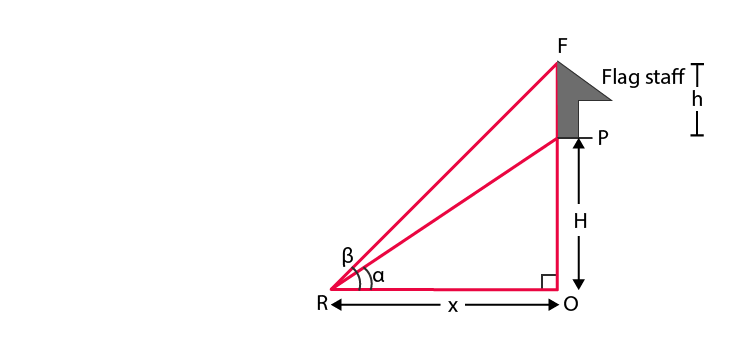
A vertical tower stands on a horizontal plane and is surmounted by a vertical flag staff of height h. At a point on the plane, the angles of elevation of the bottom and the top of the flag staff are α and β, respectively. Prove that the height of the tower is [h tan α/(tan β – tan α)].
Given that a vertical flag staff of height h is surmounted on a vertical tower of height H(say),
such that FP = h and FO = H.
The angle of elevation of the bottom and top of the flag staff on the plane is ∠PRO = α and ∠FRO = β respectively
In ∆PRO, we have
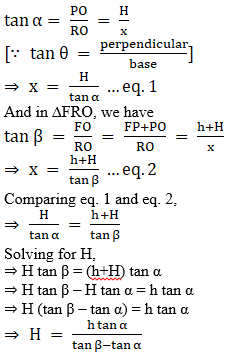
Hence, proved.
If tanθ + secθ = l, then prove that secθ = (l2 + 1)/2l.
Given: tan θ+ sec θ = l …eq. 1
Multiplying and dividing by (sec θ – tan θ) on numerator and denominator of L.H.S,
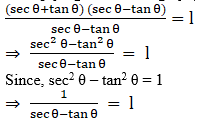
So, sec θ – tan θ = 1 …eq.2
Adding eq. 1and eq. 2, we get
(tan θ + sec θ) + (sec θ – tan θ) = 1
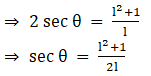
Hence, proved.
Class 10 students are advised to solve sample papers and previous years’ question papers to have an idea of the types of questions asked from the chapter Trigonometry. Also, find our online reading materials, such as notes, exemplar books, 10th Class Maths NCERT Solutions and question papers in downloadable PDF format to have a quick revision before the board exam.
Download BYJU’S – The Learning App to get personalised video lessons explaining Maths topics. Experience a new method of learning at BYJU’S to understand concepts effortlessly.