Q1Written answer
sin θ/(1+cos θ) + (1+ cos θ)/sin θ = 2cosec θ
Show solutionHide solution
Worked solution
L.H.S=
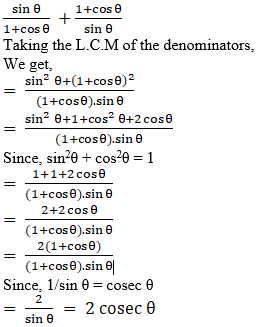
R.H.S
Hence proved.
Your cart is empty.
Practice each question, then open the answer or worked solution.
sin θ/(1+cos θ) + (1+ cos θ)/sin θ = 2cosec θ
L.H.S=
R.H.S
Hence proved.
tan A/(1+secA) – tan A/(1-secA) = 2cosec A
L.H.S:
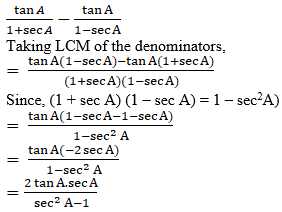
Since,
sec2A – tan2A = 1
sec2A – 1 = tan2A
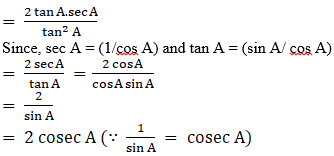
= R.H.S
Hence proved.
If tan A = ¾, then sinA cosA = 12/25
According to the question,
tan A = ¾
We know,
tan A = perpendicular/ base
So,
tan A = 3k/4k
Where,
Perpendicular = 3k
Base = 4k
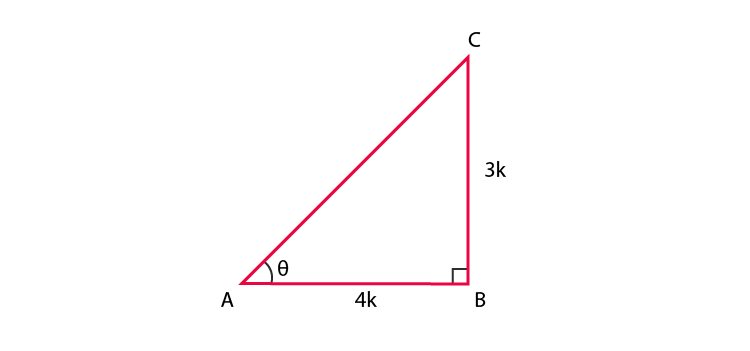
Using Pythagoras Theorem,
(hypotenuse)2 = (perpendicular)2 + (base)2
(hypotenuse)2 = (3k)2+ (4k)2 = 9k2+16k2 = 25k2
hypotenuse = 5k
To find sin A and cos A,
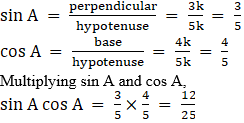
Hence, proved.
(sin α + cos α) (tan α + cot α) = sec α + cosec α
L.H.S:
(sin α + cos α) (tan α + cot α)
As we know,
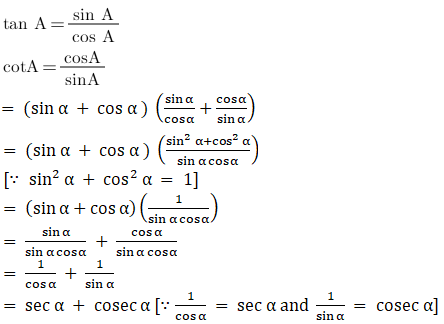
= R.H.S
Hence, proved.
(√3+1) (3 – cot 30°) = tan3 60° – 2 sin 60°
L.H.S: (√3 + 1) (3 – cot 30°)
= (√3 + 1) (3 – √3) [∵cos 30° = √3]
= (√3 + 1) √3 (√3 – 1) [∵(3 – √3) = √3 (√3 – 1)]
= ((√3)2– 1) √3 [∵ (√3+1)(√3-1) = ((√3)2 – 1)]
= (3-1) √3
= 2√3
Similarly solving R.H.S: tan3 60° – 2 sin 60°
Since, tan 60o = √3 and sin 60o = √3/2,
We get,
(√3)3 – 2.(√3/2) = 3√3 – √3
= 2√3
Therefore, L.H.S = R.H.S
Hence, proved.
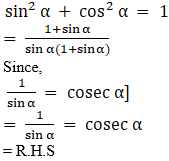
1 + (cot2 α/1+cosec α) = cosec α
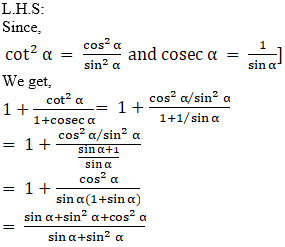
And, we know that,
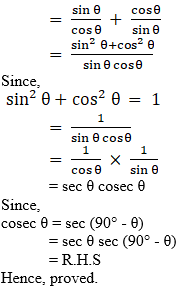
tan θ + tan (90° – θ) = sec θ sec (90° – θ)
L.H.S=
Since, tan (90° – θ) = cot θ
tan θ + tan (90° – θ)= tan θ + cot θ