My Cart
Your Cart 0

    Your cart is empty.

  • Total (Amount) ₹0.00
NCERT Exemplar · Class 10 · Maths

Chapter 7: Coordinate Geometry

Practice each question, then open the answer or worked solution.

Exercise 7.3

10 questions
Q1Written answer

Name the type of triangle formed by the points A (–5, 6), B (–4, –2) and C (7, 5).

Show solutionHide solution
Worked solution

The points are A (–5, 6), B (–4, –2) and C (7, 5)

Using distance formula,

d = √ ((x2 – x1)2 + (y2 – y1)2)

AB = √((-4+5)² + (-2-6)²)

= √1+64

=√65

BC=√((7+4)² + (5+2)²)

=√121 + 49

=√170

AC=√((7+5)² + (5-6)²)

=√144 + 1

=√145

Since all sides are of different length, ABC is a scalene triangle.
Q2Written answer

Find the points on the x–axis which are at a distance of 2√5 from the point (7, –4). How many such points are there?

Show solutionHide solution
Worked solution

Let coordinates of the point=(x, 0)(given that the point lies on x axis)

x1=7. y1=-4

x2=x. y2=0

Distance =√(x2-x1)2+ (y2-y1)2

According to the question,

2√5=√(x-7)2+ (0-(-4))2

Squaring L.H.S and R.H.S

20=x2+49-14x+16

20=x2+65-14x

0=x2-14x+45

0=x2-9x-5x+45

0=x(x-9)-5(x-9)

0=(x-9) (x-5)

x-9 =0. x-5= 0

x=9 or x=5

Therefore, coordinates of points…..(9,0)or(5,0)

Q3Written answer

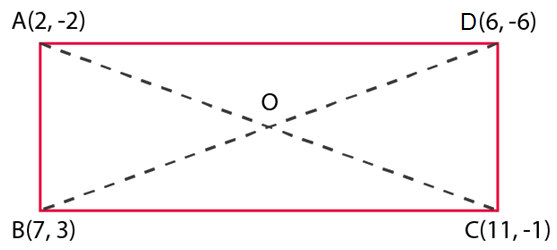
What type of a quadrilateral do the points A (2, –2), B (7, 3), C (11, –1) and D (6, –6) taken in that order, form?

Show solutionHide solution
Worked solution

The points are A (2, –2), B (7, 3), C (11, –1) and D (6, –6)

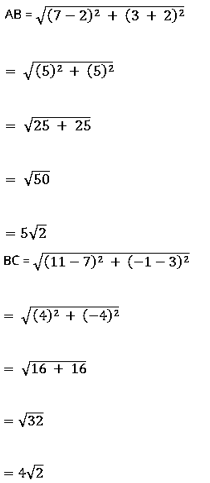
NCERT Exemplar Class 10 Maths Chapter 7 Ex. 7.3 Question 3

Using distance formula,

d = √ ((x2 – x1)2 + (y2 – y1)2)

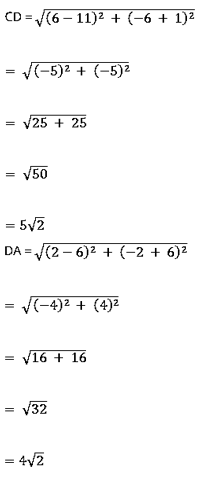
NCERT Exemplar Class 10 Maths Chapter 7 Ex. 7.3 Question 3-1

NCERT Exemplar Class 10 Maths Chapter 7 Ex. 7.3 Question 3-2

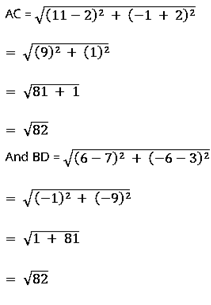
Finding diagonals AC and BD, we get,

NCERT Exemplar Class 10 Maths Chapter 7 Ex. 7.3 Question 3-3

The Quadrilateral formed is rectangle.

Q4Written answer

Find the value of a, if the distance between the points A (–3, –14) and B (a, –5) is 9 units.

Show solutionHide solution
Worked solution

Distance between two points (x1,y1) ( x2,y2) is :

d=√(x2-x1)²+(y2-y1)²

Distance between A (–3, –14) and B (a, –5) is :

=√[(a+3)²+(-5+14)²] =9

Squaring on L.H.S and R.H.S.

(a+3)²+81=81

(a+3)²=0

(a+3)(a+3)=0

a+3=0

a= -3

Q5Written answer

Find a point which is equidistant from the points A (–5, 4) and B (–1, 6)? How many such points are there?

Show solutionHide solution
Worked solution

Let the point be P

According to the question,

P is equidistant from A (–5, 4) and B (–1, 6)

Then the point P = ((x1+x2)/2, (y1+y2)/2)

= ((-5-1)/2, (6+4)/2)

= (-3 , 5 )

Q6Written answer

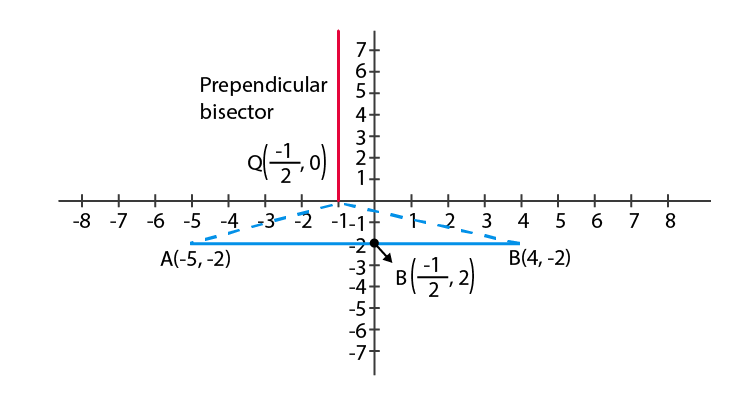
Find the coordinates of the point Q on the x–axis which lies on the perpendicular bisector of the line segment joining the points A (–5, –2) and B(4, –2). Name the type of triangle formed by the points Q, A and B.

Show solutionHide solution
Worked solution

Point Q is the midpoint of AB as the point P lies on the perpendicular bisector of AB.

NCERT Exemplar Class 10 Maths Chapter 7 Ex. 7.3 Question 6

By mid point formula:

(x1 + x2)/2 = (-5+4)/2

= -½

x = -½

Given that, P lies on x axis, so y=0

P(x,y)= (-½ , 0)

Therefore, it is an isosceles triangle

Q7Written answer

Find the value of m if the points (5, 1), (–2, –3) and (8, 2m) are collinear.

Show solutionHide solution
Worked solution

The points A(5, 1), B(–2, –3) and C(8, 2m) are collinear.

i.e., Area of ∆ABC = 0

½ [x1 (y2 – y3 ) + x2 (y3 – y1 ) + x3 (y1 – y2 )]=0

½ [5(-3 – 2m) + ( – 2)(2m – 1) + 8(1 – ( – 3))]=0

½ (-15 – 10m – 4m + 2 + 32) = 0

½ (-14m + 19) = 0

m = 19/14

Q8Written answer

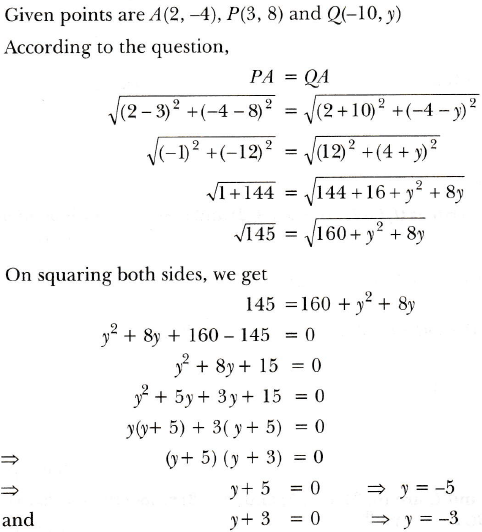
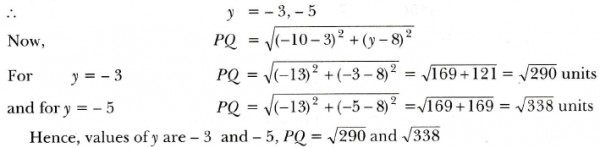
If the point A (2, – 4) is equidistant from P (3, 8) and Q (–10, y), find the values of y. Also find distance PQ.

Show solutionHide solution
Worked solution

NCERT Exemplar Class 10 Maths Chapter 7 Ex. 7.3 Question 8

NCERT Exemplar Class 10 Maths Chapter 7 Ex. 7.3 Question 8-1

Q9Written answer

Find the area of the triangle whose vertices are (–8, 4), (–6, 6) and (–3, 9).

Show solutionHide solution
Worked solution

Given vertices are:

(x₁, y₁) = (-8, 4)

(x₂, y₂) = (-6, 6)

(x₃, y₃) = (-3, 9)

Area of triangle = (½) (x₁(y₂ – y₃) + x₂(y₃ – y₁) + x₃(y₁ – y₂))

= (½) (-8(6 – 9) + -6(9 – 4) + -3(4 – 6))

= (½) (-8(-3) + -6(5) + -3(-2))

= (½) (24 – 30 + 6)

= (½) (30 – 30)

= 0 units.

Q10Written answer

In what ratio does the x–axis divide the line segment joining the points (– 4, – 6) and (–1, 7)? Find the coordinates of the point of division.

Show solutionHide solution
Worked solution

Let the ratio in which x-axis divides the line segment joining (–4, –6) and (–1, 7) = 1: k.

Then,

x-coordinate becomes (-1 – 4k) / (k + 1)

y-coordinate becomes (7 – 6k) / (k + 1)

Since P lies on x-axis, y coordinate = 0

(7 – 6k) / (k + 1) = 0

7 – 6k = 0

k = 6/7

Now, m1 = 6 and m2 = 7

By using section formula,

x = (m1x2 + m2x1)/(m1 + m2)

= (6(-1) + 7(-4))/(6+7)

= (-6-28)/13

= -34/13

So, now

y = (6(7) + 7(-6))/(6+7)

= (42-42)/13

= 0

Hence, the coordinates of P are (-34/13, 0)