My Cart
Your Cart 0

    Your cart is empty.

  • Total (Amount) ₹0.00
NCERT Exemplar · Class 10 · Maths

Chapter 7: Coordinate Geometry

Practice each question, then open the answer or worked solution.

Exercise 7.1

7 questions
Q1Written answer

The distance of the point P (2, 3) from the x-axis is

(A) 2 (B) 3 (C) 1 (D) 5

Show solutionHide solution
Worked solution

(B) 3

We know that,

(x, y) is a point on the Cartesian plane in first quadrant.

Then,

x = Perpendicular distance from Y – axis and

y = Perpendicular distance from X – axis

Therefore, the perpendicular distance from X-axis = y coordinate = 3
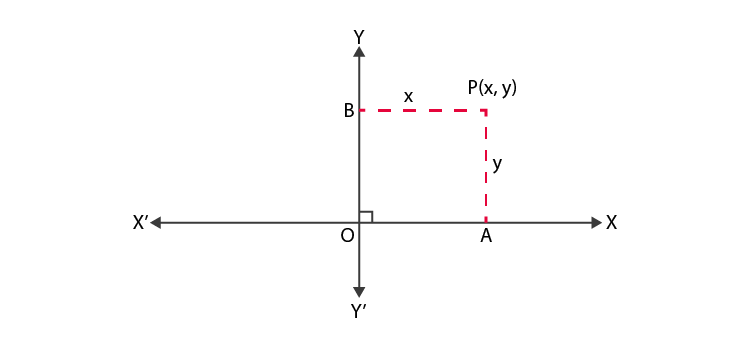
NCERT Exemplar Class 10 Maths Chapter 7 Ex. 7.1 Question 1

Q2Written answer

The distance between the points A (0, 6) and B (0, –2) is

(A) 6 (B) 8 (C) 4 (D) 2

Show solutionHide solution
Worked solution

(B) 8

Distance formula: d2 = (x2 – x1)2 + (y2 – y1)2

According to the question,

We have,

x1 = 0, x2 = 0

y1 = 6, y2 = – 2

d2 = (0 – 0)2 + ( – 2 – 6)2

d= √((0)2+ (-8)2)

d = √64

d = 8 units

Therefore, the distance between A (0, 6) and B (0, 2) is 8

Q3Written answer

The distance of the point P (–6, 8) from the origin is

(A) 8 (B) 2√7 (C) 10 (D) 6

Show solutionHide solution
Worked solution

(C) 10

Distance formula: d2 = (x2 – x1)2 + (y2 – y1)2

According to the question,

We have;

x1 = – 6, x2 = 0

y2 = 8, y2 = 0

d2 = [0 – ( – 6)]2 + [0 – 8]2

d= √((0-(-6))2+ (0-8)2

d= √((6)2+ (-8)2)

d = √(36 + 64)

d = √100

d = 10

Therefore, the distance between P ( – 6, 8) and origin O (0, 0) is 10

Q4Written answer

The distance between the points (0, 5) and (–5, 0) is

(A) 5 (B) 5√2 (C) 2√5 (D) 10

Show solutionHide solution
Worked solution

(B) 5√ 2

Distance formula: d2 = (x2 – x1)2 + (y2 – y1)2

According to the question,

We have;

x1 = 0, x2 = – 5

y2 = 5, y2 = 0

d2 = (( – 5) – 0)2 + (0 – 5)2

d= √(-5-0)2+ (0-5)2

d= √((-5)2+ (-5)2)

d = √(25 + 25)

d= √50= 5√2

So the distance between (0, 5) and ( – 5, 0) = 5√ 2

Q5Written answer

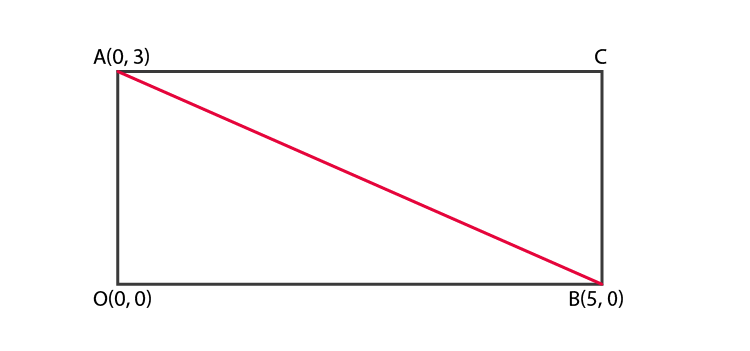
AOBC is a rectangle whose three vertices are vertices A (0, 3), O (0, 0) and B (5, 0). The length of its diagonal is

(A) 5 (B) 3 (C) √34 (D) 4

Show solutionHide solution
Worked solution

(C) √34

The three vertices are: A = (0, 3), O = (0, 0), B = (5, 0)

We know that, the diagonals of a rectangle are of equal length,

Length of the diagonal AB = Distance between the points A and B

Distance formula: d2 = (x2 – x1)2 + (y2 – y1)2

According to the question,

We have;

NCERT Exemplar Class 10 Maths Chapter 7 Ex. 7.1 Question 5

x1 = 0, x2 = 5

y2 = 3, y2 = 0

d2 = (5 – 0)2 + (0 – 3)2

d= √((5-0)2+ (0-3)2)

d = √(25 + 9)= √34

Distance between A (0, 3) and B (5, 0) is √34

Therefore, the length of its diagonal is √34

Q6Written answer

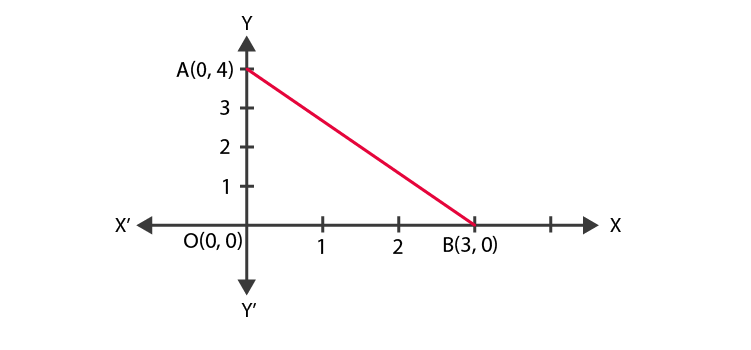
The perimeter of a triangle with vertices (0, 4), (0, 0) and (3, 0) is

(A) 5 (B) 12 (C) 11 (D) 7+ √5

Show solutionHide solution
Worked solution

(B) 12

The vertices of a triangle are (0, 4), (0, 0) and (3, 0).

Now, perimeter of ΔAOB = Sum of the length of all its sides:

= distance between (OA+OB+AB)

Distance between the points (x1,y1) and (x2, y2) is given by,

d = √ ((x2 – x1)2 + (y2 – y1)2)

NCERT Exemplar Class 10 Maths Chapter 7 Ex. 7.1 Question 6

To find:

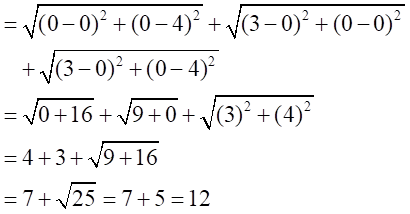
Distance between A(0, 4) and O(0, 0) + Distance between O(0, 0) and B(3, 0) + Distance between A(0, 4) and B(3, 0)

NCERT Exemplar Class 10 Maths Chapter 7 Ex. 7.1 Question 6 -1

Therefore, the required perimeter of triangle is 12

Q7Written answer

The area of a triangle with vertices A (3, 0), B (7, 0) and C (8, 4) is

(A) 14 (B) 28 (C) 8 (D) 6

Show solutionHide solution
Worked solution

(C) 8

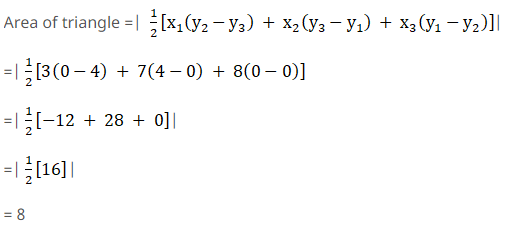
Vertices of the triangle are,

A (x1, y1) = (3, 0)

B (x2, y2) = (7, 0)

C (x3, y3) = (8, 4)

NCERT Exemplar Class 10 Maths Chapter 7 Ex. 7.1 Question 7

Therefore, the area of ΔABC is 8.