My Cart
Your Cart 0

    Your cart is empty.

  • Total (Amount) ₹0.00
NCERT Exemplar · Class 10 · Maths

Chapter 7: Coordinate Geometry

Practice each question, then open the answer or worked solution.

Exercise 7.2

6 questions
Q1Written answer

△ABC with vertices A (–2, 0), B (2, 0) and C (0, 2) is similar to △DEF with vertices D (–4, 0) E (4, 0) and F (0, 4).

Show solutionHide solution
Worked solution

True.

Justification:
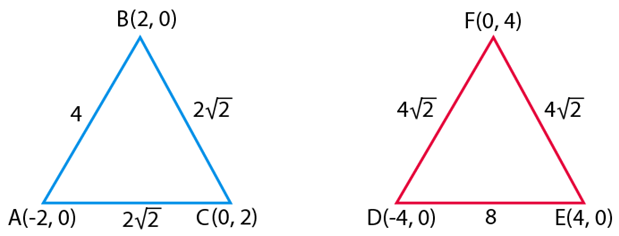
NCERT Exemplar Class 10 Maths Chapter 7 Ex. 7.2 Question 1

Using distance formula, d = √ ((x2 – x1)2 + (y2 – y1)2)

We can find,
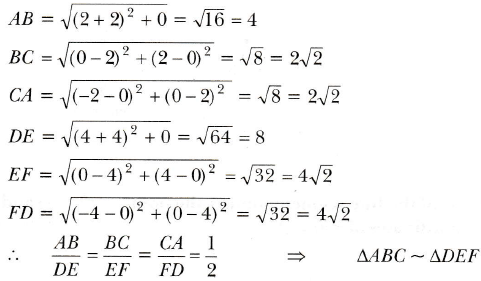
NCERT Exemplar Class 10 Maths Chapter 7 Ex. 7.2 Question 1-1

Hence, triangle ABC and DEF are similar.
Q2Written answer

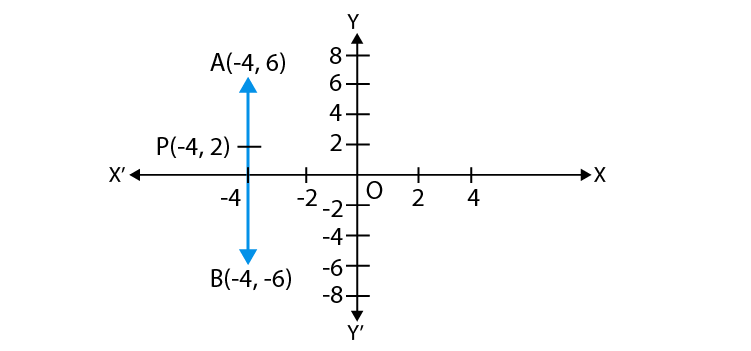
Point P (– 4, 2) lies on the line segment joining the points A (– 4, 6) and B (– 4, – 6).

Show solutionHide solution
Worked solution

True.

Justification:

Plotting the points P(- 4, 2), A (- 4, 6) and B (- 4, – 6) on a graph paper and connecting the points we get the graph,

NCERT Exemplar Class 10 Maths Chapter 7 Ex. 7.2 Question 2

Hence, from the graph it is clear that, point P ( – 4, 2) lies on the line segment joining the points A ( – 4, 6) and B ( – 4, – 6),

Q3Written answer

The points (0, 5), (0, –9) and (3, 6) are collinear.

Show solutionHide solution
Worked solution

False

Justification:

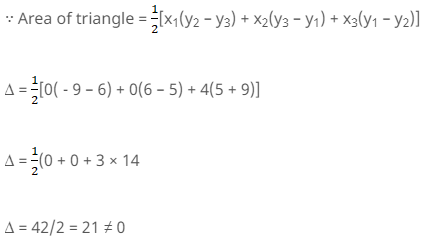
The points are collinear if area of a triangle formed by its points is equals to the zero.

Given,

x1 = 0, x2 = 0, x3 = 3 and

y1 = 5, y2 = – 9, y3 = 6

NCERT Exemplar Class 10 Maths Chapter 7 Ex. 7.2 Question 3

From the above equation, it is clear that the points are not collinear.


Q4Written answer

Point P (0, 2) is the point of intersection of y–axis and perpendicular bisector of line segment joining the points A (–1, 1) and B (3, 3).

Show solutionHide solution
Worked solution

False

Justification:

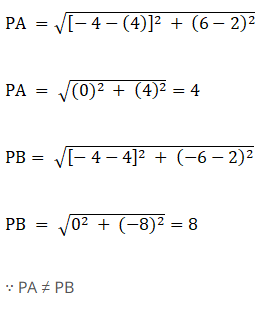
We know that, the points lying on perpendicular bisector of the line segment joining the two points is equidistant from the two points.

i.e., PA should be equals to the PB.

Using distance formula,

d = √ ((x2 – x1)2 + (y2 – y1)2)

NCERT Exemplar Class 10 Maths Chapter 7 Ex. 7.2 Question 4

Q5Written answer

Points A (3, 1), B (12, –2) and C (0, 2) cannot be the vertices of a triangle.

Show solutionHide solution
Worked solution

True.

Justification:

Coordinates of A = (x1, y1) = (3, 1)

Coordinates of B = (x2, y2) = (12, – 2)

Coordinates of C = (x3, y3) = (0, 2)

Area of ∆ABC = ∆ = 1/2 [x1 (y2 – y3) + x2 (y3 – y1 ) + x3 (y1 – y2 )]

Δ = ½ [3 – (2 – 2) + 12(2 – 1) + 0{1 – (- 2)}]

Δ = ½ [3(- 4) + 12(1) + 0]

Δ = ½ (- 12 + 12) =0

Area of ΔABC = 0

Since, the points A (3, 1), B (12, – 2) and C (0, 2) are collinear.

Therefore, the points A (3, 1), B (12, – 2) and C (0, 2) can’t be the vertices of a triangle.

Q6Written answer

Points A (4, 3), B (6, 4), C (5, –6) and D (–3, 5) are the vertices of a parallelogram.

Show solutionHide solution
Worked solution

False

Justification:

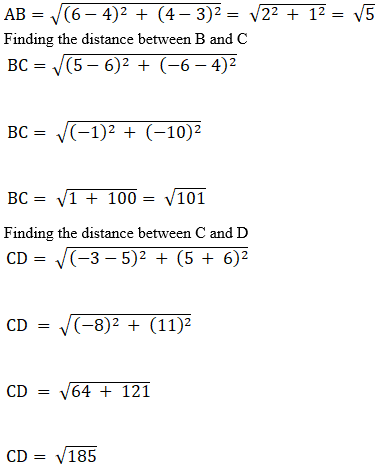
The given points are A (4, 3), B (6, 4), C (5, –6) and D (–3, 5)

Finding the distance between A and B

NCERT Exemplar Class 10 Maths Chapter 7 Ex. 7.2 Question 6

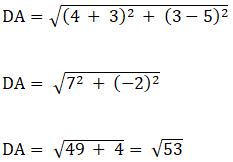
Finding the distance between D and A

NCERT Exemplar Class 10 Maths Chapter 7 Ex. 7.2 Question 6-1

Since the distances are different, we can conclude that the points are not the vertices of a parallelogram.