My Cart
Your Cart 0

    Your cart is empty.

  • Total (Amount) ₹0.00
NCERT · Class 9 · Science

Chapter 5: The Fundamental Unit of Life

Practice each question, then open the answer or worked solution.

Exercise

Textbook page 67 · 10 questions
Q1Written answer

Make a comparison and write down ways in which plant cells are different from animal cells.

Show solutionHide solution
Worked solution

The following table depicts the differences between plant cells and animal cells.

Characteristic Plant Cell Animal Cell
Cell Wall Present Absent
Shape of Cell With distinct edges, the shape is either rectangular or square-shaped. Round and irregular shape
Nucleus Present. It lies on one side of the cell Present. It lies in the centre of the cell
Lysosomes Rarely present Always present
Plastids Present Absent
Structure of Vacuoles Single or a few large vacuoles that are centrally located Presence of numerous and small vacuoles
Q2Written answer

How is a prokaryotic cell different from a eukaryotic cell?

Show solutionHide solution
Worked solution

The following are the differences between prokaryotic and eukaryotic cells.

Prokaryotic Cell Eukaryotic Cell
1.  Size: Generally small (1-10 μm)

1 μm = 10-6m

2.  The nuclear region is not well defined as the nuclear membrane is absent and is referred to as the nucleoid.

3. There is a single chromosome.

4. Membrane-bound cell organelles absent.

1. Size: Generally large (5-100 μm)

2. Nuclear region: well-defined and girdled by a nuclear membrane.

3. There is more than one chromosome.

4. Membrane-bound cell organelles present.

Q3Written answer

What would happen if the plasma membrane ruptures or breaks down?

Show solutionHide solution
Worked solution

If the plasma membrane ruptures or breaks down, then molecules of some substances will freely move in and out of the cells. As the plasma membrane acts as a mechanical barrier, the exchange of material from its surroundings through osmosis or diffusion in a cell won’t take place. Consequently, the cell would die due to the disappearance of the protoplasmic material.

Q4Written answer

What would happen to the life of a cell if there was no Golgi apparatus?

Show solutionHide solution
Worked solution

The Golgi apparatus consists of stacks of membrane-bound vesicles whose functions are as follows:

  • Storage of substances
  • Packaging of substances
  • Manufacture of substances

Without the Golgi apparatus, the cells will be disabled from packing and dispatching materials that were produced by the cells. The Golgi apparatus is also involved in the formation of cells. Hence, in the absence of the Golgi apparatus, cells will not be produced.

Q5Written answer

Which organelle is known as the powerhouse of the cell? Why?

Show solutionHide solution
Worked solution

Mitochondria are known as the powerhouse of the cell. It is because it releases the energy required for different activities of life. Mitochondria releases energy in the form of ATP (Adenosine triphosphate) molecules, essential for numerous chemical activities of life. Hence, ATP is often referred to as the ‘energy currency of the cell’.

Q6Written answer

Where do the lipids and proteins constituting the cell membrane get synthesised?

Show solutionHide solution
Worked solution

Lipids and proteins are synthesised in the ER (Endoplasmic Reticulum).

Q7Written answer

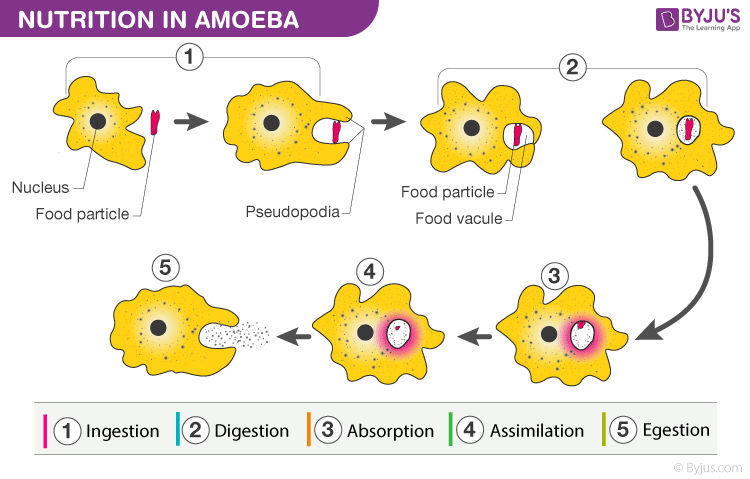
How does an Amoeba obtain its food?

Show solutionHide solution
Worked solution

Through the process of endocytosis, an Amoeba obtains its food. As its cell membrane is flexible enough, food particles are engulfed, forming a food vacuole girdling it, which is assisted by the pseudopodia. Amoeba secretes digestive enzymes to bring about digestion of the engulfed particle once the food is trapped.

Nutrition in Amoeba

Q8Written answer

What is osmosis?

Show solutionHide solution
Worked solution

The process of movement of a water molecule from a region of higher concentration to a region of lower concentration through a semipermeable membrane is known as osmosis.

Q9Written answer

Carry out the following osmosis experiment:

Take four peeled potato halves and scoop each one out to make potato cups. One of these potato cups should be made from a boiled potato. Put each potato cup in a trough containing water. Now,

(a) Keep cup A empty

(b) Put one teaspoon sugar in cup B

(c) Put one teaspoon salt in cup C

(d) Put one teaspoon sugar in the boiled potato cup D.

Keep these for two hours. Then observe the four potato cups and answer the following:

(i) Explain why water gathers in the hollowed portion of B and C.

(ii) Why is potato A necessary for this experiment?

(iii) Explain why water does not gather in the hollowed-out portions of A and D.

Show solutionHide solution
Worked solution

(i) Water accumulates in the hollowed portions of B and C as a difference in the water concentration

is observed. Thereby, endosmosis occurs as the cells act as a semipermeable membrane.

(ii) Potato A is essential in this experiment as it is significant to compare different scenarios seen in

potato cups B, C and D. Potato A in this experiment clearly shows that the potato cavity on its

own cannot bring about water movement.

(iii) Cup in A does not show any change in the water flow concentration for osmosis to occur, which

requires concentration to be higher than the other. Cells in cup D are dead; thus, there is no

existence of a semipermeable membrane for water flow. Consequently, osmosis does not occur.

Q10Written answer

Which type of cell division is required for the growth and repair of the body, and which type is involved in the formation of gametes?

Show solutionHide solution
Worked solution

There are two ways in which a cell divides:

  • Mitosis
  • Meiosis

Mitosis is the type of cell division that is involved in the growth and repair of the body, whereas meiosis is a type of cell division which results in the formation of gametes.