My Cart
Your Cart 0

    Your cart is empty.

  • Total (Amount) ₹0.00
NCERT · Class 6 · Maths

Chapter 7: Fractions

Practice each question, then open the answer or worked solution.

Exercise 7.3

Textbook page 146 · 9 questions
Q1Written answer

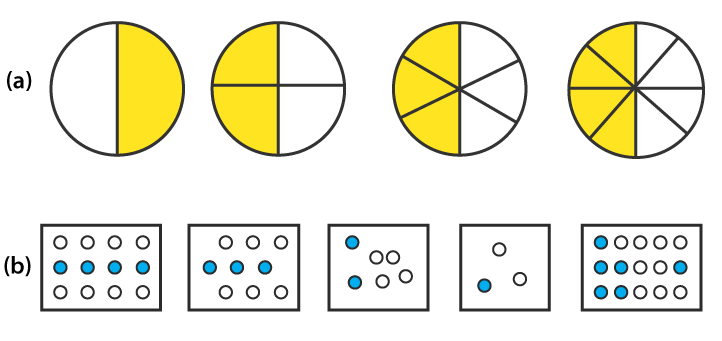
Write the fractions. Are all these fractions equivalent?
NCERT Solutions for Class 6 Maths Chapter 7 Exercise 7.3 - 1

Show solutionHide solution
Worked solution

(a)

(i) The shaded portion is 1 / 2

(ii) The shaded portion is 2 / 4 = (2 / 2) / (4 / 2) = 1 / 2

(iii) The shaded portion is 3 / 6 = (3 / 3) / (6 / 3) = 1 / 2

(iv) The shaded portion is 4 / 8 = (4 / 4) / (8 / 4) = 1 / 2

Hence, all fractions are equivalent.

(b)

(i) The shaded portion is 4 / 12 = (4 / 4) / (12 / 4) = 1 / 3

(ii)The shaded portion is 3 / 9 = (3 / 3) / (9 / 3) = 1 / 3

(iii) The shaded portion is 2 / 6 = (2 / 2) / (6 / 2) = 1 / 3

(iv) The shaded portion is 1 / 3

(v) The shaded portion is 6 / 15 = (6 / 3) / (15 / 3) = 2 / 5

All the fractions in their simplest form are not equal

Hence, they are not equivalent fractions.
Q2Written answer

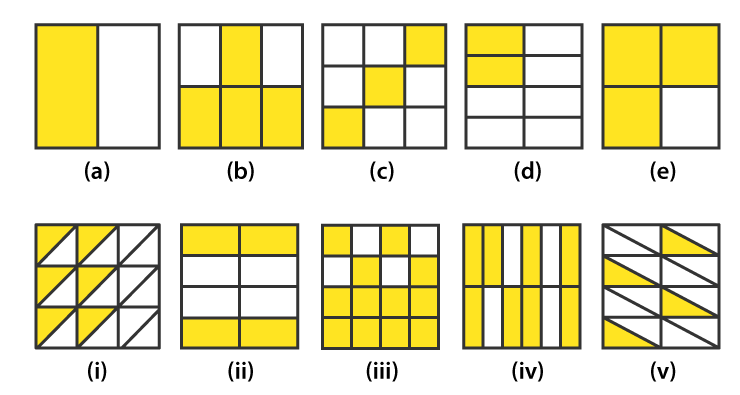
Write the fractions and pair up the equivalent fractions from each row.

NCERT Solutions for Class 6 Maths Chapter 7 Exercise 7.3 - 2

Show solutionHide solution
Worked solution

(a) 1 / 2

(b) 4 / 6 = (4 / 2) / (6 / 2)

= 2 / 3

(c) 3 / 9 = (3 / 3) / (9 / 3)

= 1 / 3

(d) 2 / 8 = (2 / 2) / (8 / 2)

= 1 / 4

(e) 3 / 4

(i) 6 / 18 = (6 / 6) / (18 / 6)

= 1 / 3

(ii) 4 / 8 = (4 / 4) / (8 / 4)

= 1 / 2

(iii) 12 / 16 = (12 / 4) / (16 / 4)

= 3 / 4

(iv) 8 / 12 = (8 / 4) / (12 / 4)

= 2 / 3

(v) 4 / 16 = (4 / 4) / (16 / 4)

= 1 / 4

The following are the equivalent fractions

(a) and (ii) = 1 / 2

(b) and (iv) = 2 / 3

(c) and (i) = 1 / 3

(d) and (v) = 1 / 4

(e) and (iii) = 3 / 4

Q3Multiple choice

Replace ☐ in each of the following by the correct number:

(e) 18 / 24 = ☐ / 4

Show answerHide answer
Correct option: A
Show solutionHide solution
Worked solution

(a) Given

2 / 7 = 8 / ☐

2 × ☐ = 7 × 8

☐ = (7 × 8) / 2

= 28

(b) Given

5 / 8 = 10 / ☐

☐ = (8 × 10) / 5

= 16

(c) Given

3 / 5 = ☐ / 20

☐ = (3 × 20) / 5

= 12

(d) Given

45 / 60 = 15 / ☐

☐ = (15 × 60) / 45

= 20

(e) Given

18 / 24 = ☐ / 4

☐ = (18 × 4) / 24

= 3

Q4Written answer

Find the equivalent fraction of 3 / 5 having

(a) denominator 20

(b) numerator 9

(c) denominator 30

(d) numerator 27

Show solutionHide solution
Worked solution

(a) We require denominator 20

Let M be the numerator of the fractions

∴ M / 20 = 3 / 5

5 × M = 20 × 3

M = (20 × 3) / 5

= 12

Therefore, the required fraction is 12 / 20

(b) We require numerator 9

Let N be the denominator of the fractions

∴ 9 / N = 3 / 5

3 × N = 9 × 5

N = (9 × 5) / 3

= 15

Therefore, the required fraction is 9 / 15

(c) We require denominator 30

Let D be the numerator of the fraction

∴ D / 30 = 3 / 5

5 × D = 3 × 30

D = (3 × 30) / 5

= 18

Therefore, the required fraction is 18 / 30

(d) We require numerator 27

Let N be the denominator of the fraction

∴ 27 / N = 3 / 5

3 × N = 5 × 27

N = (5 × 27) / 3

= 45

Therefore, the required fraction is 27 / 45


Q5Written answer

Find the equivalent fraction of 36 / 48 with

(a) numerator 9

(b) denominator 4

Show solutionHide solution
Worked solution

(a) Given numerator = 9

∴ 9 / D = 36 / 48

D × 36 = 9 × 48

D = (9 × 48) / 36

D = 12

Hence, the equivalent fraction is 9 / 12

(b) Given, denominator = 4

∴ N / 4 = 36 / 48

N × 48 = 4 × 36

N = (4 × 36) / 48

= 3

Hence, the equivalent fraction is 3 / 4

Q6Written answer

Check whether the given fractions are equivalent:

(a) 5 / 9, 30 / 54

(b) 3 / 10, 12 / 50

(c) 7 / 13, 5 / 11

Show solutionHide solution
Worked solution

(a) Given 5 / 9 and 30 / 54

We have 5× 54 = 270

9 × 30 = 270

5 × 54 = 9 × 30

Hence, 5 / 9 and 30 / 54 are equivalent fractions

(b) Given 3 / 10 and 12 / 50

We have 3 × 50 = 150

10 × 12 = 120

3 × 50 ≠ 10 × 12

Hence, 3 / 10 and 12 / 50 are not equivalent fractions

(c) Given 7 / 13 and 5 / 11

We have 7 × 11 = 77

5 × 13 = 65

7 × 11 ≠ 5 × 13

Hence, 7 / 13 and 5 / 11 are not equivalent fractions

Q7Written answer

Reduce the following fractions to simplest form:

(a) 48 / 60

(b) 150 / 60

(c) 84 / 98

(d) 12 / 52

(e) 7 / 28

Show solutionHide solution
Worked solution

(a) 48 / 60 = (12 × 4) / (12 × 5)

= 4 / 5

(b) 150 / 60 = (30 × 5) / (30 × 2)

= 5 / 2

(c) 84 / 98 = (14 × 6) / (14 × 7)

= 6 / 7

(d) 12 / 52 = (3 × 4) / (13 × 4)

= 3 / 13

(e) 7 / 28 = 7 / (7 × 4)

= 1 / 4

Q8Written answer

Ramesh had 20 pencils, Sheelu had 50 pencils and Jamaal had 80 pencils. After 4 months, Ramesh used up 10 pencils, Sheelu used up 25 pencils and Jamaal used up 40 pencils. What fraction did each use up? Check if each has used up an equal fraction of her/his pencils.

Show solutionHide solution
Worked solution

Total number of pencils Ramesh had = 20

Number of pencils used by Ramesh = 10

∴ Fraction = 10 / 20 = 1 / 2

Total number of pencils Sheelu had = 50

Number of pencils used by Sheelu = 25

∴ Fraction = 25 / 50 = 1 / 2

Total number of pencils Jamaal had = 80

Number of pencils used by Jamaal = 40

∴ Fraction = 40 / 80 = 1 / 2

Yes, each has used up an equal fraction of pencils i.e 1 / 2

Q9Written answer

Match the equivalent fractions and write two more for each.

(i) 250 / 400 (a) 2 / 3

(ii) 180 / 200 (b) 2 / 5

(iii) 660 / 990 (c) 1 / 2

(iv) 180 / 360 (d) 5 / 8

(v) 220 / 550 (e) 9 / 10

Show solutionHide solution
Worked solution

(i) 250 / 400

= (5 × 50) / (8 × 50)

= 5 / 8

25 / 40 and 30 / 48 are two more fractions

(ii) 180 / 200

= (9 × 20) / (10 × 20)

= 9 / 10

18 / 20 and 27 / 30 are two more fractions

(iii) 660 / 990

= (2 × 330) / (3 × 330)

= 2 / 3

20 / 30 and 200 / 300 are two more fractions

(iv) 180 / 360

= (1 × 180) / (2 × 180)

= 1 / 2

20 / 40 and 30 / 60 are two more fractions

(v) 220 / 550

= (2 × 110) / (5 × 110)

= 2 / 5

20 / 50 and 40 / 100 are two more fractions

∴ The equivalent fractions are

(i) 250 / 100 = (d) 5 / 8

(ii) 180 / 200 = (e) 9 / 10

(iii) 660 / 990 = (a) 2 / 3

(iv) 180 / 360 = (c) 1 / 2

(v) 220 / 550 = (b) 2 / 5