My Cart
Your Cart 0

    Your cart is empty.

  • Total (Amount) ₹0.00
NCERT · Class 5 · Maths

Chapter 6: Be My Multiple, I’ll Be Your Factor

Practice each question, then open the answer or worked solution.

Questions

15 questions
Q1Written answer

The hungry cat is trying to catch Kunjan, the mouse. Kunjan is now on the 14th step, and it can jump 2 steps at a time. The cat is on the third step. She can jump 3 steps at a time. If the mouse reaches 28, it can hide in the hole. Find out whether the mouse can get away safely.

a) The steps on which the mouse jumps

Show solutionHide solution
Worked solution

Solution:-

The mouse jumps from the 14th step to the 16, 18, 20, 22, 24, 26, and 28th steps.

b) The steps on which the cat jumps

Solution:-

The cat jumps from the 3rd step to the 6, 9, 12, 15, 18, 21, 24, and 27th steps.

c) The steps on which both the cat and the mouse jump

Solution:-

The steps on which both the cat and the mouse jump are the 18th and 24th steps.

d) Can the mouse get away?

Solution:-

Yes, the mouse can get away.
Q2Written answer

Find out

If the cat starts from the 5th step and jumps five steps at a time, and the mouse starts from the 8th step and jumps four steps at a time, can the mouse get away?

Show solutionHide solution
Worked solution

Solution:-

If the cat starts from the 5th step and jumps five steps at a time, the cat jumps from the 5th step to the 10, 15, 20, and 25th steps,

Then, the mouse starts from the 8th step and jumps four steps at a time, the mouse jumps from the 8th step to 12, 16, 20, and 24th steps.

Then, the mouse cannot get away. Cat will easily catch the mouse at the 20th step.

Q3Written answer

Who is Monto waiting for?

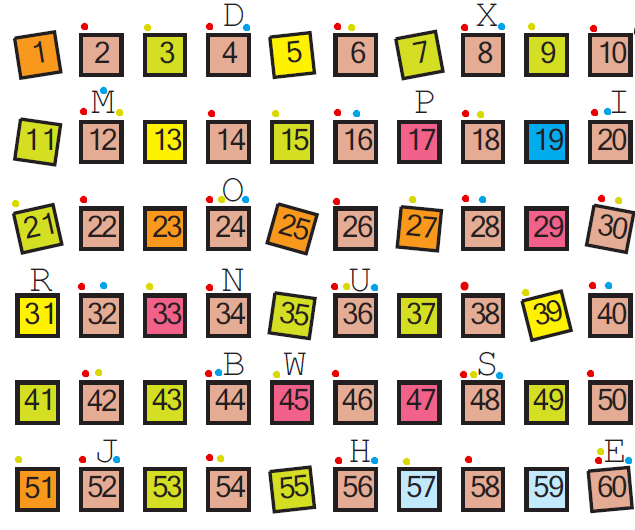
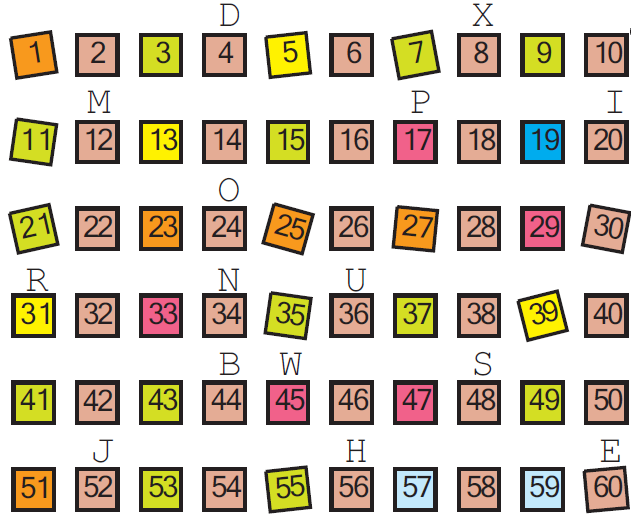
Monto cat is waiting for somebody. Do you know for whom he is waiting?

There is a trick to find out.

NCERT Solutions for Class 5 Maths Chapter 6 image 1

Mark with a red dot all the numbers which can be divided by 2.

Mark a yellow dot on the numbers which can be divided by 3 and a blue dot on the numbers which can be divided by 4.

Show solutionHide solution
Worked solution

Solution:-

NCERT Solutions for Class 5 Maths Chapter 6 image 2

(i) Which are the boxes that have dots of all three colours?

Solution:-

The boxes with dots of all three colours are 12, 24, 36, 48, and 60.

(ii) What are the letters on top of these boxes?

Solution:-

The letters on top of these boxes are M, O, U, S, and E.


(iii) Write the letters, M, O, U, S, and E, in order.

Solution:-

MOUSE,

So, Monto cat is waiting for Mouse.

Q4Written answer

Meow Game: To play this game, everyone stands in a circle. One player calls out ‘one’. The next player says ‘two’ and so on. A player who has to call out 3 or a number which can be divided by 3 has to say ‘Meow’ instead of the number. One who forgets to say ‘Meow’ is out of the game. The last player left is the winner.

Which numbers did you replace with ‘Meow’?

Show solutionHide solution
Worked solution

Solution:-

The numbers which replace with ‘Meow’ and multiples of 3 are,

3, 6, 9, 12, 15, 18, 21, 24, 27, 30, 33, 36, 39, 42, 45 and so on.

Q5Written answer

We say these numbers are multiples of 4. Find the numbers.

Play the game by changing the number to 4. Now, which numbers did you replace with ‘Meow’? These numbers are the multiples of 4.

Show solutionHide solution
Worked solution

Solution:-

The numbers which replace with ‘Meow’ and multiples of 4 are,

4, 8, 12, 16, 20, 24, 28, 32, 36, 40, and so on.

(i) Write any ten multiples of 5.

Solution:-

Ten multiples of 5 are 5, 10, 15, 20, 25, 30, 35, 40, 45, and 50.

Q6Written answer

Common Multiples

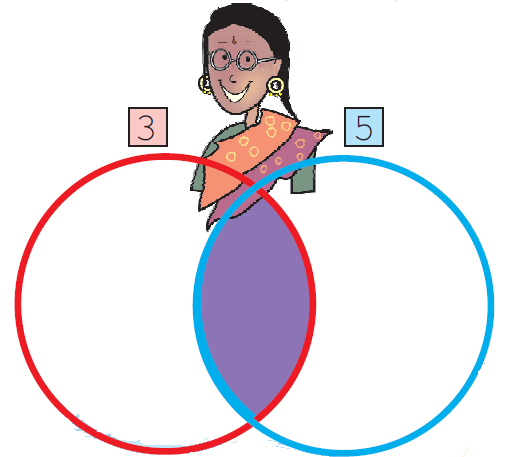
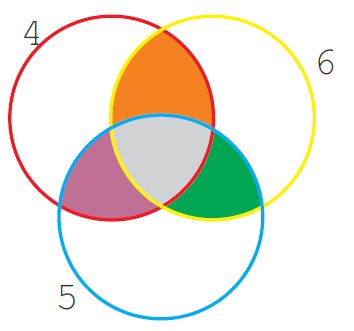
(i) Think of a number. If it is a multiple of 3, write it in the red circle. If it is a multiple of 5, write it in the blue circle.

NCERT Solutions for Class 5 Maths Chapter 6 image 3

Show solutionHide solution
Worked solution

Solution:-

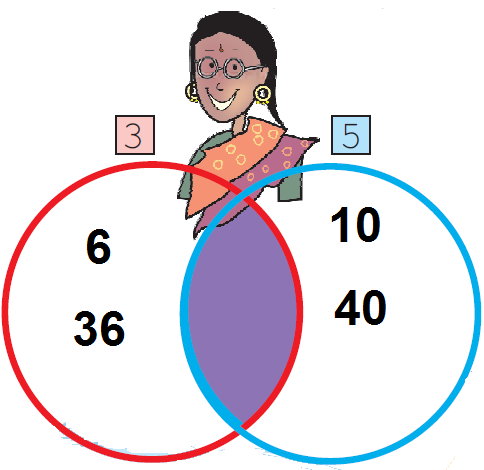
6 and 36 are multiple of 3.

10 and 40 are multiple of 5.

Then,

NCERT Solutions for Class 5 Maths Chapter 6 image 4

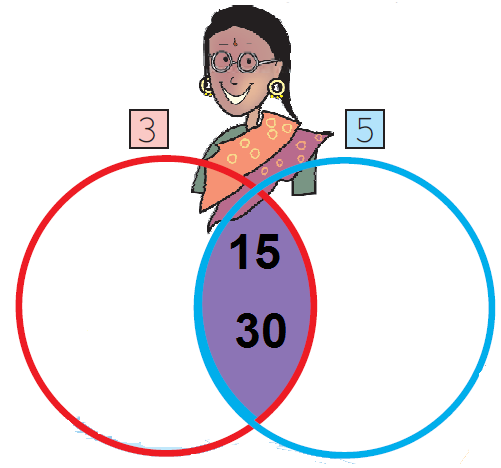
(ii) Some numbers are multiples of both 3 and 5. So we can say that they are both 3 and 5. Think! If you write the multiples common to 3 and 5 in the purple part, then will they still be in both the red and the blue circles?

Solution:-

15 and 30 are the numbers which are multiples of both 3 and 5.

NCERT Solutions for Class 5 Maths Chapter 6 image 5

Q7Written answer

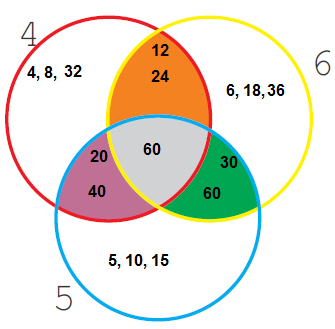
Repeat the game by putting the multiples of 4, 6 and 5 in the circles.

NCERT Solutions for Class 5 Maths Chapter 6 image 6

Show solutionHide solution
Worked solution

Solution:-

NCERT Solutions for Class 5 Maths Chapter 6 image 7

(i) What common multiples of 5 and 6 did you write in the green part?

Solution:-

30 and 60 are the common multiples of 5 and 6.

(ii) What common multiples of 4 and 6 are written in the orange part?

Solution:-

12 and 24 are the common multiples of 4 and 6.

(iii) In which coloured part did you write the common multiples of 4, 6 and 5?

Solution:-

The common multiples of 4, 6 and 5 are written in the grey part.

(iv) What is the smallest common multiple of 4, 6 and 5?

Solution:-

The smallest common multiple of 4, 6 and 5 is 60.

Q8Written answer

Tamarind seeds.

(i) Sunita took some tamarind (imli) seeds. She made groups of five with them and found that one seed was left over. She tried making groups of six and groups of four. Each time one seed was left over. What is the smallest number of seeds that Sunita had?

Show solutionHide solution
Worked solution

Solution:-

From the question, it is given that,

Sunita is trying to make groups of four, five, and six every time; one seed remains.

So, now we calculate the LCM of 4, 5, and 6 and add 1 to the LCM.

LCM of 4, 5, and 6 is 60

Adding 1 to the LCM, we get 61

Therefore, the smallest number of seeds that Sunita had was 61.

Q9Written answer

More tamarind seeds

Ammini arranges 12 tamarind seeds in the form of different rectangles. Try to make more rectangles like this using 12 tamarind seeds. How many different rectangles can you make?

Show solutionHide solution
Worked solution

Solution:-

I got four different rectangles, as shown in the figure below,

NCERT Solutions for Class 5 Maths Chapter 6 image 8

(i) If there are 15 tamarind seeds, how many rectangles can you make?

Solution:-

NCERT Solutions for Class 5 Maths Chapter 6 image 9

Q10Written answer

Colouring the Grid

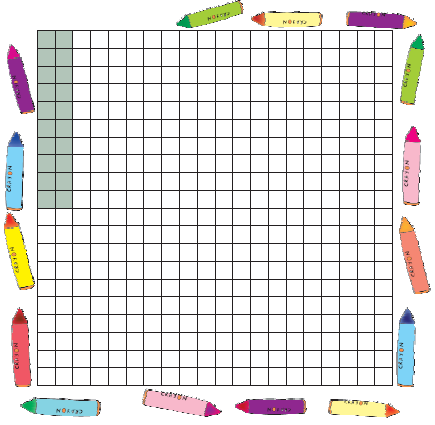
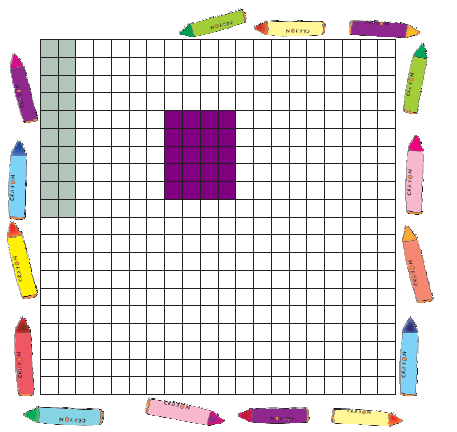
NCERT Solutions for Class 5 Maths Chapter 6 image 10

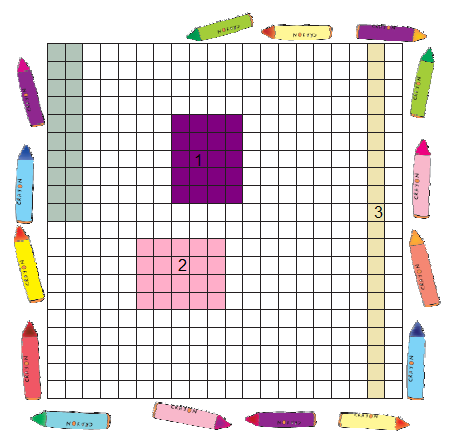
In the grid here, a rectangle made of 20 boxes is drawn.

The width of this rectangle is 2 boxes.

(i) What is its length?

Show solutionHide solution
Worked solution

Solution:-

By observing the rectangle coloured in the grid, we can say that length of the rectangle is 10 boxes.

(ii) Colour a rectangle made of 20 boxes in some other way.

Solution:-

NCERT Solutions for Class 5 Maths Chapter 6 image 11

(iii) What is the length and width of the rectangle you coloured?

Solution:-

The length of the rectangle is 5 boxes, and the width of the rectangle is 4 boxes.

(iv) In how many ways can you colour a rectangle of 20 boxes? Colour them all in the grid, and write the length and width of each rectangle you have coloured.

Solution:-

NCERT Solutions for Class 5 Maths Chapter 6 image 12

The length and width of rectangle 1 are 5 and 4, respectively.

The length and width of rectangle 2 are 4 and 5, respectively.

The length and width of rectangle 3 are 20 and 1, respectively.