My Cart
Your Cart 0

    Your cart is empty.

  • Total (Amount) ₹0.00
NCERT · Class 5 · Maths

Chapter 3: How Many Squares?

Practice each question, then open the answer or worked solution.

Questions

7 questions
Q1Written answer

NCERT Solutions For Class 5 Maths Chapter 3 Image 1

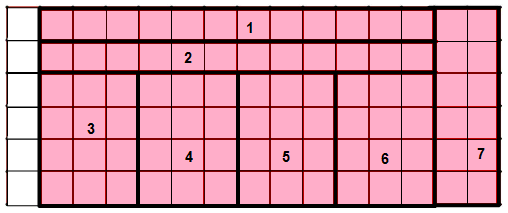
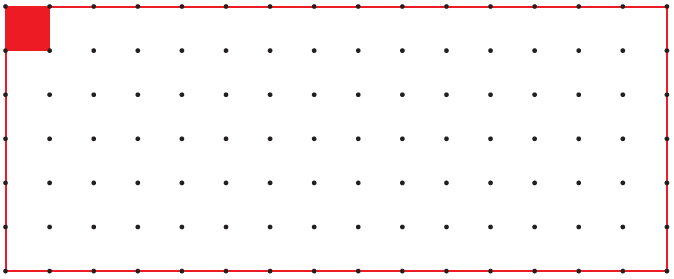
(i) Measure the side of the square on the dotted sheet. Draw here as many rectangles as possible using 12 such squares.

Show solutionHide solution
Worked solution

Solution:-

The side of the square on the dotted sheet is 1 cm.

NCERT Solutions For Class 5 Maths Chapter 3 Image 2

(ii) How many rectangles could you make?

Solution:-

We can make 7 rectangles.

Q2Written answer

Each rectangle is made out of 12 equal squares, so all have the same area, but the length of the boundary will be different.

(i) Which of these rectangles has the longest perimeter?

Show solutionHide solution
Worked solution

Solution:-

From the above figure, we can say that rectangles 1 and 2 have the longest perimeter.

We know that, perimeter of rectangle = 2 (length + breadth)

= 2 (1 + 12)

= 2 × 13

= 26 cm

(ii) Which of these rectangles has the smallest perimeter?

Solution:-

From the above figure, we can say that rectangles 3, 4, 5 and 6 have the smallest perimeter.

We know that, perimeter of rectangle = 2 (length + breadth)

= 2 (3 + 5)

= 2 × 8

= 16 cm

Q3Written answer

NCERT Solutions For Class 5 Maths Chapter 3 Image 3

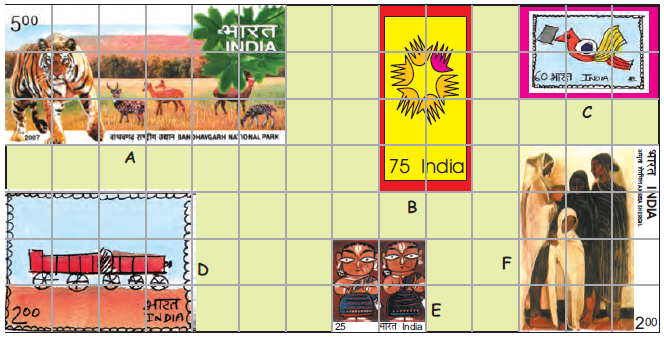
Look at these interesting stamps.

(a) How many squares of one-centimetre side do stamp A and stamp B cover? 

Show solutionHide solution
Worked solution

Solution:-

Stamp A covers 18 squares of the one-centimetre side, and Stamp B covers 8 squares of the one-centimetre side.

(b) Which stamp has the biggest area?

Solution:-

Stamp ‘A’ has the biggest area because it has 18 squares.

(i) How many squares of side 1 cm do this stamp cover?

Solution:-

This stamp has 18 squares of side 1 cm.

(ii) How much is the area of the biggest stamp?

Solution:-

The biggest stamp is in the shape of a rectangle.

Thus, the area of the biggest stamp is = length × breadth

= 3 × 6

= 18 cm2

c) Which two stamps have the same area?

Solution:-

Stamp ‘D’ and stamp ‘F’ have the same area.

(i) How much is the area of each of these stamps in square cm? 

Solution:-

We know that area of the rectangle = length × breadth

So, the area of the stamp ‘D’ = 3 × 4

= 12 cm2

Area of stamp ‘F’ = 4 × 3

= 12 cm2

Therefore, the area of stamp ‘D’ is equal to the area of stamp ‘F’.

d) The area of the smallest stamp is _____ square cm.

Solution:-

The area of smallest stamp ‘E’ = length × breadth

= 2 × 2

= 4 cm2

Therefore, the area of the smallest stamp is 4 square cm.

(i) The difference between the area of the smallest and the biggest stamp is _____ square cm.

Solution:-

Area of the biggest stamp = 18 cm2

Area of the smallest stamp = 4 cm2

Then,

The difference between the area of the smallest and the biggest stamp = 18 – 4

= 14 cm2
Q4Written answer

Guess

a) Which has the bigger area — one of your footprints or the page of the textbook?

Show solutionHide solution
Worked solution

Solution:-

When comparing the area of the footprints and the area of the page of the textbook, the area of the page of the textbook is bigger than the footprints.

b) Which has the smaller area – two five-rupee notes together or a hundred-rupee note?

Solution:-

A hundred rupee note has the smaller area.

c) Look at a 10 rupee note. Is its area more than hundred square cm?

Solution:-

No, the area of a 10 rupee note is not more than hundred square cm.

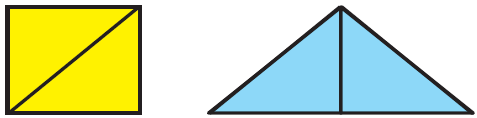
d) Is the area of the blue shape more than the area of the yellow shape? Why?

NCERT Solutions For Class 5 Maths Chapter 3 Image 4

Solution:-

No, from the given image, we can say that the area of the blue shape is equal to the area of the yellow shape. Because the yellow and blue shaped figures are divided into two triangles of equal areas.

e) Is the perimeter of the yellow shape more than the perimeter of the blue shape? Why?

Solution:-

No, the perimeter of the yellow shape is less than the perimeter of the blue shape. With the help of a ruler, we can find that the length of the boundary of the blue shape is more than the length of the boundary of the yellow shape.

Q5Written answer

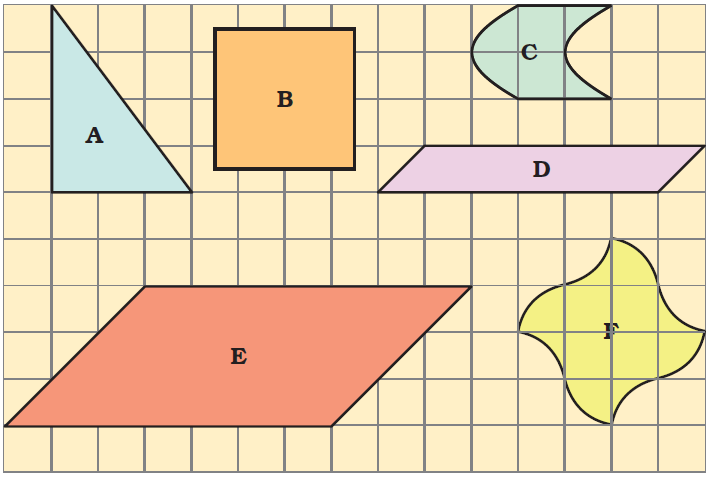
Write the area (in square cm) of the shapes below.

NCERT Solutions For Class 5 Maths Chapter 3 Image 5

Show solutionHide solution
Worked solution

Solution:-

Area of triangle fig. A = ½ × base × height

= ½ × 3 × 4

= ½ × 12

= 6 cm2

Area of square fig. B = 4 complete square + 8 half squares + 4 quarter squares

= 4 + (½ × 8) + (¼ × 4)

= 4 + 4 + 1

= 9 cm2

Area of fig. C = 2 complete square + 4 half square

= 2 + (½ × 4)

= 2 + 2

= 4 cm2

Area of fig. D = 5 complete square + 2 half square

= 5 + (½ × 2)

= 5+ 1

= 6 cm2

Area of fig. E = 18 complete square + 6 half square

= 18 + (½ × 6)

= 18 + 3

= 21 cm2

Area of fig. F = 4 complete square + 4 more than half + 4 quarter square

= 4 + (¾ × 4) + (¼ × 4)

= 4 + 3 + 1

= 8 cm2

Q6Written answer

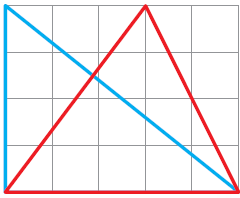
The blue triangle is half of the big rectangle. The area of the big rectangle is 20 square cm. So the area of the blue triangle is _______ square cm.

NCERT Solutions For Class 5 Maths Chapter 3 Image 6

Show solutionHide solution
Worked solution

Solution:-

From the question,

The area of the big rectangle is 20 cm2.

The area of the blue triangle is half of the big rectangle = 20/2

= 10 cm2

Q7Written answer

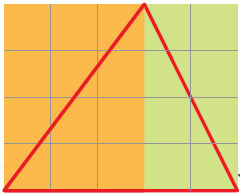
In the figure below, there are two halves of two different rectangles.

NCERT Solutions For Class 5 Maths Chapter 3 Image 7

Find the area of the two rectangles in the figure. What is the area of the red triangle? Explain.

From the figure, we can say that,

The orange rectangle contains 12 squares

So, the area of the orange rectangle = 12 cm2

Then, the green rectangle contains 8 squares

So, the area of the green rectangle = 8 cm2

Now, the area of the orange portion of the triangle = 12/2 = 6 cm2

The area of the yellow portion of the triangle = 8/2 = 4 cm2

Therefore, the area of the red triangle = 6 + 4

= 10 cm2

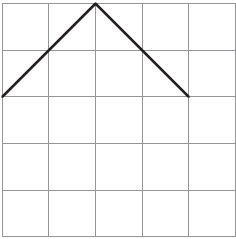
8. Suruchi drew two sides of a shape. She asked Asif to complete the shape with two more sides so that its area was 10 square cm.

NCERT Solutions For Class 5 Maths Chapter 3 Image 8

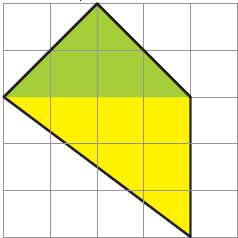
He completed the shape like the following:

NCERT Solutions For Class 5 Maths Chapter 3 Image 9

(i) Is he correct? 

Show solutionHide solution
Worked solution

Solution:-

Yes, he is correct.

(ii) Explain how the green area is 4 square cm, and the yellow area is 6 square cm.

Solution:-

Green area = 2 complete square + 4 half square

= 2 + (½ × 4)

= 2 + 2

= 4 cm2

Yellow area = 3 complete square + 2 more than half + 2 half filled

= 3 + 2 + (½ × 2)

= 3 + 2 + 1

= 6 cm2