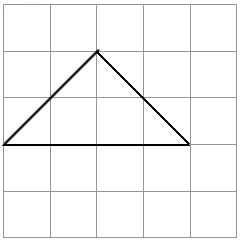
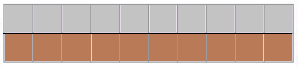
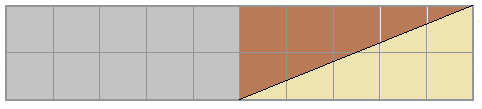
This is one of the sides of a shape. Complete the shape so that its area is 4 square cm.

Show solutionHide solution
Solution:-

The completed shape = 2 complete square + 4 half square
= 2 + (½ × 4)
= 2 + 2
= 4 cm2
Your cart is empty.
Practice each question, then open the answer or worked solution.
This is one of the sides of a shape. Complete the shape so that its area is 4 square cm.

Solution:-

The completed shape = 2 complete square + 4 half square
= 2 + (½ × 4)
= 2 + 2
= 4 cm2
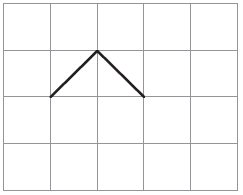
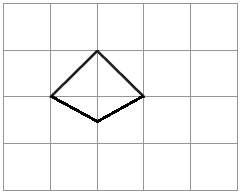
Two sides of a shape are drawn here. Complete the shape by drawing two more sides so that its area is less than 2 square cm.

Solution:-

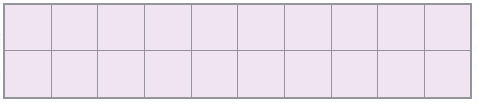
Here is a rectangle with an area of 20 square cm.

a) Draw one straight line in this rectangle to divide it into two equal triangles. What is the area of each of the triangles?
Solution:-

Area of rectangle = 10 × 2
= 20 cm2
Then, the area of two equal triangles = 20/2
= 10 cm2
Because it is given that a straight line divides the rectangle into two equal triangles.
b) Draw one straight line in this rectangle to divide it into two equal rectangles. What is the area of each of the smaller rectangles?
Solution:-

Area of big rectangle = 10 cm2
The area of each of the smaller rectangles = 20/2
= 10 cm2
c) Draw two straight lines in this rectangle to divide it into one rectangle and two equal triangles.
Solution:-

(i) What is the area of the rectangle?
Solution:-
Area of rectangle = length × breadth
= 2 × 5
= 10 cm2
(ii) What is the area of each of the triangles?
Solution:-
Area of each triangle = ½ × area of the smaller rectangle
= ½ × 10
= 5 cm2
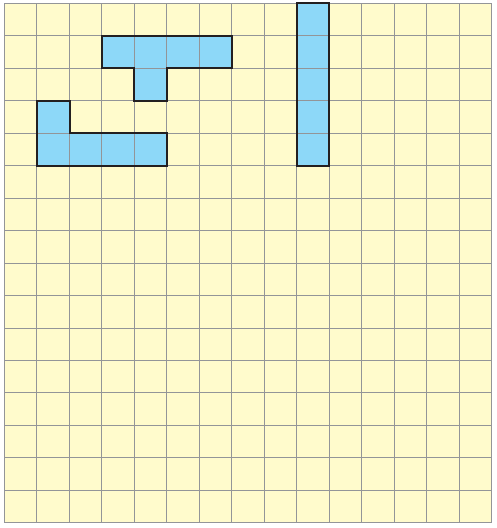
Puzzle with five squares

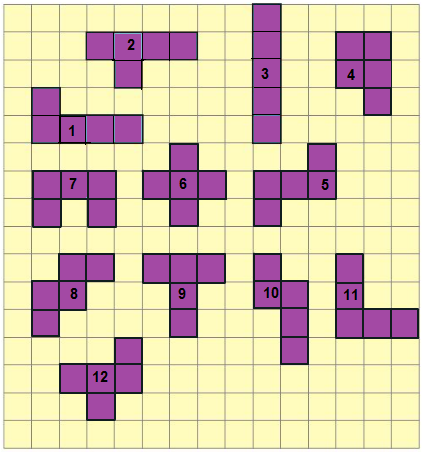
a) How many different shapes can you draw?
Solution:-
Using 5 squares, I can draw 12 shapes, as shown below:
b) Which shape has the longest perimeter? How much?
Solution:-
Shape 4 has the smallest perimeter out of the 12 shapes; the rest of the shapes have the same perimeter, i.e. = 1 + 1 + 1 + 1 + 1 + 1+ 1 + 1 + 1 + 1 + 1 + 1 = 12 cm
c) Which shape has the shortest perimeter? How much?
Solution:-
Out of 12 shapes, 4 have the smallest perimeter.
i.e. = 1 + 1 + 1 + 1 + 1 + 1 + 1 + 1 + 1 + 1 = 10 cm.
d) What is the area of the shapes (in square cm)?
Solution:-
There are 12 shapes, and each shape has five complete squares. The area of 1 square is equal to 1 cm2.
So, the area of each shape = 1 × 5 = 5 cm2
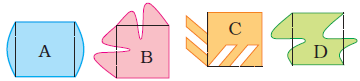
Ziri tried to make some tiles. She started with a square of 2 cm side and made shapes like the following:

Look at them carefully and find out:
(i) Which of these shapes will tile a floor (without any gaps)?
Solution:-
By observing the given figure, shape C and shape D will tile a floor without any gaps.