My Cart
Your Cart 0

    Your cart is empty.

  • Total (Amount) ₹0.00
NCERT · Class 5 · Maths

Chapter 6: Be My Multiple, I’ll Be Your Factor

Practice each question, then open the answer or worked solution.

Questions

15 questions
Q11Written answer

There are 18 bangles on the rod. Meena is trying to group them. She can put them in groups of 2, 3, 6, 9 and 18 without any bangle being left.

(i) How many groups will she have if she makes groups of 1 bangle each?

Show solutionHide solution
Worked solution

Solution:-

If Meena makes groups of 1 bangle each, she will get 18 groups.

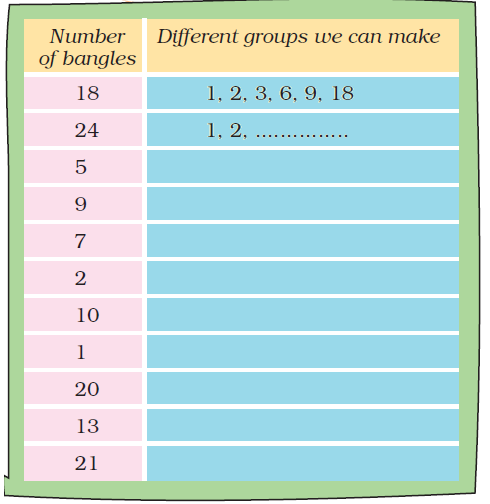
(ii) Now complete the table for different numbers of bangles. For each number, see what different groups can be made.

NCERT Solutions for Class 5 Maths Chapter 6 image 13

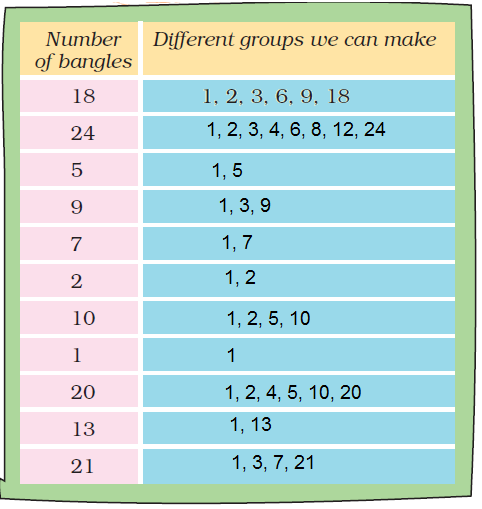
Solution:-

NCERT Solutions for Class 5 Maths Chapter 6 image 14

Q12Written answer

Fill the chart

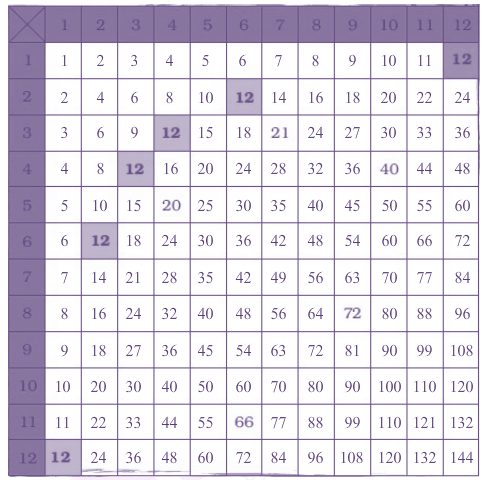
Complete the multiplication chart given here.

NCERT Solutions for Class 5 Maths Chapter 6 image 15

Look at the green boxes in the chart. These show how we can get 12 by multiplying different numbers.

12 = 4 × 3, so 12 is a multiple of both 4 and 3. 12 is also a multiple of 6 and 2, as well as 12 and 1. We say 1, 2, 3, 4, 6, and 12 are factors of 12.

NCERT Solutions for Class 5 Maths Chapter 6 image 16

Show solutionHide solution
Worked solution

Solution:-

NCERT Solutions for Class 5 Maths Chapter 6 image 17
NCERT Solutions for Class 5 Maths Chapter 6 image 18

(i) What are the factors of 10? Can you do this from the chart?

Solution:-

From the chart, factors of 10 are 1, 2, 5 and 10.

(ii) What are the factors of 36?

Solution:-

1, 2, 3, 4, 6, 9, 12, 18 and 36 are the factors of 36.

(iii) Find out all the factors of 36 from the multiplication chart.

Solution:-

From the multiplication chart, the factors of 36 are 1, 2, 3, 4, 6, and 9.

(iv) What is the biggest number for which you can find the factors from this chart?

Solution:-

From the multiplication chart, 144 is the biggest number for which we can find the factors.

(v) What can you do for numbers bigger than that?

Solution:-

First, we will extend the multiplication chart and then complete the chart.

Q13Written answer

Common Factors

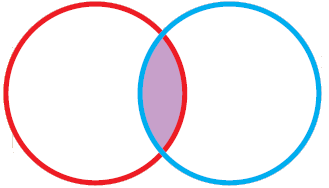
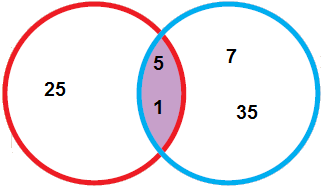
(i) Write the factors of 25 in the red circle and the factors of 35 in the blue circle.

NCERT Solutions for Class 5 Maths Chapter 6 image 19

Show solutionHide solution
Worked solution

Solution:-

NCERT Solutions for Class 5 Maths Chapter 6 image 20

(ii) Which are the factors of 25 and 35 you have written in the common part (purple) of both circles? 

Solution:-

5 and 1 are the common factors of 25 and 35 written in the common part (purple).

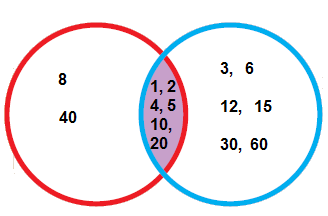
(iii) Now write the factors of 40 in the red circle and 60 in the blue circle.

 NCERT Solutions for Class 5 Maths Chapter 6 image 21

Solution:-

NCERT Solutions for Class 5 Maths Chapter 6 image 22

(iv) What are the factors written in the common (purple) part of the circle? Which is the biggest common factor of 40 and 60?

Solution:-

The factors written in the common (purple) part of the circle are 1, 2, 4, 5, 10 and 20.

20 is the biggest common factor of 40 and 60.

Q14Written answer

Factor Tree

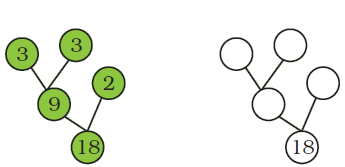
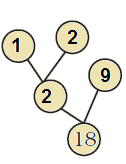
(i) Look at the factor tree. Now can you make another tree like this?

NCERT Solutions for Class 5 Maths Chapter 6 image 23

Show solutionHide solution
Worked solution

Solution:-

NCERT Solutions for Class 5 Maths Chapter 6 image 24

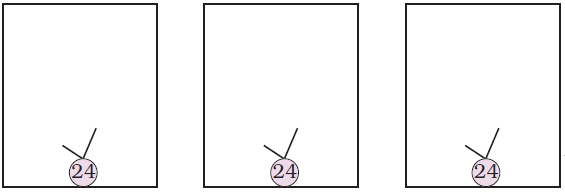
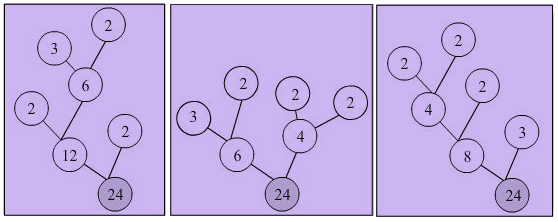
(ii) In how many ways can you draw a factor tree for 24? Draw three of them below.

NCERT Solutions for Class 5 Maths Chapter 6 image 25
Solution:-

NCERT Solutions for Class 5 Maths Chapter 6 image 26

Q15Written answer

Tiling Problems

(i) There is a garden in Anu’s house. In the middle of the garden, there is a path. They decided to tile the path using tiles of lengths 2 feet, 3 feet and 5 feet.

The mason tiled the first row with 2 feet tiles, the second row with 3 feet tiles and the third row with 5 feet tiles. The mason has not cut any of the tiles. Then, what is the shortest length of the path?

Show solutionHide solution
Worked solution

Solution:-

From the question, it is given that the mason tiled the first row with 2 feet tiles, the second row with 3 feet tiles and the third row with 5 feet tiles.

So, now we have to find the LCM of 2, 3 and 5.

The LCM of 2, 3, and 5 is 30.

Therefore, the shortest length of the path is 30 m.

(ii) Manoj has a new house. He has to lay tiles on the floor. The size of the room is 9 feet × 12 feet. In the market, there are three kinds of square tiles: 1 foot × 1 foot, 2 feet × 2 feet and 3 feet × 3 feet. Which size of tile should he buy for his room so that he can lay it without cutting?

Solution:-

From the question, it is given that the size of the room is 9 feet × 12 feet.

Size of the tiles available in the market are: 1 foot × 1 foot, 2 feet × 2 feet and 3 feet × 3 feet.

Here, 2 is not a factor of the width of the room, i.e. 9 feet, so Manoj cannot lay 2 feet × 2 feet tiles.

1 and 3 are the factors of 3 and 9.

Therefore, Monoj can buy 1 foot × 1 foot and 3 feet × 3 feet so that he can lay it without cutting.

(iii)
NCERT Solutions for Class 5 Maths Chapter 6 image 27

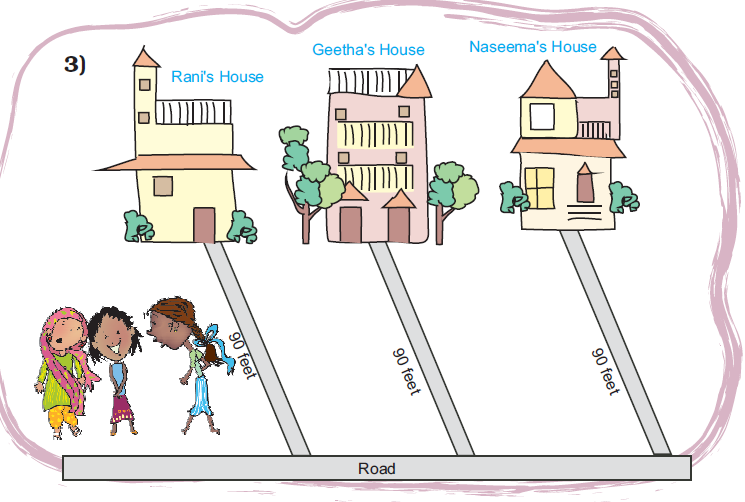
Rani, Geetha and Naseema live near each other. The distance from their house to the road is 90 feet. They decided to tile the path to the road. They all bought tiles of different designs and lengths. Rani bought the shortest tile, Geetha bought the middle-sized one, and Naseema bought the longest one. If they could tile the path without cutting any of the tiles, what is the size of the tiles each has bought? Suggest 3 different solutions. Explain how you get this answer.

Solution:-

From the question, the distance from their house to the road is 90 feet.

Factors of 90 are 1, 2, 3, 5, 6, 9 etc.

Then, possible sizes of tiles are 1 foot × 1 foot, 2 feet × 2 feet, 3 feet × 3 feet, 5 feet × 5 feet, 6 feet × 6 feet and 9 feet × 9 feet etc.

Then the size of the tiles each has bought are,

(i) Rani 1 foot × 1 foot

Geetha 2 feet × 2 feet

Naseema 3 feet × 3 feet

(ii) Rani 2 feet × 2 feet

Geetha 3 feet × 3 feet

Naseema 5 feet × 5 feet

(iii) Rani 3 feet × 3 feet

Geetha 5 feet × 5 feet

Naseema 6 feet × 6 feet