Explain why
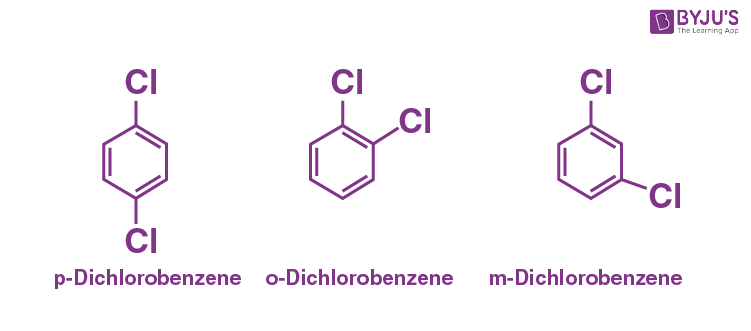
(i) the dipole moment of chlorobenzene is lower than that of cyclohexyl chloride
(ii) alkyl halides, though polar, are immiscible with water
(iii) Grignard reagents should be prepared under anhydrous conditions
Show solutionHide solution
Solution:
(i)

The Cl- atom in chlorobenzene is linked to sp2 hybridized carbon atom, whereas in cyclohexyl chloride it is linked to sp3 hybridized carbon atom. Now, as sp2 hybridized carbon has more s-character, it is more electronegative than sp3 hybridized carbon atom. Hence, the density of electrons of C-Cl bond near the Cl atom is less in chlorobenzene than in cyclohexyl chloride.
Moreover, the electron density is reduced by the –R effect of the benzene ring of chlorobenzene. Hence, chlorobenze has a decreased polarity of C-Cl bond, also the dipole moment is lower than that of cyclohexyl chloride.
(ii) When the solute water force o attraction is stronger than solute-solute and water-water force of attraction, detmines the miscibility with water. Dipole – dipole interactions hold the polar molecules of alkyl halides together. Now, the alkyl halide- alkyl halide and water-water forces of attraction are stronger than the new force of attraction between alkyl halides and water molecules. As a result, alkyl halides (though polar) are immiscible with water.
(iii) Grignard reagents are very reactive. In the presence of moisture, they react to give alkanes.
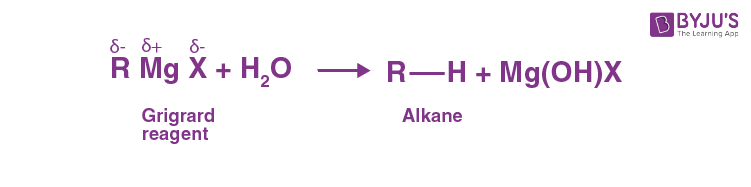
Therefore, Grignard reagents should be prepared under anhydrous conditions.