My Cart
Your Cart 0

    Your cart is empty.

  • Total (Amount) ₹0.00
NCERT · Class 12 · Chemistry

Chapter 8: Aldehydes, Ketones, and Carboxylic Acids

Practice each question, then open the answer or worked solution.

Questions

20 questions
Q12.1Written answer

What is meant by the following terms? Give an example of the reaction in
each case.

(i) Cyanohydrin

 (ii) Acetal

(iii) Semicarbazone

 (iv) Aldol

(v) Hemiacetal

 (vi) Oxime

(vii) Ketal

 (vii) Imine

(ix) 2,4-DNP-derivative

 (x) Schiff’s base

Show solutionHide solution
Worked solution

(i) Cyanohydrin:

Cyanohydrin is an organic compound with the formula RR’C(OH)CN, where alkyl or aryl groups may be R and R ‘.

NCERT Solutions for Class 12 Chemistry Chapter 12 Aldehydes, Ketones and Carboxylic Acids Q 12.1(i)

In the presence of excess sodium cyanide (NaCN) as a precursor to using cyanohydrin, aldehydes and ketones react with hydrogen cyanide (HCN). Such reactions are classified as reactions to cyanohydrins.
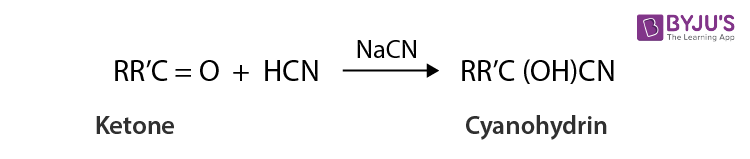
NCERT Solutions for Class 12 Chemistry Chapter 12 Aldehydes, Ketones and Carboxylic Acids Q 12.1(i)-1

The useful synthetic intermediates are Cyanohydrins.

(ii) Acetal:

The gem-dialkoxy alkanes at the terminal carbon atom consisting of two groups of alkoxy are called Acetal. One bond is connected to an alkyl group, and the other to a hydrogen atom.

NCERT Solutions for Class 12 Chemistry Chapter 12 Aldehydes, Ketones and Carboxylic Acids Q 12.1(ii)

Hemiacetals are formed in the presence of dry HCl gas when aldehydes are treated with two monohydric alcohol equivalents. In addition, hemiacetals react with another alcohol molecule to yield acetal.
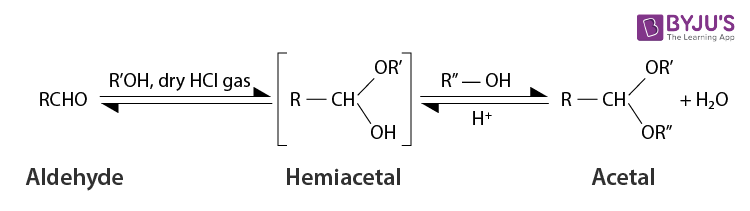
NCERT Solutions for Class 12 Chemistry Chapter 12 Aldehydes, Ketones and Carboxylic Acids Q 12.1(ii)-1

(iii) Semicarbazone:

Semicarbazone comes from aldehydes and ketones and is formed by the condensation reaction between a ketone or aldehyde and semicarbazide.
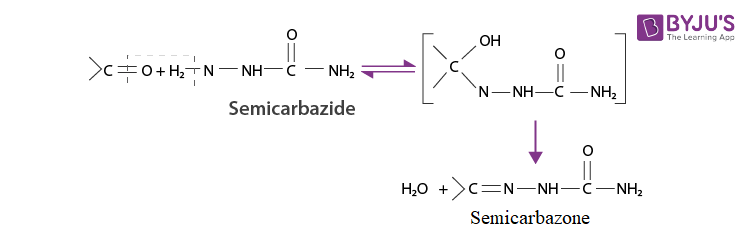
NCERT Solutions for Class 12 Chemistry Chapter 12 Aldehydes, Ketones and Carboxylic Acids Q 12.1(iii)

Semicarbarzones serve to identify and characterize aldehydes and ketones.

(iv) Aldol:

An aldol is a β-hydroxy aldehyde or ketone. It is produced in the presence of a base by the condensation reaction of two molecules of the same or a single molecule, each of two different aldehydes or ketones.
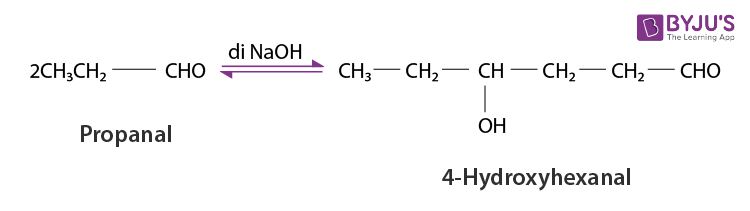
NCERT Solutions for Class 12 Chemistry Chapter 12 Aldehydes, Ketones and Carboxylic Acids Q 12.1(iv)

(v) Hemiacetal:

Hemiacetals are α−alkoxyalcohols

NCERT Solutions for Class 12 Chemistry Chapter 12 Aldehydes, Ketones and Carboxylic Acids Q 12.1(v)

The general structure of a hemiacetal.

In the presence of dry HCl gas, aldehyde reacts with one single molecule of monohydrated alcohol.
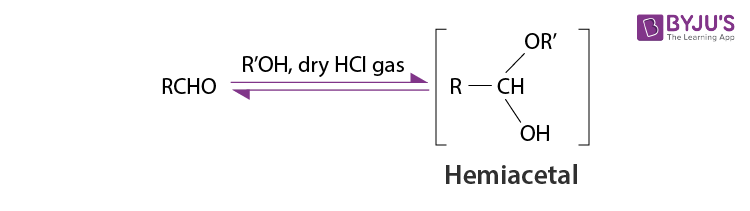
NCERT Solutions for Class 12 Chemistry Chapter 12 Aldehydes, Ketones and Carboxylic Acids Q 12.1(v)-1

(vi) Oxime:

General formula – RR′CNOH

Where R is an organic side chain and R′ is either an organic side or hydrogen side chain. If R′ is an organic side chain, then ketoxime is known, and if R′ is H, it is called aldoxime.

NCERT Solutions for Class 12 Chemistry Chapter 12 Aldehydes, Ketones and Carboxylic Acids Q 12.1(vi)

Aldehydes or ketones form oximes when treated with hydroxylamine in a weakly acidic medium.

NCERT Solutions for Class 12 Chemistry Chapter 12 Aldehydes, Ketones and Carboxylic Acids Q 12.1(vi)-1

(vii) Ketal:

Ketals are gem-dialkoxyalkanes in which one carbon atom is comprised of two groups of alkoxy within the chain. The other two carbon atom bonds are related to two alkyl groups.

NCERT Solutions for Class 12 Chemistry Chapter 12 Aldehydes, Ketones and Carboxylic Acids Q 12.1(vii)

A cyclic product is produced in the presence of dry HCl gas, called ethylene glycol ketals when ketones react with ethylene glycol.
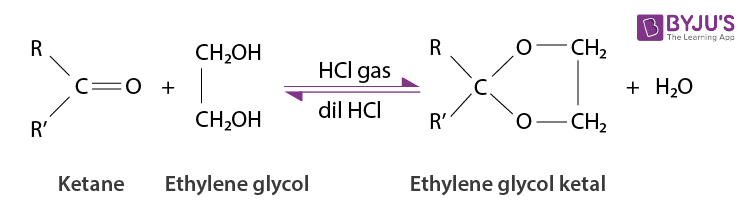
NCERT Solutions for Class 12 Chemistry Chapter 12 Aldehydes, Ketones and Carboxylic Acids Q 12.1(vii)-1

(viii) Imine:

Imines are chemical compounds which have a double bond between carbon-nitrogen.

NCERT Solutions for Class 12 Chemistry Chapter 12 Aldehydes, Ketones and Carboxylic Acids Q 12.1(viii)

The reaction of aldehydes and ketones with ammonia or 1º-amines forms imine derivatives

NCERT Solutions for Class 12 Chemistry Chapter 12 Aldehydes, Ketones and Carboxylic Acids Q 12.1(viii)-1

(ix) 2,4−DNP−derivative:

2, 4-dinitrophenylhydrazone are 2,4−DNP−derivatives which are produced in a weakly acidic medium when aldehydes or ketones react with 2,4−dinitrophenylhydrazine.
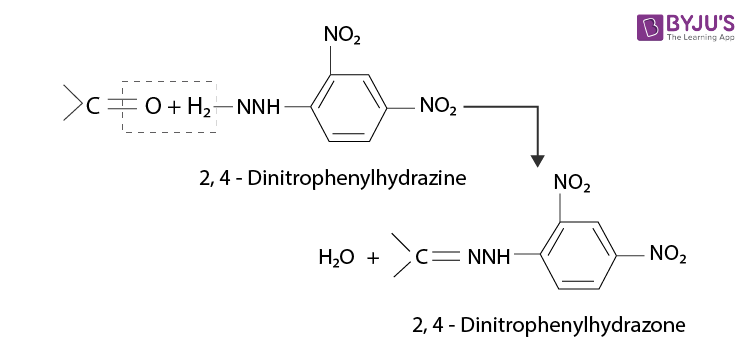
NCERT Solutions for Class 12 Chemistry Chapter 12 Aldehydes, Ketones and Carboxylic Acids Q 12.1(ix)

The 2,4−DNP derivatives are used to identify and characterise aldehydes and ketones.

(x) Schiff’s base:

Schiff’s base is a chemical compound that contains a double bond between carbon-nitrogen and the nitrogen atom connected to an aryl or alkyl group-but, not hydrogen. They have the general R1R2C formula= NR3. Thus, it’s an imine. It’s named for Hugo Schiff, a scientist.

NCERT Solutions for Class 12 Chemistry Chapter 12 Aldehydes, Ketones and Carboxylic Acids Q 12.1(x)

Aldehydes and ketones in the presence of a residue of acid on treatment with primary aliphatic or aromatic amines yield a base of a Schiff.
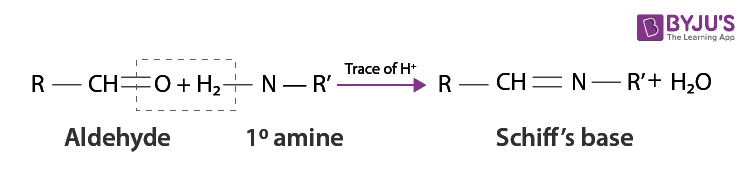
NCERT Solutions for Class 12 Chemistry Chapter 12 Aldehydes, Ketones and Carboxylic Acids Q 12.1(x)-1


Q12.2Written answer

Name the following compounds according to the IUPAC system of nomenclature:

(i) CH3CH(CH3)CH2CH2CHO

(ii) CH3CH2COCH(C2H5)CH2CH2Cl

(iii) CH3CH=CHCHO

(iv) CH3COCH2COCH3

(v) CH3CH(CH3)CH2C(CH3)2COCH3

(vi) (CH3)3CCH2COOH

(vii) OHCC6H4CHO-p

Show solutionHide solution
Worked solution

(i) 4-methylpentanal

(ii) 6-Chloro-4-ethylhexan-3-one

(iii) But-2-en-1-al

(iv) Pentane-2,4-dione

(v) 3,3,5-Trimethylhexan-2-one

(vi) 3,3-Dimethylbutanoic acid

(vii) Benzene-1,4-dicarbaldehyde

Q12.3Written answer

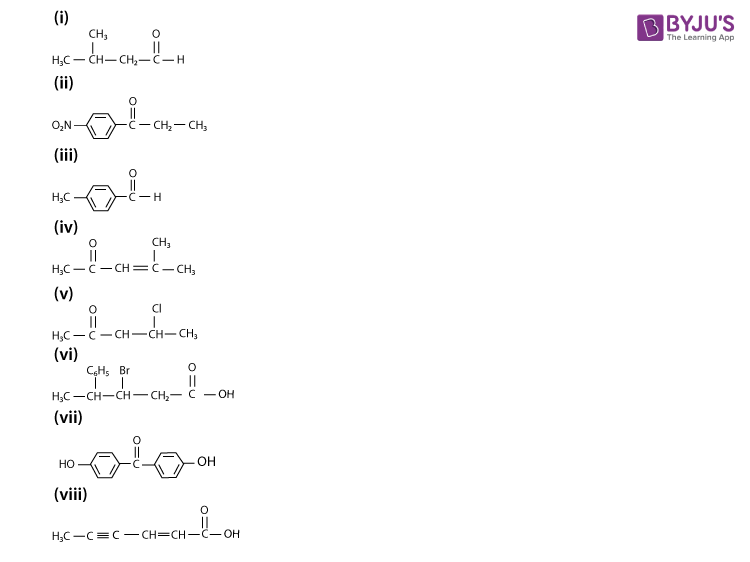
Draw the structures of the following compounds.

(i) 3-Methylbutanal

 (ii) p-Nitropropiophenone

(iii) p-Methylbenzaldehyde

(iv) 4-Methylpent-3-en-2-one

(v) 4-Chloropentan-2-one

(vi) 3-Bromo-4-phenylpentanoic acid

(vii) p,p’-Dihydroxybenzophenone

 (viii) Hex-2-en-4-ynoic acid

Show solutionHide solution
Worked solution

NCERT Solutions for Class 12 Chemistry Chapter 12 Aldehydes, Ketones and Carboxylic Acids Q 12.3

Q12.4Written answer

Write the IUPAC names of the following ketones and aldehydes. Wherever
possible, also give common names.

(i) CH3CO(CH2)4CH3

(ii) CH3CH2CHBrCH2CH(CH3)CHO

(iii) CH3(CH2)5CHO

(iv)Ph-CH=CH-CHO

(v)

NCERT Solutions for Class 12 Chemistry Chapter 12 Aldehydes, Ketones and Carboxylic Acids Q 12.4(v)

(vi)PhCOPh

Show solutionHide solution
Worked solution

(i) CH3CO(CH2)4CH3

IUPAC name: Heptan-2-one

Common name: Methyl pentyl ketone

(ii) CH3CH2CHBrCH2CH(CH3)CHO

IUPAC name: 4-Bromo-2-methylhaxanal

Common name: (γ-Bromo-α-methyl-caproaldehyde)

(iii) CH3(CH2)5CHO

IUPAC name: Heptanal

(iv) Ph-CH=CH-CHO

IUPAC name: 3-phenylprop-2-enal

Common name: β-Pheynolacrolein

(v)

NCERT Solutions for Class 12 Chemistry Chapter 12 Aldehydes, Ketones and Carboxylic Acids Q 12.4(v)

IUPAC name: Cyclopentanecarbaldehyde

(vi) PhCOPh

IUPAC name: Diphenylmethanone

Common name: Benzophenone

Q12.5Written answer

Draw structures of the following derivatives.

(i) The 2,4-dinitrophenylhydrazone of benzaldehyde

(ii) Cyclopropanone oxime

(iii) Acetaldehydedimethylacetal

(iv) The semicarbazone of cyclobutanone

(v) The ethylene ketal of hexan-3-one

(vi) The methyl hemiacetal of formaldehyde

Show solutionHide solution
Worked solution

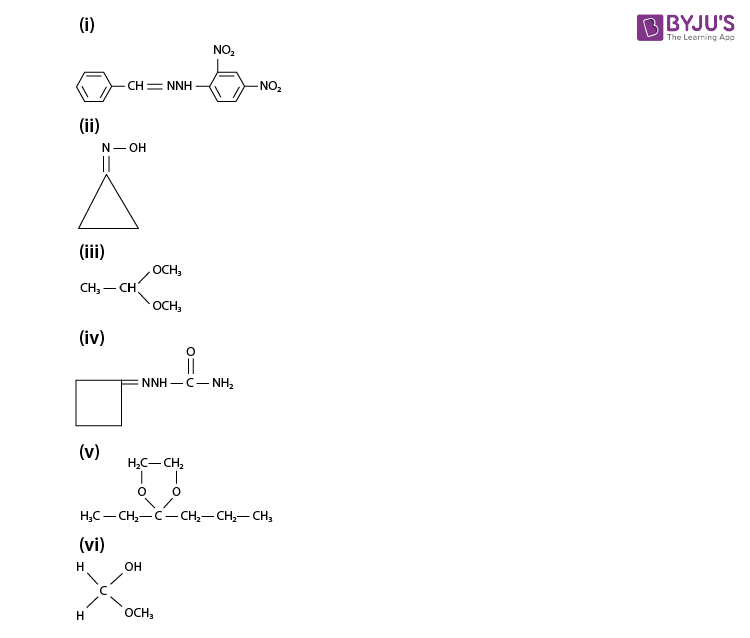
NCERT Solutions for Class 12 Chemistry Chapter 12 Aldehydes, Ketones and Carboxylic Acids Q 12.5

Q12.6Written answer

Predict the products formed when cyclohexanecarbaldehyde reacts with
following reagents.
(i) PhMgBr and then H3O+

(ii) Tollens’ reagent

(iii) Semicarbazide and weak acid

(iv) Excess ethanol and acid

(v) Zinc amalgam and dilute hydrochloric acid

Show solutionHide solution
Worked solution

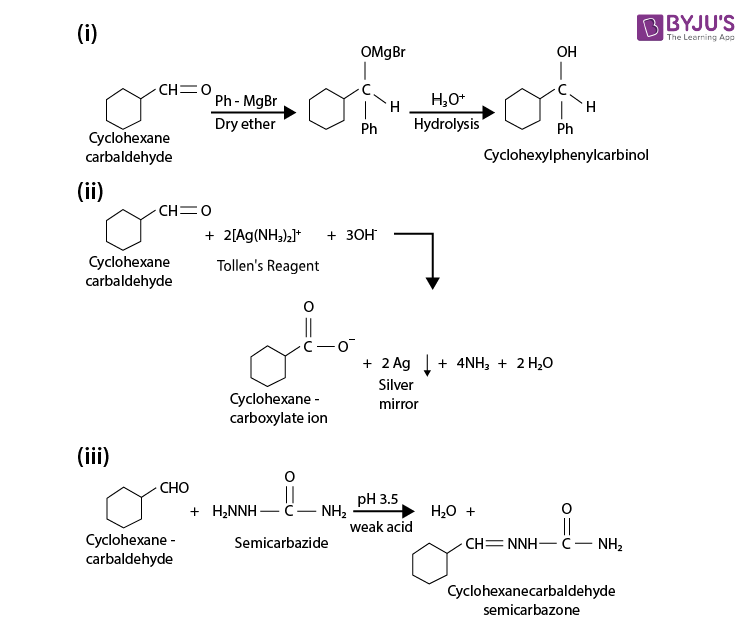
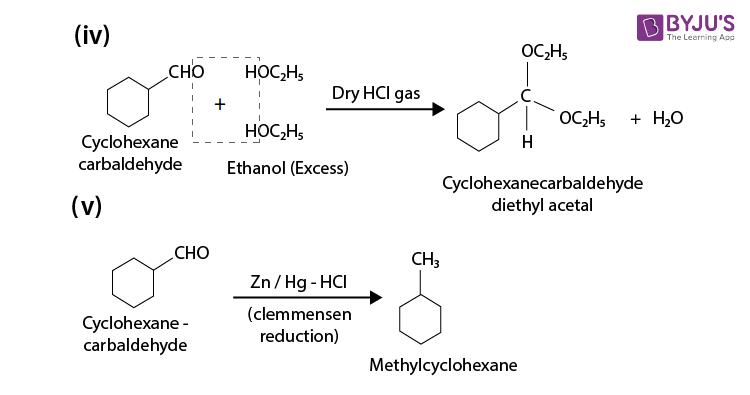
Solution coming soon.

Q12.7Written answer

NCERT Solutions for Class 12 Chemistry Chapter 12 Aldehydes, Ketones and Carboxylic Acids Question 6 image 1
NCERT Solutions for Class 12 Chemistry Chapter 12 Aldehydes, Ketones and Carboxylic Acids Question 6 image 2
Which of the following compounds would undergo aldol condensation, which
the Cannizzaro reaction and which neither? Write the structures of the expected
products of aldol condensation and Cannizzaro reaction.
(i) Methanal

 (ii) 2-Methylpentanal

(iii) Benzaldehyde

 (iv) Benzophenone

(v) Cyclohexanone

(vi) 1-Phenylpropanone

(vii) Phenylacetaldehyde

(viii) Butan-1-ol

(ix) 2, 2-Dimethylbutanal

Show solutionHide solution
Worked solution

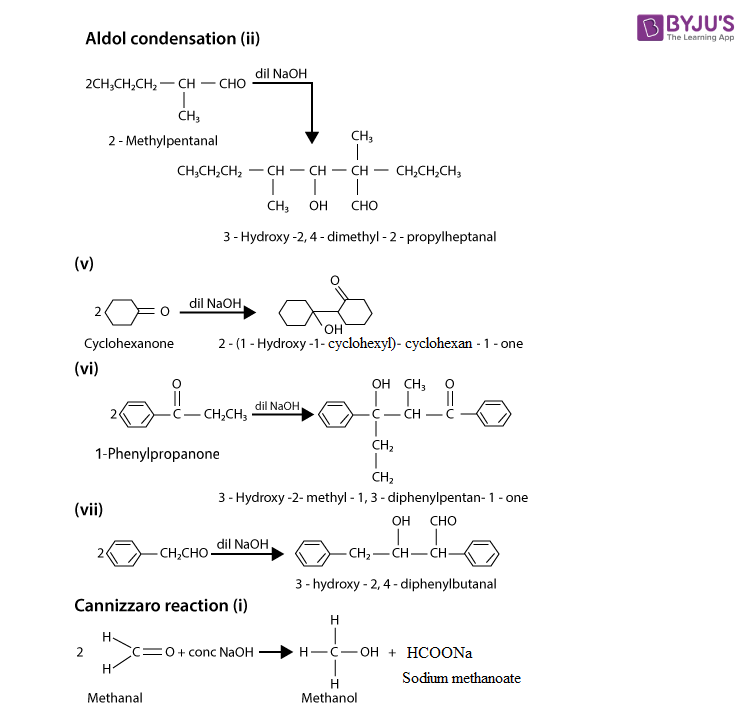
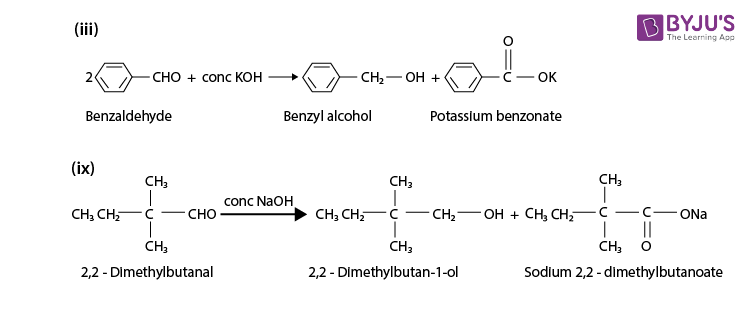
Aldehydes and ketones having at least one α-hydrogen undergo aldol condensation. The compounds (ii) 2−methylpentanal, (v) cyclohexanone, (vi) 1-phenylpropanone, and (vii) phenylacetaldehyde contain one or more α-hydrogen atoms. Therefore, these undergo aldol condensation.

Aldehydes having no α-hydrogen atoms undergo Cannizzaro reactions. The compounds (i) Methanal, (iii) Benzaldehyde, and (ix) 2, 2-dimethylbutanal do not have any αhydrogen.

Therefore, these undergo Cannizzaro reactions.

Compound (iv) Benzophenone is a ketone having no α-hydrogen atom, and compound (viii) Butan-1-ol is alcohol. Hence, these compounds do not undergo either aldol condensation or Cannizzaro reactions.

NCERT Solutions for Class 12 Chemistry Chapter 12 Aldehydes, Ketones and Carboxylic Acids Question 7 image 1

NCERT Solutions for Class 12 Chemistry Chapter 12 Aldehydes, Ketones and Carboxylic Acids Question 7 image 2

Q12.8Written answer

How will you convert ethanal into the following compounds?
(i) Butane-1, 3-diol

 (ii) But-2-enal

 (iii) But-2-enoic acid

Show solutionHide solution
Worked solution

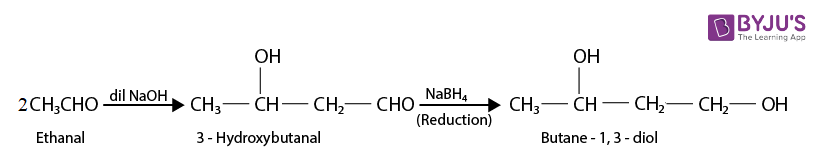
(i) Ethanal produces 3-hydroxybutanal giving butane-1, 3-diol on reduction when it is treated with dilute alkali.

NCERT Solutions for Class 12 Chemistry Chapter 12 Aldehydes, Ketones and Carboxylic Acids Question 8 image 1

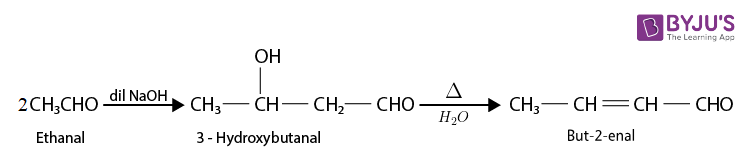
(ii) Ethanal gives 3-hydroxybutanal which on heating produces but-2-enal when it is treated with dilute alkali.

NCERT Solutions for Class 12 Chemistry Chapter 12 Aldehydes, Ketones and Carboxylic Acids Question 8 image 2
(iii) But-2-enal produced in the above reaction produces but-2-enoic acid when it is treated with Tollen’s reagent.

Q12.9Written answer

NCERT Solutions for Class 12 Chemistry Chapter 12 Aldehydes, Ketones and Carboxylic Acids Question 8 image 3

Write structural formulas and names of four possible aldol condensation products from propanal and butanal. In each case, indicate which aldehyde acts as a nucleophile and which as an electrophile.

Show solutionHide solution
Worked solution

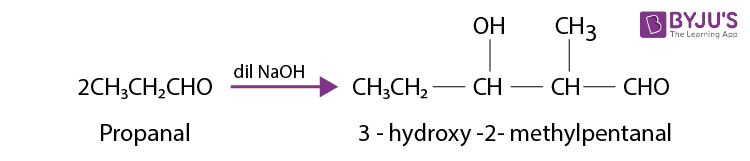
(i) One molecule of propanal acts as a nucleophile, and the other molecule acts as an electrophile.

NCERT Solutions for Class 12 Chemistry Chapter 12 Aldehydes, Ketones and Carboxylic Acids Question 9 image 1
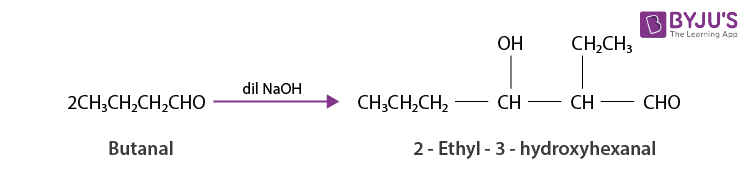
(ii) Taking two molecules of butanal, one which acts as a nucleophile and the other as an electrophile.

NCERT Solutions for Class 12 Chemistry Chapter 12 Aldehydes, Ketones and Carboxylic Acids Question 9 image 2
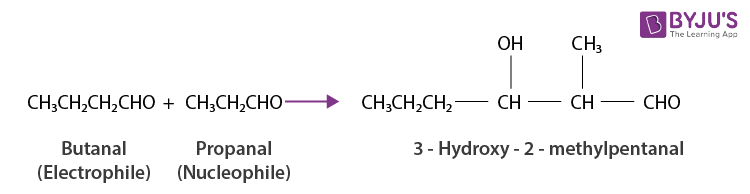
(iii) Taking one molecule each of propanal and butanal in which propanal acts as a nucleophile and butanal act as an electrophile.

NCERT Solutions for Class 12 Chemistry Chapter 12 Aldehydes, Ketones and Carboxylic Acids Question 9 image 3
 

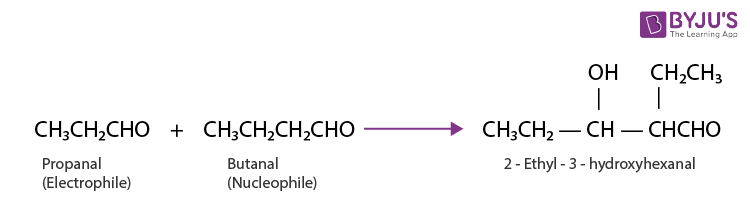
(iv) Taking one molecule each of propanal and butanal in which propanal acts as an electrophile and butanal acts as a nucleophile.

Q12.10Written answer

NCERT Solutions for Class 12 Chemistry Chapter 12 Aldehydes, Ketones and Carboxylic Acids Question 9 image 4

An organic compound with the molecular formula C9H10O forms a 2,4-DNP derivative, reduces Tollens’ reagent and undergoes the Cannizzaro reaction. On vigorous oxidation, it gives 1,2-benzenedicarboxylic acid. Identify the compound.

Show solutionHide solution
Worked solution

The compound having molecular formula C9H10O forms a 2,4-DNP derivative and reduces Tollen’s reagent. Therefore, the given compound must be an aldehyde. Again, the compound gives 1, 2 benzene dicarboxylic acids and undergoes a Cannizzaro reaction followed by oxidation. Therefore, the −CHO group is directly attached to a benzene ring, and this benzaldehyde is ortho-substituted. Hence, the compound is found to be 2-ethylbenzaldehyde.

NCERT Solutions for Class 12 Chemistry Chapter 12 Aldehydes, Ketones and Carboxylic Acids Question 10 image 1
The given reactions can be explained by the following equations.