My Cart
Your Cart 0

    Your cart is empty.

  • Total (Amount) ₹0.00
NCERT · Class 12 · Chemistry

Chapter 5: Coordination Compounds

Practice each question, then open the answer or worked solution.

Exercise questions

32 questions
Q21Written answer

${{\text{ }\!\![\!\!\text{ Fe(CN}{{\text{)}}_{\text{6}}}\text{ }\!\!]\!\!\text{ }}^{\text{4-}}}$ and ${{\text{ }\!\![\!\!\text{ Fe(}{{\text{H}}_{\text{2}}}\text{O}{{\text{)}}_{\text{6}}}\text{ }\!\!]\!\!\text{ }}^{\text{2+}}}$ are of different colors in dilute solution. Why?

Show solutionHide solution
Worked solution

Ans: The color of a certain coordinating chemical relies on the amount of the energy dividing the crystal field, ${{\text{ }\!\!\Delta\!\!\text{ }}_{\text{0}}}$. In turn, this CFSE depends on the ligand nature. The colors of ${{\text{ }\!\![\!\!\text{ Fe(CN}{{\text{)}}_{\text{6}}}\text{ }\!\!]\!\!\text{ }}^{\text{4-}}}$ and ${{\text{ }\!\![\!\!\text{ Fe(}{{\text{H}}_{\text{2}}}\text{O}{{\text{)}}_{\text{6}}}\text{ }\!\!]\!\!\text{ }}^{\text{2+}}}$ vary because the CFSE is different. Now, CN– is a powerful field ligand with greater CFSE than the CFSE water value. This means that intra-d-d transition absorption of energy also differs. The color also differs, however.


Q22Written answer

Discuss the nature of bonding in metal carbonyls.

Show solutionHide solution
Worked solution

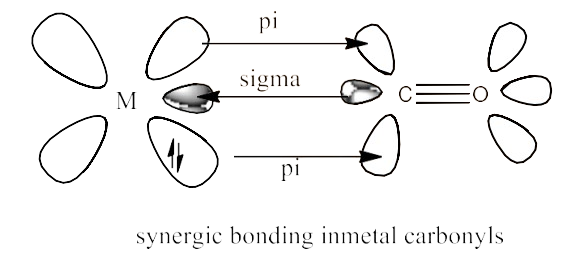
Ans: The carbon metal linkages in metal carbonyls are characterized by both s and p. $\text{M-C }\!\!\sigma\!\!\text{ }$ bond consists of a donation into an empty metal orbital of a lone pair of electrons on the carbonyl carbon.

$\text{M-C }\!\!\pi\!\!\text{ }$ bond is the donation to the empty carbon dioxide vacant anti-bonding ${{\text{ }\!\!\pi\!\!\text{ }}^{\text{*}}}$ orbital of a pair of electrons from the d-filled metal orbital. The reverse bonding of the carbonyl group is also known. The ligand-metal interaction provides a synergistic effect that enhances the relationship between CO and metal. The synergistic action reinforces the connection between CO and metal. The diagram is given below:


The nature of bonding in metal carbonyls


Q23Written answer

Give the oxidation state, d-orbital occupation and coordination number of the central metal ion in the following complexes:

(i) ${{\text{K}}_{\text{3}}}\text{ }\!\![\!\!\text{ Co(}{{\text{C}}_{\text{2}}}{{\text{O}}_{\text{4}}}{{\text{)}}_{\text{3}}}\text{ }\!\!]\!\!\text{ }$ 

(ii) ${{\text{(N}{{\text{H}}_{\text{4}}}\text{)}}_{\text{2}}}\text{ }\!\![\!\!\text{ Co}{{\text{F}}_{\text{4}}}\text{ }\!\!]\!\!\text{ }$ 

(iii) $\text{cis- }\!\![\!\!\text{ Cr(en}{{\text{)}}_{\text{2}}}\text{C}{{\text{l}}_{\text{2}}}\text{ }\!\!]\!\!\text{ Cl}$ 

(iv) $\text{ }\!\![\!\!\text{ Mn(}{{\text{H}}_{\text{2}}}\text{O}{{\text{)}}_{\text{6}}}\text{ }\!\!]\!\!\text{ S}{{\text{O}}_{\text{4}}}$ 

Show solutionHide solution
Worked solution

Ans: The complex will be ${{\text{ }\!\![\!\!\text{ Co(}{{\text{C}}_{\text{2}}}{{\text{O}}_{\text{4}}}{{\text{)}}_{\text{3}}}\text{ }\!\!]\!\!\text{ }}^{\text{3-}}}$.

Oxidation state of cobalt will be = x – 6 = - 3 

The oxidation state is = +3

Coordination number = 6

In +3 oxidation state of Co the configuration is $\text{3}{{\text{d}}^{\text{6}}}$.

So, the configuration will be $\text{t}_{\text{2g}}^{\text{6}}\text{ e}_{\text{g}}^{\text{0}}$ 


Ans: The complex will be ${{\text{ }\!\![\!\!\text{ Co}{{\text{F}}_{4}}\text{ }\!\!]\!\!\text{ }}^{\text{2-}}}$.

Oxidation state of cobalt will be = x – 4 = - 2 

The oxidation state is = +2

Coordination number = 4

In +2 oxidation state of Co the configuration is $\text{3}{{\text{d}}^{7}}$.

So, the configuration will be 


Ans: The complex will be ${{\text{ }\!\![\!\!\text{ Cr(en}{{\text{)}}_{2}}\text{C}{{\text{l}}_{\text{2}}}\text{ }\!\!]\!\!\text{ }}^{+}}$.

Oxidation state of chromium will be = x + 0 – 2 = + 1 

The oxidation state is = + 3

Coordination number = 6

In +3 oxidation state of Cr the configuration is $\text{3}{{\text{d}}^{3}}$.

So, the configuration will be $\text{t}_{\text{2g}}^{3}$


Ans: The complex will be ${{\text{ }\!\![\!\!\text{ Mn(}{{\text{H}}_{\text{2}}}\text{O}{{\text{)}}_{6}}\text{ }\!\!]\!\!\text{ }}^{2+}}$.

Oxidation state of manganese will be = x + 0 = + 2 

The oxidation state is = + 2

Coordination number = 6

In +2 oxidation state of Mn the configuration is $\text{3}{{\text{d}}^{5}}$.

So, the configuration will be $\text{t}_{\text{2g}}^{3}\text{ e}_{\text{g}}^{2}$


Q24Written answer

Write down the IUPAC name for each of the following complexes and indicate the oxidation state, electronic configuration and coordination number. Also give stereochemistry and magnetic moment of the complex:

(i) $\text{K }\!\![\!\!\text{ Cr(}{{\text{H}}_{\text{2}}}\text{O}{{\text{)}}_{\text{2}}}{{\text{(}{{\text{C}}_{\text{2}}}{{\text{O}}_{\text{4}}}\text{)}}_{\text{2}}}\text{ }\!\!]\!\!\text{ }\text{.3}{{\text{H}}_{\text{2}}}\text{O}$ 

(ii) $\text{ }\!\![\!\!\text{ CrC}{{\text{l}}_{\text{3}}}\text{p}{{\text{y}}_{\text{3}}}\text{ }\!\!]\!\!\text{ }$ 

(iii) ${{\text{K}}_{\text{4}}}\text{ }\!\![\!\!\text{ Mn(CN}{{\text{)}}_{\text{6}}}\text{ }\!\!]\!\!\text{ }$ 

(iv) $\text{ }\!\![\!\!\text{ Co(N}{{\text{H}}_{\text{3}}}{{\text{)}}_{\text{5}}}\text{Cl }\!\!]\!\!\text{ C}{{\text{l}}_{\text{2}}}$

(v) $\text{Cs }\!\![\!\!\text{ FeC}{{\text{l}}_{\text{4}}}\text{ }\!\!]\!\!\text{ }$ 

Show solutionHide solution
Worked solution

Ans: Its IUPAC name is Potassium diaquadioxalatochromate(III) hydrate.

Oxidation state of chromium = +3

Electronic configuration = $\text{3}{{\text{d}}^{\text{3}}}\text{ = t}_{\text{2g}}^{\text{3}}$

Coordination number = 6 

Shape = octahedral

Stereochemistry:


Number of unpaired electrons = 3

Magnetic moment =

\[\text{ }\!\!\mu\!\!\text{  = }\sqrt{\text{n(n+2)}}\] 

\[\text{ }\!\!\mu\!\!\text{  = }\sqrt{\text{3(3+2)}}\] 

\[\text{ }\!\!\mu\!\!\text{  = }\sqrt{15}\]

\[\text{ }\!\!\mu\!\!\text{  =3}\text{.87 BM}\]


Ans: Its IUPAC name is Trichloridotripyridinechromium(III).

Oxidation state of chromium = +3

Electronic configuration = $\text{3}{{\text{d}}^{\text{3}}}\text{ = t}_{\text{2g}}^{\text{3}}$ 

Coordination number = 6

Shape = octahedral

Stereochemistry:


Number of unpaired electrons = 3

Magnetic moment =

\[\text{ }\!\!\mu\!\!\text{ =}\sqrt{\text{n(n+2)}}\] 

\[\text{ }\!\!\mu\!\!\text{ =}\sqrt{\text{3(3+2)}}\] 

\[\text{ }\!\!\mu\!\!\text{ =}\sqrt{15}\] 

\[\text{ }\!\!\mu\!\!\text{ =3}\text{.87 BM}\] 


Ans: Its IUPAC name is Potassium hexacyanomanganate(II).

Oxidation state of manganese = +2

Electronic configuration = $\text{3}{{\text{d}}^{5}}\text{ = t}_{\text{2g}}^{5}$ 

Coordination number = 6

Shape = octahedral

Stereochemistry: optically inactive

Number of unpaired electrons = 1

Magnetic moment =

\[\text{ }\!\!\mu\!\!\text{ =}\sqrt{\text{n(n+2)}}\] 

\[\text{ }\!\!\mu\!\!\text{ =}\sqrt{\text{1(1+2)}}\] 

\[\text{ }\!\!\mu\!\!\text{ =}\sqrt{3}\]

\[\text{ }\!\!\mu\!\!\text{ =1}\text{.73 BM}\]


Ans: Its IUPAC name is Pentaamminechloridecobalt(III) chloride.

Oxidation state of manganese = +3

Electronic configuration = $\text{3}{{\text{d}}^{6}}\text{ = t}_{\text{2g}}^{6}$ 

Coordination number = 6

Shape = octahedral

Stereochemistry: 


Number of unpaired electrons = 0

Magnetic moment = 0


Ans: Its IUPAC name is Caesium tetrachloridoferrate(II).

Oxidation state of manganese = +3

Electronic configuration = $\text{3}{{\text{d}}^{\text{5}}}\text{ = }{{\text{e}}^{\text{2}}}\text{ t}_{\text{2}}^{\text{3}}$ 

Coordination number = 4

Shape = tetrahedral

Stereochemistry: optically inactive

Number of unpaired electrons = 5

Magnetic moment =

\[\text{ }\!\!\mu\!\!\text{ =}\sqrt{\text{n(n+2)}}\] 

\[\text{ }\!\!\mu\!\!\text{ =}\sqrt{\text{5(5+2)}}\] 

\[\text{ }\!\!\mu\!\!\text{ =}\sqrt{35}\] 

\[\text{ }\!\!\mu\!\!\text{ =5}\text{.92 BM}\]

Q25Written answer

What is meant by stability of a coordination compound in solution? State the factors which govern stability of complexes.

Show solutionHide solution
Worked solution

Ans: The stability of the complex in a solution relates to the extent to which the two species are in balance. In terms of stability or formation constant , stability may be expressed numerically.

\[\text{M + 3L }\rightleftharpoons \text{M}{{\text{L}}_{\text{3}}}\]

 Stability constant, $\beta \text{ }=\text{ }\frac{[M{{L}_{3}}]}{[M]{{[L]}^{3}}}$

The higher the stability constant value, the more the percentage of $\text{M}{{\text{L}}_{\text{3}}}$  in the solution is for this reaction.

Stability can be of two types:

Thermodynamic stability:

Thermodynamic stability determines to what extent the compound at the point of balance is produced or converted into another species.

Kinetic stability:

This helps to determine how quickly the change is to achieve the condition of balance.

Factors that affect the stability of a complex are:

Charge on the central metal ion: The greater the charge on the central metal ion, the greater is the stability of the complex.

Basic nature of the ligand: A more basic ligand will form a more stable complex.

Presence of chelate rings: Chelation increases the stability of complexes.


Q26Written answer

What is meant by the chelate effect? Give an example.

Show solutionHide solution
Worked solution

Ans: When a ligand binds to the metal ion in a way that creates a ring, the interaction of a metal ligand is more stable. In other terms, we may argue that chelate ring complexes are more stable than ring-free complexes. This is known as the Chelate effect.

For example,

\[\text{N}{{\text{i}}^{\text{2+}}}\text{(aq) + 6 N}{{\text{H}}_{\text{3}}}\text{(aq) }\rightleftharpoons \text{  }\!\![\!\!\text{ Ni(N}{{\text{H}}_{\text{3}}}{{\text{)}}_{\text{6}}}{{\text{ }\!\!]\!\!\text{ }}^{\text{2+}}}\]

For this reaction, $\text{log  }\!\!\beta\!\!\text{  = 8}\text{.61}$ 

\[\text{N}{{\text{i}}^{\text{2+}}}\text{(aq) + 3 en(aq) }\rightleftharpoons \text{  }\!\![\!\!\text{ Ni(en}{{\text{)}}_{3}}{{\text{ }\!\!]\!\!\text{ }}^{\text{2+}}}\]

For this reaction, $\text{log  }\!\!\beta\!\!\text{  = 18}\text{.28}$


Q27Written answer

Discuss briefly giving an example in each case the role of coordination compounds in:

(i) biological system

(ii) medicinal chemistry

(iii) Analytical Chemistry

(iv) Extraction/Metallurgy of Metals

Show solutionHide solution
Worked solution

Ans: The presence of the chlorophyll pigment enables photosynthesis. The pigment is a magnesium co-ordinating molecule. Multiple coordinated chemicals perform essential functions in the human biological system. An iron coordination complex is, for example, the oxygen transporter of blood i.e. haemoglobin.

The cobalt coordination compound is vitamin B12, cyanocobalamine The anaemia anti-pernicious factor. Enzymes such as carboxypeptidase A and carbon dioxide are among other biologically important molecules containing co-ordinated metal ions.


Ans: Certain platinum coordinating chemicals (e.g., cis-platinum) suppress tumour development.

Chelating ligands D-penicillamine, and desferrioxime B by forming coordination compounds, eliminate the excess of metal ions existing in a hazardous proportion in plant and animal systems such as copper or iron. EDTA is used in lead poisoning therapy.


Ans: A number of basic radicals are identified in the salt analysis using the colour changes with different reagents. These colour shift is due to the coordination of molecules or complexes formed with various ligands by the basic radicals.

For example: EDTA, DMG, etc.


Ans: The extraction process includes the production of complexes of many metals from their ores. In an aqueous solution, for instance, gold mixes to create $\text{Au(CN}{{\text{)}}_{\text{2}}}$ with cyanide ions. Gold is then recovered from this solution by adding zinc.


Q28Written answer

How many ions are produced from the complex $\text{Co(N}{{\text{H}}_{\text{3}}}{{\text{)}}_{\text{6}}}\text{C}{{\text{l}}_{\text{2}}}$ in solution?

(i) 6

(ii) 4

(iii) 3

(iv) 2

Show solutionHide solution
Worked solution

Ans: (iii) 3

The coordination number of cobalt is 6, therefore, the complex will be $\text{ }\!\![\!\!\text{ Co(N}{{\text{H}}_{\text{3}}}{{\text{)}}_{\text{6}}}\text{ }\!\!]\!\!\text{ C}{{\text{l}}_{\text{2}}}$. When this ionizes, three ions are formed. The reaction is given below:\[\text{ }\!\![\!\!\text{ Co(N}{{\text{H}}_{\text{3}}}{{\text{)}}_{\text{6}}}\text{ }\!\!]\!\!\text{ C}{{\text{l}}_{\text{2}}}\text{ }\xrightarrow{\text{aq}}\text{  }\!\![\!\!\text{ Co(N}{{\text{H}}_{\text{3}}}{{\text{)}}_{\text{6}}}{{\text{ }\!\!]\!\!\text{ }}^{\text{2+}}}\text{ + 2 C}{{\text{l}}^{\text{-}}}\] 


Q29Written answer

Amongst the following ions which one has the highest magnetic moment value?

(i) ${{\text{ }\!\![\!\!\text{ Cr(}{{\text{H}}_{\text{2}}}\text{O}{{\text{)}}_{\text{6}}}\text{ }\!\!]\!\!\text{ }}^{\text{3+}}}$ 

(ii) ${{\text{ }\!\![\!\!\text{ Fe(}{{\text{H}}_{\text{2}}}\text{O}{{\text{)}}_{\text{6}}}\text{ }\!\!]\!\!\text{ }}^{\text{2+}}}$ 

(iii) ${{\text{ }\!\![\!\!\text{ Zn(}{{\text{H}}_{\text{2}}}\text{O}{{\text{)}}_{\text{6}}}\text{ }\!\!]\!\!\text{ }}^{\text{2+}}}$ 

Show solutionHide solution
Worked solution

Ans: The number of unpaired electrons in this compound is 3.

Magnetic moment =

\[\text{ }\!\!\mu\!\!\text{ =}\sqrt{\text{n(n+2)}}\] 

\[\text{ }\!\!\mu\!\!\text{ =}\sqrt{\text{3(3+2)}}\] 

\[\text{ }\!\!\mu\!\!\text{ =}\sqrt{15}\] 

\[\text{ }\!\!\mu\!\!\text{ =3}\text{.87 BM}\]


Ans: The number of unpaired electrons in this compound is 4.

Magnetic moment =

\[\text{ }\!\!\mu\!\!\text{ =}\sqrt{\text{n(n+2)}}\] 

\[\text{ }\!\!\mu\!\!\text{ =}\sqrt{\text{4(4+2)}}\] 

\[\text{ }\!\!\mu\!\!\text{ =}\sqrt{24}\] 

\[\text{ }\!\!\mu\!\!\text{ =4}\text{.89 BM}\]


Ans: The number of unpaired electrons in this compound is 0

Magnetic moment = 0

So, ${{\text{ }\!\![\!\!\text{ Fe(}{{\text{H}}_{\text{2}}}\text{O}{{\text{)}}_{\text{6}}}\text{ }\!\!]\!\!\text{ }}^{\text{2+}}}$ is the compound which has the highest magnetic moment.


Q30Written answer

The oxidation number of cobalt in$\text{K }\!\![\!\!\text{ Co(CO}{{\text{)}}_{\text{4}}}\text{ }\!\!]\!\!\text{ }$ is

(i) +1

(ii) +3

(iii) –1

(iv) –3

Show solutionHide solution
Worked solution

Ans: The complex will be ${{\text{ }\!\![\!\!\text{ Co(CO}{{\text{)}}_{\text{4}}}\text{ }\!\!]\!\!\text{ }}^{\text{-}}}$ 

The oxidation state of Cobalt will be = x + 0 = - 1 

The oxidation number of Co = -1

Therefore, the answer is an option (iii) -1.