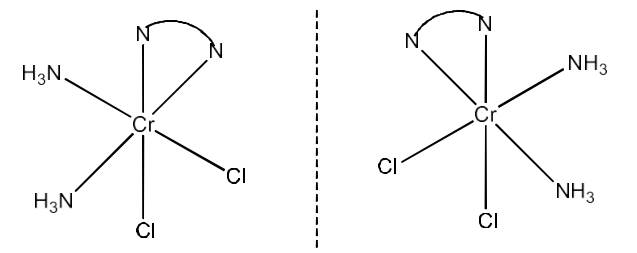
Ans: All of them are explained below:
(i) Coordination entity
A central metal atom or an ions connected to a set number of ions or molecules known as ligands comprises a coordination entity.
For example:
${{\text{ }\!\![\!\!\text{ Ni(N}{{\text{H}}_{\text{3}}}{{\text{)}}_{\text{6}}}\text{ }\!\!]\!\!\text{ }}^{\text{2+}}}\text{, }\!\![\!\!\text{ Fe(CN}{{\text{)}}_{\text{6}}}{{\text{ }\!\!]\!\!\text{ }}^{\text{4+}}}$ are cationic complex.
${{\text{ }\!\![\!\!\text{ PtC}{{\text{l}}_{\text{4}}}\text{ }\!\!]\!\!\text{ }}^{\text{2-}}}\text{, }\!\![\!\!\text{ Ag(CN}{{\text{)}}_{\text{2}}}{{\text{ }\!\!]\!\!\text{ }}^{\text{-}}}$ are anionic complex.
$\text{ }\!\![\!\!\text{ Ni(CO}{{\text{)}}_{\text{4}}}\text{ }\!\!]\!\!\text{ , }\!\![\!\!\text{ Co(N}{{\text{H}}_{\text{3}}}{{\text{)}}_{\text{4}}}\text{C}{{\text{l}}_{\text{2}}}\text{ }\!\!]\!\!\text{ }$ are neutral complex.
(ii) Ligand
Ligands are regarded as the neutral molecules or negated ions which surround the metal atom in a coordinating entity. Ligands are generally polar and have a pair of valence electrons at least one unshared. For example, ${{\text{H}}_{\text{2}}}\text{O, C}{{\text{N}}^{\text{-}}}\text{, N}{{\text{H}}_{\text{3}}}\text{, CO}$ etc are some ligands.
(iii) Coordination number
A coordination number of central-metal atom is called the total number of ligands (whether neutral or negative ion) that are connected to the central-metal atom in the coordinating sphere. It is also known for its ligancy.
For example, ${{\text{K}}_{\text{2}}}\text{ }\!\![\!\!\text{ PtC}{{\text{l}}_{\text{6}}}\text{ }\!\!]\!\!\text{ }$ contains platinum as the central metal ion and chloride ions as ligands. Since, there are 6 ligands, therefore the coordination number is 6.
(iv) Coordination polyhedron
The coordination polyhedrons on the core atom may be described as the spatial arrangement of the ligands directly associated in the coordinating field to the central metal ion.
For example, square planar is a coordination polyhedron.
(v) Homoleptic complex
These are the complexes where the metal ion is linked to just one type of donor group. For example, ${{\text{ }\!\![\!\!\text{ PtC}{{\text{l}}_{\text{6}}}\text{ }\!\!]\!\!\text{ }}^{\text{2-}}}$ is a homoleptic complex.
(vi) Heteroleptic complex.
These are the complexes where the metal ion is linked to more than one type of donor group. For example, ${{\text{ }\!\![\!\!\text{ Co(N}{{\text{H}}_{\text{3}}}{{\text{)}}_{\text{4}}}\text{C}{{\text{l}}_{\text{2}}}\text{ }\!\!]\!\!\text{ }}^{\text{+}}}$ is a heteroleptic complex.