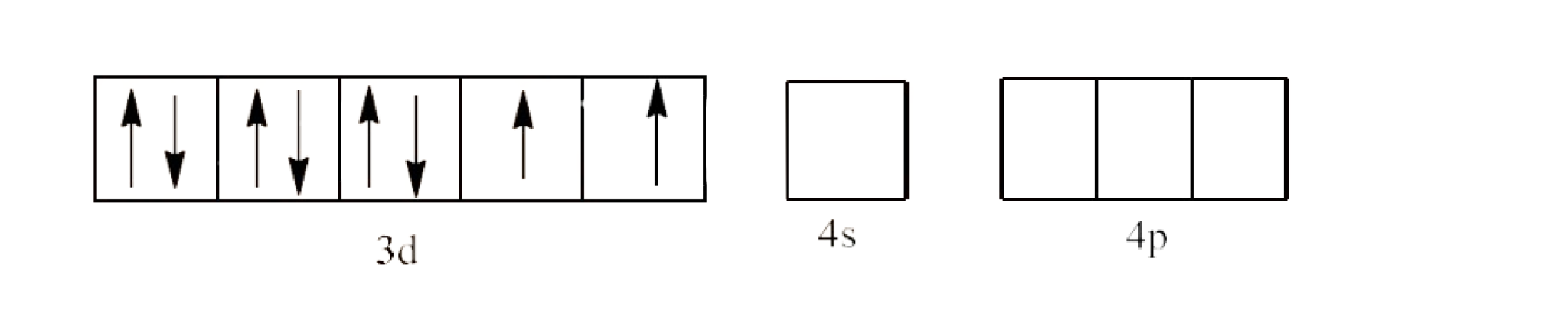
Ans: In ${{\text{ }\!\![\!\!\text{ Fe(CN}{{\text{)}}_{\text{6}}}\text{ }\!\!]\!\!\text{ }}^{4-}}$ the oxidation state of Fe is in +2 oxidation state, which will cause the configuration of Fe as ${{\text{d}}^{\text{6}}}$.
Since $\text{C}{{\text{N}}^{\text{-}}}$ is a strong field ligand, it causes unpaired electrons to be paired. This will lead to ${{\text{d}}^{\text{2}}}\text{s}{{\text{p}}^{\text{3}}}$ hybridization. This is shown below:
Therefore, the geometry of the complex is octahedral and it is a diamagnetic complex.
Ans: In ${{\text{ }\!\![\!\!\text{ Fe(F}{{\text{)}}_{\text{6}}}\text{ }\!\!]\!\!\text{ }}^{\text{3-}}}$ the oxidation state of Fe is in +3 oxidation state, which will cause the configuration of Fe as ${{\text{d}}^{5}}$.
Since ${{\text{F}}^{\text{-}}}$ is a weak field ligand, it does not cause pairing of electrons. This will lead to $\text{s}{{\text{p}}^{\text{3}}}{{\text{d}}^{\text{2}}}$ hybridization. This is shown below:
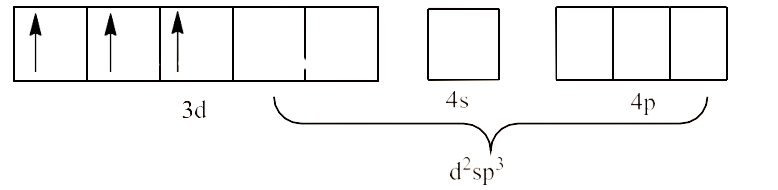
The geometry of the complex is octahedral and it is paramagnetic.
Ans: In ${{\text{ }\!\![\!\!\text{ Co(}{{\text{C}}_{2}}{{\text{O}}_{4}}{{\text{)}}_{3}}\text{ }\!\!]\!\!\text{ }}^{3-}}$ the oxidation state of Co is in +3 oxidation state, which will cause the configuration of Co as ${{\text{d}}^{\text{6}}}$.
Since oxalate is a strong field ligand, it causes unpaired electrons to be paired. This will lead to ${{\text{d}}^{\text{2}}}\text{s}{{\text{p}}^{\text{3}}}$ hybridization. This is shown below:
Therefore, the geometry of the complex is octahedral and it is a diamagnetic complex.
Ans: In ${{\text{ }\!\![\!\!\text{ Co}{{\text{F}}_{\text{6}}}\text{ }\!\!]\!\!\text{ }}^{\text{3-}}}$ the oxidation state of Co is in +3 oxidation state, which will cause the configuration of Co as ${{\text{d}}^{6}}$.
Since ${{\text{F}}^{\text{-}}}$ is a weak field ligand, it does not cause pairing of electrons. This will lead to $\text{s}{{\text{p}}^{\text{3}}}{{\text{d}}^{\text{2}}}$ hybridization.
The geometry of the complex is octahedral and it is paramagnetic.