My Cart
Your Cart 0

    Your cart is empty.

  • Total (Amount) ₹0.00
NCERT · Class 12 · Chemistry

Chapter 5: Coordination Compounds

Practice each question, then open the answer or worked solution.

Exercise questions

32 questions
Q1Written answer

Explain the bonding in coordination compounds in terms of Werner's postulates.

Show solutionHide solution
Worked solution

Ans: Werner's theory is the first theory to explain the nature of bonding in coordination compounds. 

The main postulates of this theory are:

(i) Two types of valencies, primary and secondary valencies, are present in coordinated compound metals.

(ii) Negative ions are primary valencies, which are ionizable. The dotted line is depicted

(iii) The primary valence is equivalent to the metal ion oxidation number.

Secondary valencies are non-ionizing and neutral ions are both fulfilled. It is shown by a solid line.

(vi) The secondary valence refers to the metal ion coordination number.

(v) Those valencies project in the space allocated to a given geometry of the coordination compound in a specified direction.   


Q2Written answer

$\text{FeS}{{\text{O}}_{\text{4}}}$ solution mixed with ${{\text{(N}{{\text{H}}_{\text{4}}}\text{)}}_{\text{2}}}\text{S}{{\text{O}}_{\text{4}}}$ solution in 1:1 molar ratio gives the test of $\text{F}{{\text{e}}^{\text{2+}}}$ ion but $\text{CuS}{{\text{O}}_{\text{4}}}$ solution mixed with aqueous ammonia in 1:4 molar ratio does not give the test of $\text{C}{{\text{u}}^{\text{2+}}}$ ion. Explain why?

Show solutionHide solution
Worked solution

Ans: Let us see the reactions happening in both the cases.

\[{{\text{(N}{{\text{H}}_{\text{4}}}\text{)}}_{\text{2}}}\text{S}{{\text{O}}_{\text{4}}}\text{ + FeS}{{\text{O}}_{\text{4}}}\text{ + 6}{{\text{H}}_{\text{2}}}\text{O }\to \text{ FeS}{{\text{O}}_{\text{4}}}\text{.(N}{{\text{H}}_{\text{4}}}{{\text{)}}_{\text{2}}}\text{S}{{\text{O}}_{\text{4}}}\text{.6}{{\text{H}}_{\text{2}}}\text{O}\]

\[\text{4N}{{\text{H}}_{3}}\text{ + CuS}{{\text{O}}_{\text{4}}}\text{ + 5}{{\text{H}}_{\text{2}}}\text{O }\to \text{  }\!\![\!\!\text{ Cu(N}{{\text{H}}_{3}}{{\text{)}}_{4}}\text{ }\!\!]\!\!\text{ S}{{\text{O}}_{\text{4}}}\text{.5}{{\text{H}}_{\text{2}}}\text{O}\] 

The compound \[\text{FeS}{{\text{O}}_{\text{4}}}\text{.(N}{{\text{H}}_{\text{4}}}{{\text{)}}_{\text{2}}}\text{S}{{\text{O}}_{\text{4}}}\text{.6}{{\text{H}}_{\text{2}}}\text{O}\] is Mohr’s salt while $\text{ }\!\![\!\!\text{ Cu(N}{{\text{H}}_{\text{3}}}{{\text{)}}_{\text{4}}}\text{ }\!\!]\!\!\text{ S}{{\text{O}}_{\text{4}}}\text{.5}{{\text{H}}_{\text{2}}}\text{O}$ is Tetraamminocopper(II) sulphate. 

Both \[\text{FeS}{{\text{O}}_{\text{4}}}\text{.(N}{{\text{H}}_{\text{4}}}{{\text{)}}_{\text{2}}}\text{S}{{\text{O}}_{\text{4}}}\text{.6}{{\text{H}}_{\text{2}}}\text{O}\] and $\text{ }\!\![\!\!\text{ Cu(N}{{\text{H}}_{\text{3}}}{{\text{)}}_{\text{4}}}\text{ }\!\!]\!\!\text{ S}{{\text{O}}_{\text{4}}}\text{.5}{{\text{H}}_{\text{2}}}\text{O}$ are classified as compounds, with one main distinction, i.e., the former is an example of a double salt, while the latter is a compound for co-ordination.

\[\text{FeS}{{\text{O}}_{\text{4}}}\text{.(N}{{\text{H}}_{\text{4}}}{{\text{)}}_{\text{2}}}\text{S}{{\text{O}}_{\text{4}}}\text{.6}{{\text{H}}_{\text{2}}}\text{O}\] is a double salt and it contains the $\text{F}{{\text{e}}^{\text{2+}}}$ ions that are in ionizable form. Therefore, it will give the $\text{F}{{\text{e}}^{\text{2+}}}$ test.

$\text{ }\!\![\!\!\text{ Cu(N}{{\text{H}}_{\text{3}}}{{\text{)}}_{\text{4}}}\text{ }\!\!]\!\!\text{ S}{{\text{O}}_{\text{4}}}\text{.5}{{\text{H}}_{\text{2}}}\text{O}$ is a coordination compound and it contains the $\text{C}{{\text{u}}^{\text{+}}}$ ion and it is not in an ionizable form. Therefore, it doesn’t give the $\text{C}{{\text{u}}^{\text{+}}}$ ion test.


Q3Written answer

Explain with two examples each of the following: coordination entity, ligand, coordination number, coordination polyhedron, homoleptic and heteroleptic.

Show solutionHide solution
Worked solution

Ans: All of them are explained below:

(i) Coordination entity

A central metal atom or an ions connected to a set number of ions or molecules known as ligands comprises a coordination entity.

For example:

${{\text{ }\!\![\!\!\text{ Ni(N}{{\text{H}}_{\text{3}}}{{\text{)}}_{\text{6}}}\text{ }\!\!]\!\!\text{ }}^{\text{2+}}}\text{,  }\!\![\!\!\text{ Fe(CN}{{\text{)}}_{\text{6}}}{{\text{ }\!\!]\!\!\text{ }}^{\text{4+}}}$ are cationic complex.

${{\text{ }\!\![\!\!\text{ PtC}{{\text{l}}_{\text{4}}}\text{ }\!\!]\!\!\text{ }}^{\text{2-}}}\text{,  }\!\![\!\!\text{ Ag(CN}{{\text{)}}_{\text{2}}}{{\text{ }\!\!]\!\!\text{ }}^{\text{-}}}$ are anionic complex.

$\text{ }\!\![\!\!\text{ Ni(CO}{{\text{)}}_{\text{4}}}\text{ }\!\!]\!\!\text{ ,  }\!\![\!\!\text{ Co(N}{{\text{H}}_{\text{3}}}{{\text{)}}_{\text{4}}}\text{C}{{\text{l}}_{\text{2}}}\text{ }\!\!]\!\!\text{ }$ are neutral complex.


(ii) Ligand

Ligands are regarded as the neutral molecules or negated ions which surround the metal atom in a coordinating entity. Ligands are generally polar and have a pair of valence electrons at least one unshared. For example, ${{\text{H}}_{\text{2}}}\text{O, C}{{\text{N}}^{\text{-}}}\text{, N}{{\text{H}}_{\text{3}}}\text{, CO}$ etc are some ligands.


(iii) Coordination number

A coordination number of central-metal atom is called the total number of ligands (whether neutral or negative ion) that are connected to the central-metal atom in the coordinating sphere. It is also known for its ligancy.

For example, ${{\text{K}}_{\text{2}}}\text{ }\!\![\!\!\text{ PtC}{{\text{l}}_{\text{6}}}\text{ }\!\!]\!\!\text{ }$ contains platinum as the central metal ion and chloride ions as ligands. Since, there are 6 ligands, therefore the coordination number is 6.


(iv) Coordination polyhedron

The coordination polyhedrons on the core atom may be described as the spatial arrangement of the ligands directly associated in the coordinating field to the central metal ion.

For example, square planar is a coordination polyhedron.


(v) Homoleptic complex

These are the complexes where the metal ion is linked to just one type of donor group. For example, ${{\text{ }\!\![\!\!\text{ PtC}{{\text{l}}_{\text{6}}}\text{ }\!\!]\!\!\text{ }}^{\text{2-}}}$ is a homoleptic complex.


(vi) Heteroleptic complex.

These are the complexes where the metal ion is linked to more than one type of donor group. For example, ${{\text{ }\!\![\!\!\text{ Co(N}{{\text{H}}_{\text{3}}}{{\text{)}}_{\text{4}}}\text{C}{{\text{l}}_{\text{2}}}\text{ }\!\!]\!\!\text{ }}^{\text{+}}}$ is a heteroleptic complex.

Q4Written answer

What is meant by unidentate, bidentate and ambidentate ligands? Give two examples for each.

Show solutionHide solution
Worked solution

Ans: These are explained below:

(i) Unidentate ligand

Ligands with only one donor sites are called unidentate ligands. For example, $\text{C}{{\text{l}}^{\text{-}}}$ and $\text{N}{{\text{H}}_{\text{3}}}$ are unidentate ligand.


(ii) Didentate ligand.

Ligands that have two donor sites are called didentate ligands. For example, ethane-1,2-diamine and oxalate ion. These are given below:


(iii) Ambidentate ligand

Ligands that can attach themselves to the central metal atom through two different atoms are called ambidentate ligands. For example, $\text{N}{{\text{O}}_{\text{2}}}$ group and $\text{SCN}$ group. 

$\text{N}{{\text{O}}_{\text{2}}}$ group can attack from the nitrogen atom and oxygen atom. SCN group can attack from nitrogen atom and sulfur atom.


Q5Written answer

Specify the oxidation numbers of the metals in the following coordination entities:

(i) ${{\text{ }\!\![\!\!\text{ Co(}{{\text{H}}_{\text{2}}}\text{O)(CN)(en}{{\text{)}}_{\text{2}}}\text{ }\!\!]\!\!\text{ }}^{\text{2+}}}$ 

(ii) ${{\text{ }\!\![\!\!\text{ PtC}{{\text{l}}_{\text{4}}}\text{ }\!\!]\!\!\text{ }}^{\text{2-}}}$ 

(iii) $\text{ }\!\![\!\!\text{ Cr(N}{{\text{H}}_{\text{3}}}{{\text{)}}_{\text{3}}}\text{C}{{\text{l}}_{\text{3}}}\text{ }\!\!]\!\!\text{ }$ 

(iv) ${{\text{ }\!\![\!\!\text{ CoB}{{\text{r}}_{\text{2}}}{{\text{(en)}}_{\text{2}}}\text{ }\!\!]\!\!\text{ }}^{\text{+}}}$ 

(v) ${{\text{K}}_{\text{3}}}\text{ }\!\![\!\!\text{ Fe(CN}{{\text{)}}_{\text{6}}}\text{ }\!\!]\!\!\text{ }$ 

Show solutionHide solution
Worked solution

Ans: Let us assume that the coordination number of Co is x.

Therefore, we can write:

\[\text{x + 0 + (-1) + 2 (0) = +2}\]

\[\text{x - 1 = +2}\]

x = +3

So, the coordination number of cobalt is +3.


Ans: Let us assume that the coordination number of Pt is x.

Therefore, we can write:

\[\text{x + 4 (-1) = -2}\]

x = +2

So, the coordination number of platinum is +2


Ans: Let us assume that the coordination number of Cr is x.

Therefore, we can write:

\[\text{x + 0 + 3 (-1) = 0}\]

\[\text{x - 3 = 0}\]

x = +3

So, the oxidation number of chromium is +3


Ans: Let us assume that the coordination number of Co is x.

Therefore, we can write:

\[\text{x + 2 (-1) + 0 = +1}\]

\[\text{x - 2 = +1}\]

x = +3

So, the oxidation number of cobalt is +3


Ans: This can be written as ${{\text{ }\!\![\!\!\text{ Fe(CN}{{\text{)}}_{\text{6}}}\text{ }\!\!]\!\!\text{ }}^{\text{3-}}}$ 

Let us assume that the coordination number of Fe is x.

Therefore, we can write:

\[\text{x + 6 (-1) = -3}\]

\[\text{x - 6 = -3}\]

x = +3

So, the oxidation number of iron is +3


Q6Written answer

Using IUPAC norms write the formulas for the following:

(i) Tetrahydroxozincate(II)

(ii) Potassium tetrachloridopalladate(II)

(iii) Diamminedichloridoplatinum(II)

(iv) Potassium tetracyanonickelate(II)

(v) Pentaamminenitrito-O-cobalt(III)

(vi) Hexaamminecobalt(III)sulphate

(vii) Potassium tri(oxalato)chromate(III)

(viii) Hexaammineplatinum(IV)

(ix) Tetrabromidocuprate(II)

(x) Pentaamminenitrito-N-cobalt(III)

Show solutionHide solution
Worked solution

Ans: The formula of Tetrahydroxozincate(II) is ${{\text{ }\!\![\!\!\text{ Zn(OH}{{\text{)}}_{\text{4}}}\text{ }\!\!]\!\!\text{ }}^{\text{2-}}}$ 


Ans: The formuls of Potassium tetrachloridopalladate(II) is ${{\text{K}}_{\text{2}}}\text{ }\!\![\!\!\text{ PdC}{{\text{l}}_{\text{4}}}\text{ }\!\!]\!\!\text{ }$ 


Ans: The formula of Diamminedichloridoplatinum(II) is $\text{ }\!\![\!\!\text{ Pt(N}{{\text{H}}_{\text{3}}}{{\text{)}}_{\text{2}}}\text{C}{{\text{l}}_{\text{2}}}\text{ }\!\!]\!\!\text{ }$. 


Ans: The formula of Potassium tetracyanonickelate(II) is ${{\text{K}}_{\text{2}}}\text{ }\!\![\!\!\text{ Ni(CN}{{\text{)}}_{\text{4}}}\text{ }\!\!]\!\!\text{ }$ 


Ans: The formula of Pentaamminenitrito-O-cobalt(III) is ${{\text{ }\!\![\!\!\text{ Co(N}{{\text{H}}_{\text{3}}}{{\text{)}}_{\text{5}}}\text{(ONO) }\!\!]\!\!\text{ }}^{\text{2+}}}$ 


Ans: The formula of Hexaamminecobalt(III)sulphate is ${{\text{ }\!\![\!\!\text{ Co(N}{{\text{H}}_{\text{3}}}{{\text{)}}_{\text{6}}}\text{ }\!\!]\!\!\text{ }}_{\text{2}}}{{\text{(S}{{\text{O}}_{\text{4}}}\text{)}}_{\text{3}}}$ 


Ans: The formula of Potassium tri(oxalato)chromate(III) is ${{\text{K}}_{\text{3}}}\text{ }\!\![\!\!\text{ Cr(}{{\text{C}}_{\text{2}}}{{\text{O}}_{\text{4}}}{{\text{)}}_{\text{3}}}\text{ }\!\!]\!\!\text{ }$ 


Ans: The formula of Hexaammineplatinum(IV) is ${{\text{ }\!\![\!\!\text{ Pt(N}{{\text{H}}_{\text{3}}}{{\text{)}}_{\text{6}}}\text{ }\!\!]\!\!\text{ }}^{\text{4+}}}$ 


Ans: The formula of Tetrabromidocuprate(II) is ${{\text{ }\!\![\!\!\text{ CuB}{{\text{r}}_{\text{4}}}\text{ }\!\!]\!\!\text{ }}^{\text{2-}}}$


Ans: The formula of Pentaamminenitrito-N-cobalt(III) is ${{\text{ }\!\![\!\!\text{ Co(N}{{\text{H}}_{\text{3}}}{{\text{)}}_{\text{5}}}\text{(N}{{\text{O}}_{\text{2}}}\text{) }\!\!]\!\!\text{ }}^{\text{2+}}}$ 


Q7Written answer

Using IUPAC norms write the systematic names of the following:

(i) $\text{ }\!\![\!\!\text{ Co(N}{{\text{H}}_{\text{3}}}{{\text{)}}_{\text{6}}}\text{ }\!\!]\!\!\text{ C}{{\text{l}}_{\text{3}}}$ 

(ii) $\text{ }\!\![\!\!\text{ Pt(N}{{\text{H}}_{\text{3}}}{{\text{)}}_{\text{2}}}\text{(N}{{\text{H}}_{\text{2}}}\text{C}{{\text{H}}_{\text{3}}}\text{) }\!\!]\!\!\text{ Cl}$ 

(iii) ${{\text{ }\!\![\!\!\text{ Ti(}{{\text{H}}_{\text{2}}}\text{O}{{\text{)}}_{\text{6}}}\text{ }\!\!]\!\!\text{ }}^{\text{3+}}}$ 

(iv) $\text{ }\!\![\!\!\text{ Co(N}{{\text{H}}_{\text{3}}}{{\text{)}}_{\text{4}}}\text{Cl(N}{{\text{O}}_{\text{2}}}\text{) }\!\!]\!\!\text{ Cl}$ 

(v) ${{\text{ }\!\![\!\!\text{ Mn(}{{\text{H}}_{\text{2}}}\text{O}{{\text{)}}_{\text{6}}}\text{ }\!\!]\!\!\text{ }}^{\text{2+}}}$ 

(iv) ${{\text{ }\!\![\!\!\text{ NiC}{{\text{l}}_{\text{4}}}\text{ }\!\!]\!\!\text{ }}^{\text{2-}}}$

(vii) $\text{ }\!\![\!\!\text{ Ni(N}{{\text{H}}_{\text{3}}}{{\text{)}}_{\text{6}}}\text{ }\!\!]\!\!\text{ C}{{\text{l}}_{\text{2}}}$ 

(viii) ${{\text{ }\!\![\!\!\text{ Co(en}{{\text{)}}_{\text{3}}}\text{ }\!\!]\!\!\text{ }}^{\text{3+}}}$ 

(ix) $\text{ }\!\![\!\!\text{ Ni(CO}{{\text{)}}_{\text{4}}}\text{ }\!\!]\!\!\text{ }$ 

Show solutionHide solution
Worked solution

Ans: The IUPAC name of the compound is Hexaamminecobalt(III) chloride.


Ans: The IUPAC name of the compound is Diamminechloride (methyl amine) platinum(II) chloride.


Ans: The IUPAC name of the compound is Hexaaquatitanium(III) ion.


Ans: The IUPAC name of the compound is Tetraamminechloridonitrito-N-cobalt(III) chloride.


Ans: The IUPAC name of the compound is Hexaaquamanganese(II) ion.


Ans: The IUPAC name of the compound is Tetrachloridenickelate(II) ion.


Ans: The IUPAC name of the compound is Hexaamminenickel(II) chloride.


Ans: The IUPAC name of the compound is Tris (ethane-1, 2-diamine) cobalt(III) ion.


Ans: The IUPAC name of the compound is Tetracarbonyl nickel(0).


Q8Written answer

List various types of isomerism possible for coordination compounds, giving an example of each.

Show solutionHide solution
Worked solution

Ans: Let us see the types of isomerism. These are discussed below with examples.

Geometrical isomerism:

In heteroleptic complexes this isomerism is prevalent. The various geometric arrangements of the ligands are responsible for it. For example:


Optical isomerism:

The isomerism of this sort occurs in chiral compounds. Isomers represent each other's mirror reflections and are not superimposable. For example:


Linkage isomerism:

When the coordination sphere has ambidentate ligand, this isomerism occurs. For example, $\text{ }\!\![\!\!\text{ Co(N}{{\text{H}}_{\text{3}}}{{\text{)}}_{\text{5}}}\text{(N}{{\text{O}}_{\text{2}}}\text{) }\!\!]\!\!\text{ (N}{{\text{O}}_{\text{3}}}{{\text{)}}_{\text{2}}}\text{ and  }\!\![\!\!\text{ Co(N}{{\text{H}}_{\text{3}}}{{\text{)}}_{\text{5}}}\text{(ONO) }\!\!]\!\!\text{ (N}{{\text{O}}_{\text{3}}}{{\text{)}}_{\text{2}}}$

Coordination isomerism:

This form of isomerism occurs when ligands of various metal ions in the complex are exchanged among cationic and anionic entities. For example, $\text{ }\!\![\!\!\text{ Co(N}{{\text{H}}_{\text{3}}}{{\text{)}}_{\text{6}}}\text{ }\!\!]\!\!\text{  }\!\![\!\!\text{ Cr(CN}{{\text{)}}_{\text{6}}}\text{ }\!\!]\!\!\text{  and  }\!\![\!\!\text{ Cr(N}{{\text{H}}_{\text{3}}}{{\text{)}}_{\text{6}}}\text{ }\!\!]\!\!\text{  }\!\![\!\!\text{ Co(CN}{{\text{)}}_{\text{6}}}\text{ }\!\!]\!\!\text{ }$ 

Ionization isomerism:

The counter-ion replaces the ligand in the coordinating sphere, this is the kind of isomerism. Thus, ionisation isomers are termed complexes which have the same composition but which provide distinct ions when dissolved in water. For example, $\text{ }\!\![\!\!\text{ Co(N}{{\text{H}}_{\text{3}}}{{\text{)}}_{\text{5}}}\text{(N}{{\text{O}}_{\text{2}}}\text{) }\!\!]\!\!\text{ (N}{{\text{O}}_{\text{3}}}{{\text{)}}_{\text{2}}}\text{ and  }\!\![\!\!\text{ Co(N}{{\text{H}}_{\text{3}}}{{\text{)}}_{\text{5}}}\text{(N}{{\text{O}}_{\text{3}}}\text{) }\!\!]\!\!\text{ (N}{{\text{O}}_{\text{3}}}\text{)(N}{{\text{O}}_{\text{2}}}\text{)}$

Solvate isomerism:

Solvent isomers differ in that the solvent molecule is directly connected to the metal ion or is simply in the crystal grid as a free solvent molecule. For example, $\text{ }\!\![\!\!\text{ Cr(}{{\text{H}}_{\text{2}}}\text{O}{{\text{)}}_{\text{6}}}\text{ }\!\!]\!\!\text{ C}{{\text{l}}_{\text{3}}}\text{ and  }\!\![\!\!\text{ Cr(}{{\text{H}}_{\text{2}}}\text{O}{{\text{)}}_{\text{5}}}\text{Cl }\!\!]\!\!\text{ (}{{\text{H}}_{\text{2}}}\text{O)C}{{\text{l}}_{\text{2}}}$ 


Q9Written answer

How many geometrical isomers are possible in the following coordination entities?

(i) ${{\text{ }\!\![\!\!\text{ Cr(}{{\text{C}}_{\text{2}}}{{\text{O}}_{\text{4}}}{{\text{)}}_{\text{3}}}\text{ }\!\!]\!\!\text{ }}^{\text{3-}}}$ 

(ii) $\text{ }\!\![\!\!\text{ Co(N}{{\text{H}}_{\text{3}}}{{\text{)}}_{\text{3}}}\text{C}{{\text{l}}_{\text{3}}}\text{ }\!\!]\!\!\text{ }$ 

Show solutionHide solution
Worked solution

Ans: For this complex no geometrical isomerism is possible there is only one type of ligand and it is a bidentate ligand. 


Ans: For this compound there are two geometrical isomers possible, i.e., Facial-form and Meridional form. These are given below:


Q10Written answer

Draw the structures of optical isomers of:

(i) ${{\text{ }\!\![\!\!\text{ Cr(}{{\text{C}}_{\text{2}}}{{\text{O}}_{\text{4}}}{{\text{)}}_{\text{3}}}\text{ }\!\!]\!\!\text{ }}^{\text{3-}}}$ 

(ii) ${{\text{ }\!\![\!\!\text{ PtC}{{\text{l}}_{\text{2}}}{{\text{(en)}}_{\text{2}}}\text{ }\!\!]\!\!\text{ }}^{\text{2+}}}$

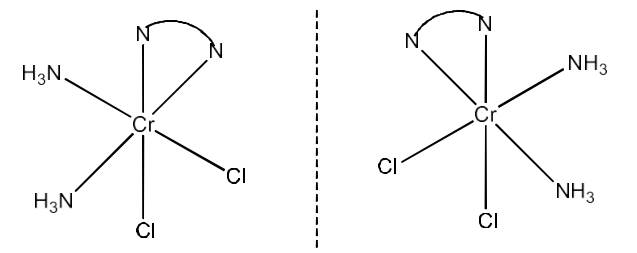
(iii) ${{\text{ }\!\![\!\!\text{ Cr(N}{{\text{H}}_{\text{3}}}{{\text{)}}_{\text{2}}}\text{C}{{\text{l}}_{\text{2}}}\text{(en) }\!\!]\!\!\text{ }}^{\text{+}}}$ 

Show solutionHide solution
Worked solution

Ans: The structure is given below:


Ans: The structure is given below:


Ans: The structures are given below:


cis-form


This is of the cis-form


This is of the trans-form