My Cart
Your Cart 0

    Your cart is empty.

  • Total (Amount) ₹0.00
NCERT · Class 12 · Chemistry

Chapter 4: The d & f Block Elements

Practice each question, then open the answer or worked solution.

Questions

37 questions
Q8.21Written answer

How would you account for the following?
(i) Of the d4 species, Cr2+ is strongly reducing while manganese(III) is strongly oxidising.
(ii) Cobalt(II) is stable in an aqueous solution, but in the presence of complexing reagents, it is easily oxidised.
(iii) The d1 configuration is very unstable in ions.

Show solutionHide solution
Worked solution

(i) Cr2+ is strongly reducing in nature. It has a d4 configuration. While acting as a reducing agent, it gets oxidised to Cr3+ (electronic configuration, d3). This d3 configuration can be written as configuration, which is a more stable configuration. In the case of Mn3+ (d4), it acts as an oxidising agent and gets reduced to Mn2+ (d5). This has an exactly half-filled d-orbital and is highly stable.

(ii) Co(II) is stable in aqueous solutions. However, in the presence of strong field complexing reagents, it is oxidised to Co (III). Although the 3rd ionisation energy for Co is high, the higher amount of crystal field stabilisation energy (CFSE) released in the presence of strong-field ligands overcomes this ionisation energy.

(iii) The ions in the d1 configuration tend to lose one more electron to get into a stable d0 configuration. Also, the hydration or lattice energy is more than sufficient to remove the only electron present in the d-orbital of these ions. Therefore, they act as reducing agents.
Q8.22Written answer

What is meant by ‘disproportionation’? Give two examples of disproportionation reactions in an aqueous solution.

Show solutionHide solution
Worked solution

It is found that sometimes a relatively less stable oxidation state undergoes an oxidation-reduction reaction in which it is simultaneously oxidised and reduced. This is called disproportionation.

For example,

(a)

\(\begin{array}{l}3Cr O^{3-}_4 + 8H^+ \rightarrow 2Cr O^{2-}_4 + Cr^{3+} + 4H_2 O\end{array} \)

Cr(V) is oxidised to Cr(VI) and reduced to Cr(III).

(b)

\(\begin{array}{l}3Mn O^{2-}_4 + 4H^+ \rightarrow 2Mn O^{-}_4 + Mn O_2 + 2H_2 O\end{array} \)

Mn (VI) is oxidized to Mn (VII) and reduced to Mn (IV).

Q8.23Written answer

Which metal in the first series of transition metals exhibits +1 oxidation state most frequently and why?

Show solutionHide solution
Worked solution

In the first series of transition metals, Cu exhibits +1 oxidation state very frequently. We know Cu has an electronic configuration of [Ar] 3d 10, that is, the completely filled d-orbital makes it highly stable.

Q8.24Written answer

Calculate the number of unpaired electrons in the following gaseous ions: Mn3+, Cr3+, V3+ and Ti3+. Which one of these is the most stable in an aqueous solution?

Show solutionHide solution
Worked solution
  Gaseous ions Number of unpaired electrons
(i) Mn2+, [Ar] 3d4 4
(ii) Cr3+,[Ar] 3d3 3
(iii) V3+,[Ar] 3d2 2
(iv) Ti3+, [Ar]3d1 1

Cr3+ is the most stable in aqueous solutions owing to a

\(\begin{array}{l}t^3_{2g}\end{array} \)
Q8.25Written answer

Give examples and suggest reasons for the following features of transition metal chemistry.
(i) The lowest oxide of transition metal is basic, and the highest is amphoteric/acidic.
(ii) A transition metal exhibits the highest oxidation state in oxides and fluorides.
(iii) The highest oxidation state is exhibited in oxoanions of a metal.

Show solutionHide solution
Worked solution

(i) In the case of a lower oxide of a transition metal, the metal atom has a low oxidation state. This means that some of the valence electrons of the metal atom are not involved in bonding. As a result, it can donate electrons and behave as a base. On the other hand, in the case of a higher oxide of a transition metal, the metal atom has a high oxidation state. This means that the valence electrons are involved in bonding, so they are unavailable. There is also a highly effective nuclear charge. As a result, it can accept electrons and behave as an acid.

For example,

\(\begin{array}{l}Mn^{II}O\end{array} \)
\(\begin{array}{l}Mn^{VII}_2O_7\end{array} \)

(ii) Oxygen and fluorine act as strong oxidising agents because of their high electronegativities and small sizes. Hence, they bring out the highest oxidation states from the transition metals. In other words, a transition metal exhibits higher oxidation states in oxides and fluorides.

For example, in OsF6 and V2O5, the oxidation states of Os and V are +6 and +5, respectively.

(iii) Oxygen is a strong oxidising agent due to its high electronegativity and small size. So, oxo-anions of metal have the highest oxidation state. For example, in, the oxidation state of Mn is +7.

Q8.26Written answer

Indicate the steps in the preparation of:
(i) K2Cr2O7 from chromite ore. (ii) KMnO4 from pyrolusite ore.

Show solutionHide solution
Worked solution

(i) Potassium dichromate ( K2Cr2O7 ) is prepared from chromite ore (FeCr2O4) in the following steps.

Step (1): Preparation of sodium chromate

\(\begin{array}{l}4FeCr_2O_4 + 16 NaOH + 7O_2 \rightarrow 8Na_2CrO_4 + 2 Fe_2O_3 + 8H_2O\end{array} \)

Step (2): Conversion of sodium chromate into sodium dichromate

\(\begin{array}{l}2Na_2CrO_4 + Conc. H_2SO_4 \rightarrow Na_2Cr_2O_3 + Na_2SO_4 + H_2O\end{array} \)

Step(3): Conversion of sodium dichromate to potassium dichromate

\(\begin{array}{l}Na_2Cr_2O_7 + 2KCl \rightarrow K_2Cr_2O_7 + 2NaCl\end{array} \)

Potassium chloride is less soluble than sodium chloride and is obtained in the form of orange-coloured crystals and can be removed by filtration.

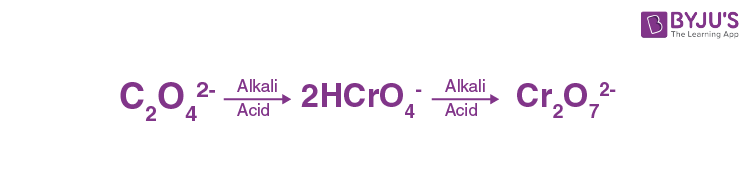
The dichromate ion

\(\begin{array}{l}Cr_2O^{2-}_7\end{array} \)
\(\begin{array}{l}CrO^{2-}_4\end{array} \)

However, by changing the pH, they can be interconverted.

NCERT Solutions for Class 12 Chemistry Chapter 8 D and F Block Elements Q 8.26(i)

(ii) Potassium permanganate ( KMnO4 ) can be prepared from pyrolusite (MnO2). The ore is fused with KOH in the presence of either atmospheric oxygen or an oxidising agent, such as KNO3 or KClO4, to give K2MnO4.

\(\begin{array}{l}2MnO_2 + 4KOH + O_2 \overset{heat}{\rightarrow} 2K_2MnO_4 + 2H_2O\end{array} \)

The green mass can be extracted with water and then oxidized either electrolytically or by passing chlorine/ozone into the solution. Electrolytic oxidation

\(\begin{array}{l}K_2MnO_4\leftrightarrow 2K^+ + MnO^{2-}_4\end{array} \)
\(\begin{array}{l}H_2O\leftrightarrow H^+ + OH^-\end{array} \)

At the anode, manganate ions are oxidised to permanganate ions.

\(\begin{array}{l}MnO^{2-}_4\leftrightarrow MnO^-_4 + e^-\end{array} \)

Oxidation by chlorine

\(\begin{array}{l}2K_2MnO_4 + Cl_2 \rightarrow 2KMnO_4 + 2KCl\end{array} \)
\(\begin{array}{l}2MnO^{2-}_4 + Cl_2 \rightarrow 2MnO^-_4 + 2Cl^-\end{array} \)

Oxidation by ozone

\(\begin{array}{l}2K_2MnO_4 +O_2 + H_2O \rightarrow 2 KMnO_4 + 2KOH + O_2\end{array} \)
\(\begin{array}{l}2MnO^{2-}_4 +O_2 + H_2O \rightarrow 2 MnO^{2-}_4 + 2OH^- + O_2\end{array} \)
Q8.27Written answer

What are alloys? Name an important alloy which contains some of the lanthanoid metals. Mention its uses.

Show solutionHide solution
Worked solution

An alloy is a solid solution of two or more elements in a metallic matrix. It can be a partial solid solution or a complete solid solution. Alloys generally are created as they have varied properties compared to their constituent elements. An important alloy of lanthanoids is Mischmetal. It contains lanthanoids (94−95%), iron (5%), and traces of Al, Ca, Si, C, S.

Uses

(a) It is used in tracer bullets and shells.

(b) Mischmetal is used in cigarettes and gas lighters.

(c) It is used in flame-throwing tanks.

Q8.28Written answer

What are inner transition elements? Decide which of the following atomic numbers are the atomic numbers of the inner transition elements: 29, 59, 74, 95, 102, 104.

Show solutionHide solution
Worked solution

Inner transition metals: Elements in which the last electron enters the f-orbital.

The elements in which the 4f and the 5f orbitals are progressively filled are called f-block elements.

From the given atomic numbers, the inner transition elements are the ones with atomic numbers 59, 95, and 102.

Q8.29Written answer

The chemistry of the actinoid elements is not as smooth as that of the lanthanoids. Justify this statement by giving some examples of the oxidation state of these elements.

Show solutionHide solution
Worked solution

Lanthanoids project 3 oxidation states (+2, +3, +4). From these, the +3 state is the most common. Lanthanoids display a limited number of oxidation states because the energy difference between 4f, 5d, and 6s orbitals’ is quite large. While the energy difference between 5f, 6d, and 7s orbitals’ is very less. Hence, actinoids display a large number of oxidation states.

For example, neptunium displays +3, +4, +5, and +7, while uranium and plutonium display +3, +4, +5, and +6 oxidation states. The most common oxidation state in the case of actinoids is also +3.

Q8.30Written answer

Which is the last element in the series of actinoids? Write the electronic configuration of this element. Comment on the possible oxidation state of this element.

Show solutionHide solution
Worked solution

In the actinoid series, the last element is lawrencium, Lr. The atomic number of the element is 103, and its electronic configuration is [Rn] 5f14 6d1 7s2. The most common oxidation state displayed by it is +3; because after losing 3 electrons, it attains a stable f14 configuration.