My Cart
Your Cart 0

    Your cart is empty.

  • Total (Amount) ₹0.00
NCERT · Class 12 · Chemistry

Chapter 4: The d & f Block Elements

Practice each question, then open the answer or worked solution.

Questions

37 questions
Q8.11Written answer

Explain, giving reasons.
(i) Transition metals and many of their compounds show paramagnetic behaviour.
(ii) The enthalpies of atomisation of the transition metals are high.
(iii) The transition metals generally form coloured compounds.
(iv) Transition metals and their many compounds act as good catalysts.

Show solutionHide solution
Worked solution

(i) Transition metals show paramagnetic behaviour. Paramagnetism arises due to the presence of unpaired electrons, with each electron having a magnetic moment associated with its spin angular momentum and orbital angular momentum. However, in the first transition series, the orbital angular momentum is quenched. Therefore, the resulting paramagnetism is only because of the unpaired electron.

(ii) Transition elements have a highly effective nuclear charge and a large number of valence electrons. Therefore, they form very strong metallic bonds. As a result, the enthalpy of atomisation of transition metals is high.

(iii) Most of the complexes of transition metals are coloured. This is because of the absorption of radiation from the visible light region to promote an electron from one of the d−orbitals to another. In the presence of ligands, the d-orbitals split up into two sets of orbitals having different energies. Therefore, the transition of electrons can take place from one set to another. The energy required for these transitions is quite small and falls in the visible region of radiation. The ions of transition metals absorb the radiation of a particular wavelength, and the rest is reflected, imparting colour to the solution.

(iv) The catalytic activity of the transition elements can be explained by two basic facts.

(a) Transition metals provide a suitable surface for the reactions to occur.

(b) Owing to their ability to show variable oxidation states and form complexes, transition metals form unstable intermediate compounds. Thus, they provide a new path with lower activation energy, Ea, for the reaction.
Q8.12Written answer

What are interstitial compounds? Why are such compounds well-known for transition metals?

Show solutionHide solution
Worked solution

Transition metals are large in size, and they also contain lots of interstitial sites.

These interstitial sites can be used to trap atoms of other elements (that have small atomic sizes), such as H, C, N. The compounds resulting are called interstitial compounds.

Q8.13Written answer

How is the variability in oxidation states of transition metals different from that of non-transition metals? Illustrate with examples.

Show solutionHide solution
Worked solution

In the case of transition elements, the oxidation state can vary from +1 to the highest oxidation state by removing all its valence electrons. Also, in transition elements, the oxidation states differ by 1 (Fe2+ and Fe3+; Cu+ and Cu2+). In non-transition elements, the oxidation states differ by 2, for example, +2 and +4 or +3 and +5, etc.

Q8.14Written answer

Describe the preparation of potassium dichromate from iron chromite ore. What is the effect of increasing pH on a solution of potassium dichromate?

Show solutionHide solution
Worked solution

From iron chromite ore, Potassium dichromate is prepared as in the following steps.

Step (1): Preparation of sodium chromate

\(\begin{array}{l}4Fe Cr_2 O_4 +16 Na OH+7 O_2\rightarrow 8 Na_2 Cr O_4 + 2Fe_2 O_3 + 8 H_2 O\end{array} \)

Step (2): Conversion of sodium chromate into sodium dichromate

\(\begin{array}{l}2Na_{2} Cr O_4 + conc. H_2 SO_4 \rightarrow Na_2 Cr_{2} O_7 + Na_2 SO_4 + H_2 O\end{array} \)

Step (3): Conversion of sodium dichromate to potassium dichromate

\(\begin{array}{l}Na_{2} Cr_2 O_7 + 2KCl \rightarrow K_2 Cr_{2} O_7 + 2Na Cl\end{array} \)

Potassium chloride is less soluble than sodium chloride and is obtained in the form of orange-coloured crystals and can be removed by filtration.

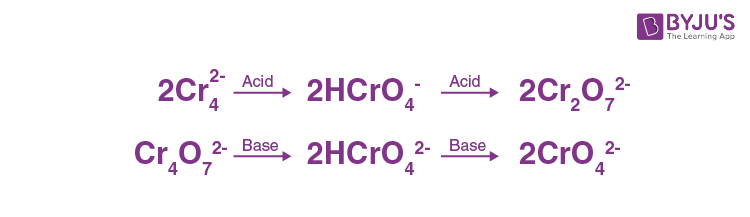
The dichromate ion

\(\begin{array}{l}(Cr_2 O_7^{2-})\end{array} \)
\(\begin{array}{l}(Cr O_4^{2-})\end{array} \)

However, by changing the pH, they can be interconverted.

NCERT Solutions for Class 12 Chemistry Chapter 8 D and F Block Elements Q 8.14

Q8.15Written answer

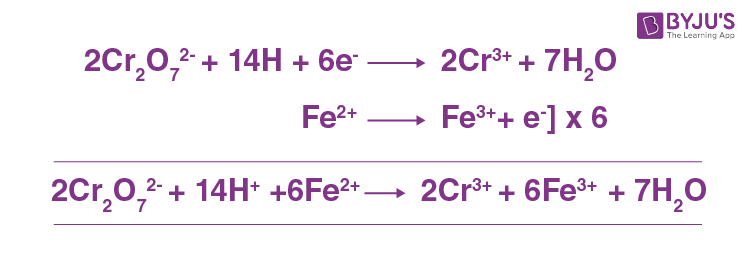
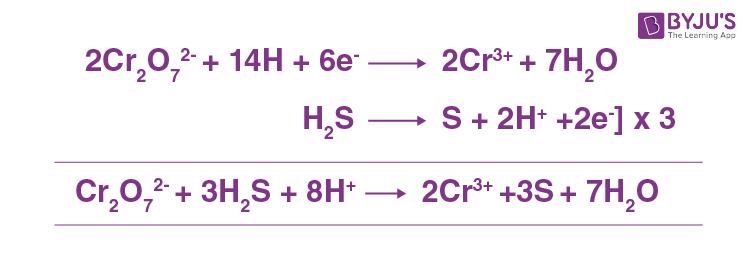
Describe the oxidising action of potassium dichromate and write the ionic equations for its reaction with
(i) iodide (ii) iron(II) solution and (iii) H2S

Show solutionHide solution
Worked solution
\(\begin{array}{l}k_2 Cr_2 O_7\end{array} \)
\(\begin{array}{l}k_2 Cr_2 O_7 + 4 H_2 SO_4\rightarrow K_2 SO_4 + Cr_2(SO_4)_3 + 4 H_2O+3[O]\end{array} \)
\(\begin{array}{l}k_2 Cr_2 O_7\end{array} \)

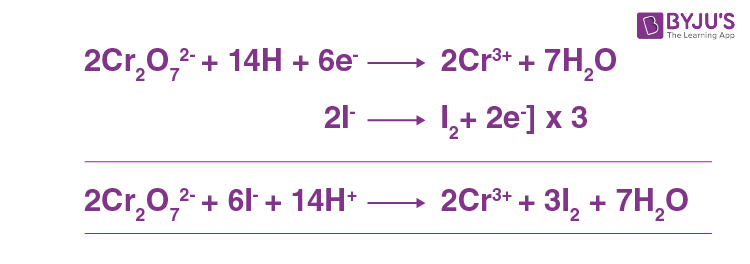
(i)

\(\begin{array}{l}k_2 Cr_2 O_7\end{array} \)

NCERT Solutions for Class 12 Chemistry Chapter 8 D and F Block Elements Q 8.15(i)

(ii)

\(\begin{array}{l}k_2 Cr_2 O_7\end{array} \)

NCERT Solutions for Class 12 Chemistry Chapter 8 D and F Block Elements Q 8.15(ii)

(iii)

\(\begin{array}{l}k_2 Cr_2 O_7\end{array} \)
2

NCERT Solutions for Class 12 Chemistry Chapter 8 D and F Block Elements Q 8.15(iii)

Q8.16Written answer

Describe the preparation of potassium permanganate. How does the acidified permanganate solution react with

(i) iron(II) ions (ii) SO2 and (iii) oxalic acid?

Write the ionic equations for the reactions.

Show solutionHide solution
Worked solution

Potassium permanganate can be prepared from pyrolusite (MnO2). The ore is fused with KOH in the presence of either atmospheric oxygen or an oxidising agent, such as KNO3 or KClO4, to give K2MnO4.

\(\begin{array}{l}2 Mn O_2 + 4 KOH + O_2 \overset{heat}{\rightarrow} 2K_2 MnO_4 + 2 H_2 O\end{array} \)

The green mass can be extracted with water and then oxidised either electrolytically or by passing chlorine/ozone into the solution. Electrolytic oxidation

\(\begin{array}{l}K_2 Mn O_4\leftrightarrow 2k^+ +MnO^{2-}_4\end{array} \)
\(\begin{array}{l}H_2 O\leftrightarrow H^+ + OH^{-}\end{array} \)

At the anode, manganate ions are oxidised to permanganate ions.

\(\begin{array}{l}MnO^{2-}_4\leftrightarrow MnO^-_4 + e^-\end{array} \)

Oxidation by chlorine

\(\begin{array}{l}2 K_2 MnO_4 + Cl_2 \rightarrow 2MnO_4 + 2KCl\end{array} \)
\(\begin{array}{l}2 MnO_4^{2-} + Cl_2 \rightarrow 2MnO_4^- + 2Cl^-\end{array} \)

Oxidation by ozone

\(\begin{array}{l}2 KMnO_4 + O_3 + H_2O \rightarrow 2KMnO_4 + 2KOH + O_2\end{array} \)
\(\begin{array}{l}2 MnO_4^{2-} + O_3 + H_2O \rightarrow 2MnO_4^{2-} + 2OH^- + O_2\end{array} \)

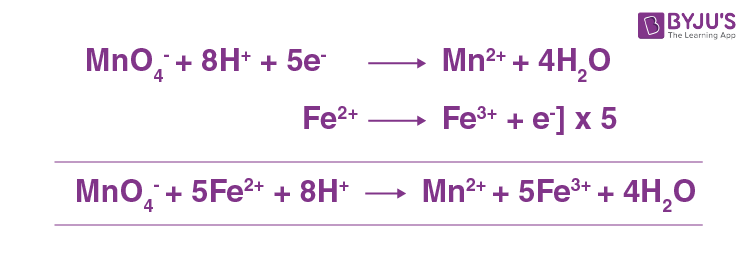
(i) Acidified KMnO4 solution oxidises Fe (II) ions to Fe (III) ions, i.e., ferrous ions to ferric ions.

NCERT Solutions for Class 12 Chemistry Chapter 8 D and F Block Elements Q 8.16(i)

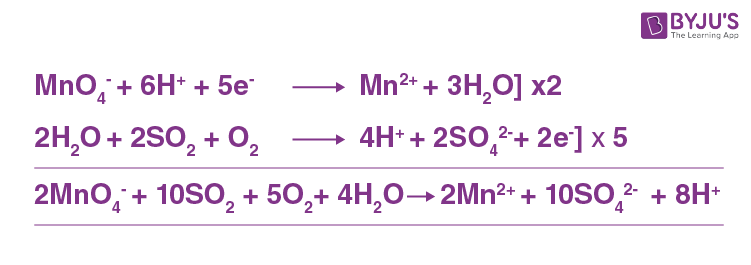
(ii). Acidified potassium permanganate oxidises SO2 to sulphuric acid.

NCERT Solutions for Class 12 Chemistry Chapter 8 D and F Block Elements Q 8.16(ii)

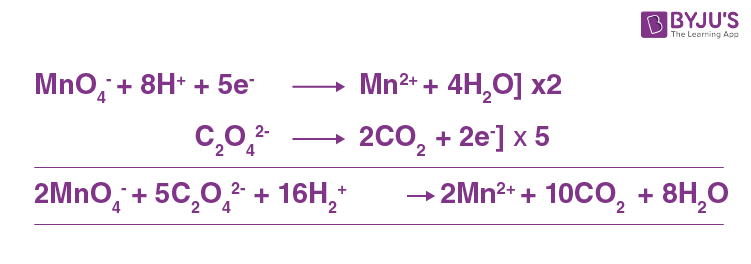
(iii) Acidified potassium permanganate oxidises oxalic acid to carbon dioxide

NCERT Solutions for Class 12 Chemistry Chapter 8 D and F Block Elements Q 8.16(iii)

Q8.17Written answer

For M2+/M and M3+/M2+ systems, the EV values for some metals are as follows:
Cr2+/Cr -0.9V  Cr3/Cr2+ -0.4 V
Mn2+/Mn -1.2V  Mn3+/Mn2+ +1.5 V
Fe2+/Fe -0.4V Fe3+/Fe2+ +0.8 V

Use this data to comment upon:
(i) the stability of Fe3+ in acid solution as compared to that of Cr3+ or Mn3+ and
(ii) the ease with which iron can be oxidised as compared to a similar process for either chromium or manganese metal.

Show solutionHide solution
Worked solution

(i) The reduction potentials for the given pairs increase in the following order.

Mn2+ / Mn < Cr2+ / Cr < Fe2+ /Fe

So, the oxidation of Fe to Fe2+ is not as easy as the oxidation of Cr to Cr2+ and the oxidation of Mn to Mn2+. Thus, these metals can be arranged in the increasing order of their ability to get oxidised as Fe < Cr < Mn

(ii) The

\(\begin{array}{l}E^{\Theta}\end{array} \)
3+2+3+2+3+2+3+2+3+2+3+2+3+3+3+3+3+3+
Q8.18Written answer

Predict which of the following will be coloured in an aqueous solution. Ti3+, V3+, Cu+, Sc3+, Mn2+, Fe3+ and Co2+. Give reasons for each.

Show solutionHide solution
Worked solution

Ions with electrons in the d-orbital will be the only ones that will be coloured, and the ions with empty d-orbital will be colourless.

Element Atomic Number Ionic

State

Electronic Configuration in Ionic

State

Ti 22 Ti3+ [Ar] 3d1
V 23 V3+ [Ar] 3d2
Cu 29 Cu+ [Ar] 3d10
Sc 21 Sc3+ [Ar]
Mn 25 Mn2+ [Ar] 3d5
Fe 26 Fe3+ [Ar] 3d5
Co 27 Co2+ [Ar] 3d7

All other ions, except Sc3+, will be coloured in an aqueous solution because of d−d transitions. Not Sc3+, as it has an empty d-orbital.

Q8.19Written answer

Compare the stability of the +2 oxidation state for the elements of the first transition series.

Show solutionHide solution
Worked solution
Sc     +3
Ti +1 +2 +3 +4
V +1 +2 +3 +4 +5
Cr +1 +2 +3 +4 +5 +6
Mn +1 +2 +3 +4 +5 +6 +7
Fe +1 +2 +3 +4 +5 +6
Co +1 +2 +3 +4 +5
Ni +1 +2 +3 +4
Cu +1 +2 +3
Zn   +2

 From the table above,

Mn shows the maximum number of oxidation states, changing between +2 to +7.

The number of oxidation states increases as we move on from Sc to Mn.

On moving from Mn to Zn, the number of oxidation states decreases due to a decrease in the number of available unpaired electrons.

The relative stability of the +2 oxidation state increases on moving from top to bottom. This is because, on moving to the bottom from the top, it becomes more and more difficult to remove the third electron from the d-orbital.

Q8.20Written answer

Compare the chemistry of actinoids with that of the lanthanoids with special reference to:
(i) electronic configuration (iii) oxidation state
(ii) atomic and ionic sizes and (iv) chemical reactivity

Show solutionHide solution
Worked solution

(i) Electronic configuration

The general electronic configuration for lanthanoids is [Xe]54 4f0-14 5d0-1 6s2, and that for actinoids is [Rn]86 5f1-14 6d0-1 7s2. Unlike 4f orbitals, 5f orbitals are not deeply buried and participate in bonding to a greater extent.

(ii) Atomic and ionic sizes

Similar to lanthanoids, actinoids also exhibit actinoid contraction (overall decrease in atomic and ionic radii). The contraction is greater due to the poor shielding effect of 5f orbitals.

(iii) Oxidation states

The principal oxidation state of lanthanoids is (+3). However, sometimes we also encounter oxidation states of + 2 and + 4. This is because of the extra stability of fully-filled and half-filled orbitals. Actinoids exhibit a greater range of oxidation states. This is because the 5f, 6d, and 7s levels are of comparable energies. Again, (+3) is the principal oxidation state for actinoids. Actinoids such as lanthanoids have more compounds in the +3 state than in the +4 state.

(iv) Chemical reactivity

In the lanthanide series, the earlier members of the series are more reactive. They have reactivity that is comparable to Ca. With an increase in the atomic number, the lanthanides start behaving similarly to Al. Actinoids, on the other hand, are highly reactive metals, especially when they are finely divided. When they are added to boiling water, they give a mixture of oxide and hydride. Actinoids combine with most non-metals at moderate temperatures. Alkalies have no action on these actinoids. In the case of acids, they are slightly affected by nitric acid (because of the formation of a protective oxide layer).