My Cart
Your Cart 0

    Your cart is empty.

  • Total (Amount) ₹0.00
NCERT · Class 11 · Maths

Chapter 9: Sequences and Series Exercise 9.3

Practice each question, then open the answer or worked solution.

Questions

32 questions
Q21Written answer

Find four numbers forming a geometric progression in which the third term is greater than the first term by 9, and the second term is greater than the 4th by 18.

Show solutionHide solution
Worked solution

Consider a to be the first term and r to be the common ratio of the G.P.

Then,

a1 = a, a2 = ar, a3 = ar2, a4 = ar3

From the question, we have

a3 = a1 + 9

ar2 = a + 9 … (i)

a2 = a4 + 18

ar = ar3 + 18 … (ii)

So, from (1) and (2), we get

a(r2 – 1) = 9 … (iii)

ar (1– r2) = 18 … (iv)

Now, dividing (4) by (3), we get
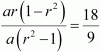
NCERT Solutions Class 11 Mathematics Chapter 9 ex.9.3 - 25

-r = 2

r = -2

On substituting the value of r in (i), we get

4a = a + 9

3a = 9

∴ a = 3

Therefore, the first four numbers of the G.P. are 3, 3(– 2), 3(–2)2, and 3(–2)3

i.e., 3¸–6, 12, and –24.

Q22Written answer

If the pth, qth and rth terms of a G.P. are a, b and c, respectively. Prove that aq-r br-p cp-q = 1

Show solutionHide solution
Worked solution

Let’s take A to be the first term and R to be the common ratio of the G.P.

Then according to the question, we have

ARp–1 = a

ARq–1 = b

ARr–1 = c

Then,

aq–r br–p cp–q

= Aq–r × R(p–1) (q–r) × Ar–p × R(q–1) (r–p) × Ap–q × R(r –1)(p–q)

= Aq – r + r – p + p – q × R (pr – pr – q + r) + (rq – r + p – pq) + (pr – p – qr + q)

= A0 × R0

= 1

Hence proved.

Q23Written answer

If the first and the nth term of a G.P. are a and b, respectively, and if P is the product of n terms, prove that P2 = (ab)n.

Show solutionHide solution
Worked solution

Given, the first term of the G.P is a, and the last term is b.

Thus,

The G.P. is a, ar, ar2, ar3, … arn–1, where r is the common ratio.

Then,

b = arn–1  … (1)

P = Product of n terms

= (a) (ar) (ar2) … (arn–1)

= (a × a ×…a) (r × r2 × …rn–1)

= an r 1 + 2 +…(n–1)  … (2)

Here, 1, 2, …(n – 1) is an A.P.

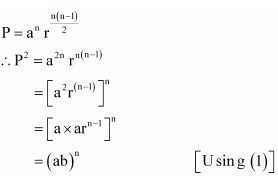
NCERT Solutions Class 11 Mathematics Chapter 9 ex.9.3 - 26

And, the product of n terms P is given by,

NCERT Solutions Class 11 Mathematics Chapter 9 ex.9.3 - 27

Q24Written answer

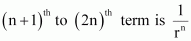
Show the ratio of the sum of the first n terms of a G.P. to the sum of terms from NCERT Solutions Class 11 Mathematics Chapter 9 ex.9.3 - 28.

Show solutionHide solution
Worked solution

Let a be the first term and r be the common ratio of the G.P.

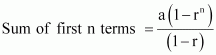
NCERT Solutions Class 11 Mathematics Chapter 9 ex.9.3 - 30

Since there are n terms from (n +1)th to (2n)th term,

Sum of terms from(n + 1)th to (2n)th term
NCERT Solutions Class 11 Mathematics Chapter 9 ex.9.3 - 31

a n +1 = ar n + 1 – 1 = arn

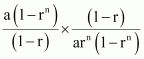
Thus, the required ratio =
NCERT Solutions Class 11 Mathematics Chapter 9 ex.9.3 - 32
NCERT Solutions Class 11 Mathematics Chapter 9 ex.9.3 - 43

Thus, the ratio of the sum of the first n terms of a G.P. to the sum of terms from (n + 1)th to (2n)th term is NCERT Solutions Class 11 Mathematics Chapter 9 ex.9.3 - 33.

Q25Written answer

If a, b, c and d are in G.P., show that (a2 + b2 + c2)(b2 + c2 + d2) = (ab + bc + cd)2.

Show solutionHide solution
Worked solution

Given, a, b, c, d are in G.P.

So, we have

bc = ad  … (1)

b2 = ac  … (2)

c2 = bd  … (3)

Taking the R.H.S., we have

R.H.S.

= (ab + bc + cd)2

= (ab + ad + cd)2  [Using (1)]

= [ab + d (a + c)]2

= a2b2 + 2abd (a + c) + d2 (a + c)2

= a2b2 +2a2bd + 2acbd + d2(a2 + 2ac + c2)

= a2b2 + 2a2c2 + 2b2c2 + d2a2 + 2d2b2 + d2c2  [Using (1) and (2)]

= a2b2 + a2c2 + a2c2 + b2c2 + b2c2 + d2a2 + d2b2 + d2b2 + d2c2

= a2b2 + a2c2 + a2d2 + b2 × b2 + b2c2 + b2d2 + c2b2 + c2 × c2 + c2d2

= a2(b2 + c2 + d2) + b2 (b2 + c2 + d2) + c2 (b2+ c2 + d2)

= (a2 + b2 + c2) (b2 + c2 + d2)

= L.H.S.

Thus, L.H.S. = R.H.S.

Therefore,

(a2 + b2 + c2)(b2 + c2 + d2) = (ab + bc + cd)2

Q26Written answer

Insert two numbers between 3 and 81 so that the resulting sequence is G.P.

Show solutionHide solution
Worked solution

Let’s assume G1 and G2 to be two numbers between 3 and 81 such that the series 3, G1, G2, 81 forms a G.P.

And let a be the first term and r be the common ratio of the G.P.

Now, we have the 1st term as 3 and the 4th term as 81.

81 = (3) (r)3

r3 = 27

∴ r = 3 (Taking real roots only)

For r = 3,

G1 = ar = (3) (3) = 9

G2 = ar2 = (3) (3)2 = 27

Therefore, the two numbers which can be inserted between 3 and 81 so that the resulting sequence becomes a G.P. are 9 and 27.

Q27Written answer

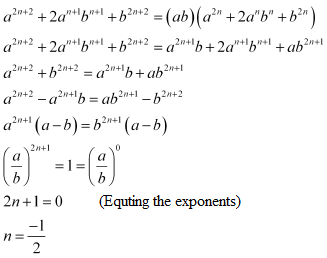
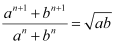
Find the value of n so that NCERT Solutions Class 11 Mathematics Chapter 9 ex.9.3 - 34may be the geometric mean between a and b.
Show solutionHide solution
Worked solution

We know that,

The G. M. of a and b is given by √ab.

Then, from the question, we have

NCERT Solutions Class 11 Mathematics Chapter 9 ex.9.3 - 35

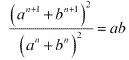
By squaring both sides, we get

NCERT Solutions Class 11 Mathematics Chapter 9 ex.9.3.27

Performing cross multiplication after expanding, we get,

NCERT Solutions Class 11 Mathematics Chapter 9 ex.9.3 - 36

Q28Written answer

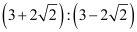
The sum of two numbers is 6 times their geometric mean; show that numbers are in the ratioNCERT Solutions Class 11 Mathematics Chapter 9 ex.9.3 - 37.

Show solutionHide solution
Worked solution

Consider the two numbers to be a and b.

Then, G.M. = √ab.

From the question, we have

NCERT Solutions Class 11 Mathematics Chapter 9 ex.9.3 - 38

Q29Written answer

If A and G be A.M. and G.M., respectively, between two positive numbers, prove that the

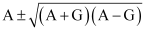
NCERT Solutions Class 11 Mathematics Chapter 9 ex.9.3 - 39

numbers are.

Show solutionHide solution
Worked solution

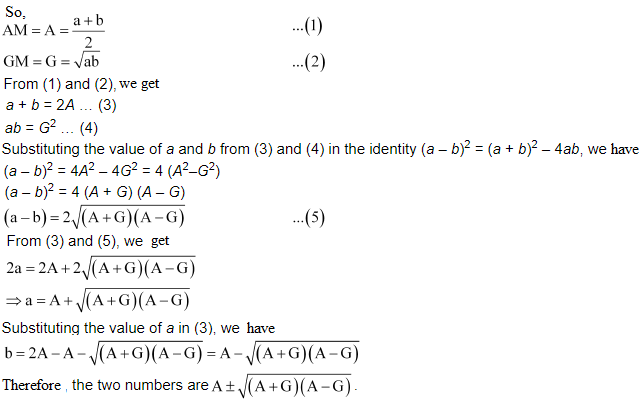
Given that A and G are A.M. and G.M. between two positive numbers.

And, let these two positive numbers be a and b.

NCERT Solutions Class 11 Mathematics Chapter 9 ex.9.3 - 40

Q30Written answer

The number of bacteria in a certain culture doubles every hour. If there were 30 bacteria present in the culture originally, how many bacteria will be present at the end of 2nd hour, 4th hour and nth hour?

Show solutionHide solution
Worked solution

Given, the number of bacteria doubles every hour. Hence, the number of bacteria after every hour will form a G.P.

Here, we have a = 30 and r = 2

So, a3 = ar2 = (30) (2)2 = 120

Thus, the number of bacteria at the end of 2nd hour will be 120.

And, a5 = ar4 = (30) (2)4 = 480

The number of bacteria at the end of 4th hour will be 480.

an +1 = arn = (30) 2n

Therefore, the number of bacteria at the end of nth hour will be 30(2)n.