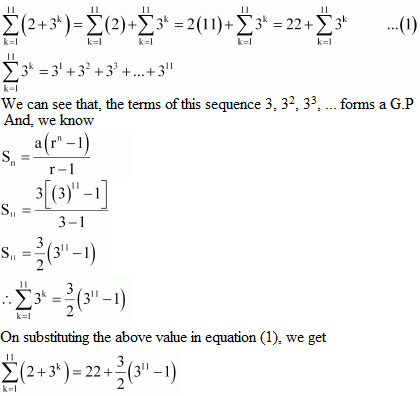
Q11Written answer
Evaluate: 
Show solutionHide solution
Worked solution
Your cart is empty.
Practice each question, then open the answer or worked solution.
Evaluate:
The sum of the first three terms of a G.P. is 39/10, and their product is 1. Find the common ratio and the terms.
Let a/r, a, ar be the first three terms of the G.P.
a/r + a + ar = 39/10 …… (1)
(a/r) (a) (ar) = 1 …….. (2)
From (2), we have
a3 = 1
Hence, a = 1 [Considering real roots only]
Substituting the value of a in (1), we get
1/r + 1 + r = 39/10
(1 + r + r2)/r = 39/10
10 + 10r + 10r2 = 39r
10r2 – 29r + 10 = 0
10r2 – 25r – 4r + 10 = 0
5r(2r – 5) – 2(2r – 5) = 0
(5r – 2) (2r – 5) = 0
Thus,
r = 2/5 or 5/2
Therefore, the three terms of the G.P. are 5/2, 1 and 2/5.
How many terms of G.P. 3, 32, 33, … are needed to give the sum 120?
Given G.P. is 3, 32, 33, …
Let’s consider that n terms of this G.P. be required to obtain the sum 120.
We know that,

Here, a = 3 and r = 3
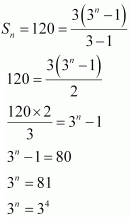
Equating the exponents, we get n = 4
Therefore, four terms of the given G.P. are required to obtain the sum 120.
The sum of the first three terms of a G.P. is 16, and the sum of the next three terms is 128. Determine the first term, the common ratio and the sum to n terms of the G.P.
Let’s assume the G.P. to be a, ar, ar2, ar3, …
Then according to the question, we have
a + ar + ar2 = 16 and ar3 + ar4 + ar5 = 128
a (1 + r + r2) = 16 … (1) and,
ar3(1 + r + r2) = 128 … (2)
Dividing equation (2) by (1), we get
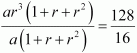
r3 = 8
r = 2
Now, using r = 2 in (1), we get
a (1 + 2 + 4) = 16
a (7) = 16
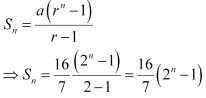
a = 16/7
Now, the sum of terms is given as
Given a G.P. with a = 729 and 7th term 64, determine S7.
Given,
a = 729 and a7 = 64
Let r be the common ratio of the G.P.
Then we know that, an = a rn–1
a7 = ar7–1 = (729)r6
⇒ 64 = 729 r6
r6 = 64/729
r6 = (2/3)6
r = 2/3
And we know that
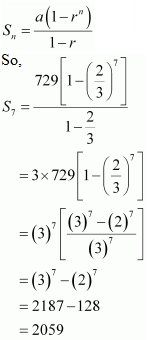
Find a G.P. for which the sum of the first two terms is –4 and the fifth term is 4 times the third term.
Consider a to be the first term and r to be the common ratio of the G.P.
Given, S2 = -4
Then, from the question, we have

And,
a5 = 4 x a3
ar4 = 4ar2
r2 = 4
r = ± 2
Using the value of r in (1), we have
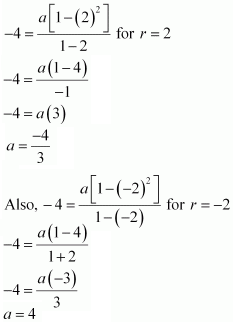
Therefore, the required G.P is
-4/3, -8/3, -16/3, …. Or 4, -8, 16, -32, ……
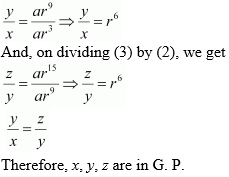
If the 4th, 10th and 16th terms of a G.P. are x, y and z, respectively. Prove that x, y, and z are in G.P.
Let a be the first term and r be the common ratio of the G.P.
According to the given condition,
a4 = a r3 = x … (1)
a10 = a r9 = y … (2)
a16 = a r15 = z … (3)
On dividing (2) by (1), we get
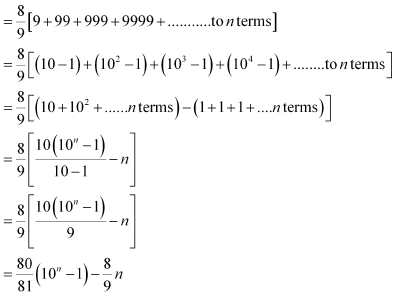
Find the sum to n terms of the sequence, 8, 88, 888, 8888…
Given sequence: 8, 88, 888, 8888…
This sequence is not a G.P.
But, it can be changed to G.P. by writing as
Sn = 8 + 88 + 888 + 8888 + …………….. to n terms
Find the sum of the products of the corresponding terms of the sequences 2, 4, 8, 16, 32 and 128, 32, 8, 2, 1/2.
The required sum = 2 x 128 + 4 x 32 + 8 x 8 + 16 x 2 + 32 x ½
= 64[4 + 2 + 1 + ½ + 1/22]
Now, it’s seen that
4, 2, 1, ½, 1/22 is a G.P.
With the first term, a = 4
Common ratio, r =1/2
We know,

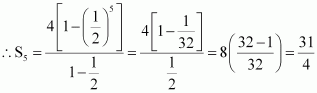
Therefore, the required sum = 64(31/4) = (16)(31) = 496
Show that the products of the corresponding terms of the sequences a, ar, ar2, …arn-1 and A, AR, AR2, … ARn-1 form a G.P, and find the common ratio.
To be proved: The sequence, aA, arAR, ar2AR2, …arn–1ARn–1, forms a G.P.
Now, we have
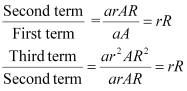
Therefore, the above sequence forms a G.P., and the common ratio is rR.