My Cart
Your Cart 0

    Your cart is empty.

  • Total (Amount) ₹0.00
NCERT · Class 10 · Science

Chapter 8: Heredity and Evolution

Practice each question, then open the answer or worked solution.

Exercise-9.2

Textbook page 147 · 4 questions
Q1Written answer

How do Mendel’s experiments show that traits may be dominant or recessive?

Show solutionHide solution
Worked solution

Mendel showed that the traits could either be dominant or recessive through his experiments that focused on the mono-hybrid cross. The experiment involved him crossing tall (TT) pea plants with dwarf (tt) pea plants. The resultant plants which formed after fertilisation represented the F1 (or filial) generation. All the F1 plants were tall. Mendel then proceeded to self-pollinate the filial generation plants, and the result was that 1/4th of the plants obtained in the F2 generation were dwarfs. From this experiment, Mendel concluded that the F1 tall plants were not true-breeding; instead, they carried the traits for both tall and dwarf heights. A portion of the plants was tall due to the fact that the traits for tallness were dominant over the traits for dwarfness. This cements the notion that traits can either be dominant or recessive.
Q2Written answer

How do Mendel’s experiments show that traits are inherited independently?

Show solutionHide solution
Worked solution

Mendel’s experiments show that traits are inherited independently through his dihybrid cross experiment. The experiment involved him using two traits – namely, seed shape and seed colour. The colour yellow (YY) is dominant over green (yy), while the round shape (RR) is dominant over the wrinkled shape (rr). The F2 progeny of the dihybrid cross resulted in a phenotypic ratio of 9:3:3:1; therefore, 9 plants with round yellow (RRYY) seeds, 3 plants with round green (RRyy) seeds and 3 plants with wrinkled yellow (rrYY) seeds and one with wrinkled green seeds (rryy). He further observed that the wrinkled greens and the round yellow are parental combinations while the round green and wrinkled yellow are new. A dihybrid cross between two seeds with dominant traits (RRYY) and non-dominant traits (rryy) resulted in the production of 4 types of gametes (RY, Ry, rY and ry). This means each of the gametes segregates independently of the other, and each with a frequency of 25% of the total gametes produced.

Q3Written answer

A man with blood group A marries a woman with blood group O, and their daughter has blood group O. Is this information enough to tell you which of the traits – blood group A or O – is dominant? Why or why not?

Show solutionHide solution
Worked solution

Given information is not enough to tell us which characteristics are dominant – blood group A or O. Blood type A is always dominant in ABO blood, and blood type O is always recessive. Here, the father’s blood group may be genotypically AA (homozygous) or AO (heterozygous), whereas that of the mother can be OA or OO.

Q4Written answer

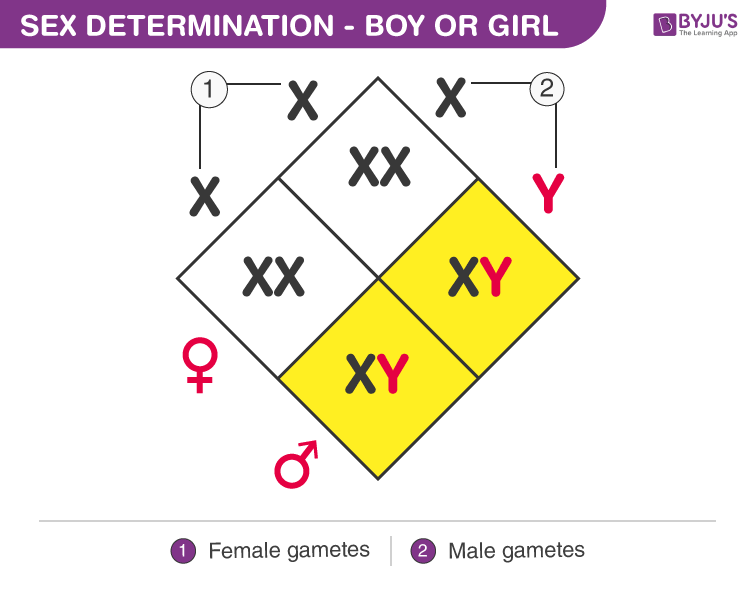
How is the sex of the child determined in human beings?

Show solutionHide solution
Worked solution

The sex of the child in humans is determined by the males. Males have XY chromosomes, while females have XX chromosomes. Hence, if:

  • The male’s X chromosomes combine with the female’s X chromosomes, the mother gives birth to a girl
  • The male’s Y chromosome combines with the female’s X chromosome, the mother gives birth to a boy

NCERT Solutions for Class 10 Chapter 9 Image 1